
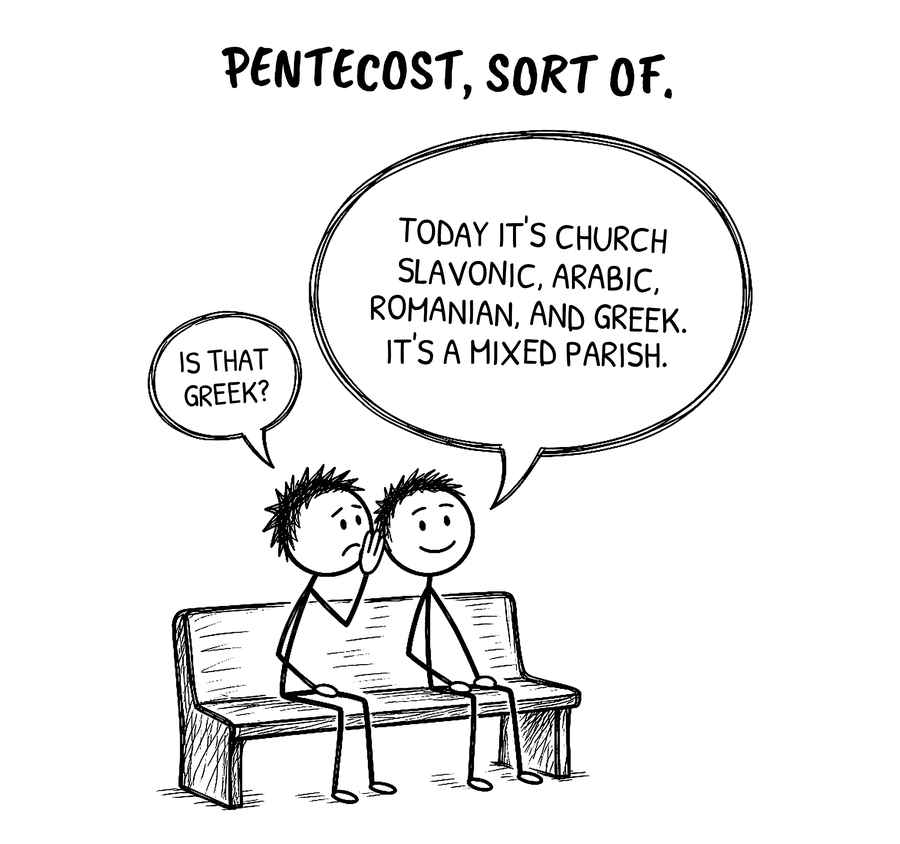
An Orthodox parish in America usually prays in English with some Greek, Slavonic, Arabic, or Romanian mixed in, and its vocabulary comes from all of them. The screen of icons across the front of the church is the iconostasis in most English books, the templon in a Greek parish, and the ikonostas in a Russian one. Same wall. Same icons. Three words.
A newcomer can't be expected to know that all three point at one thing. So this guide follows a few plain rules.
The word you'll hear
In the text we use the form of each word you're most likely to hear in an American parish, spelled the way a parish bulletin spells it. When one family of churches has its own word for something, the entry says so and names the family: Greek, Slavic, Antiochian, Romanian, and so on.
The first time a Greek or Slavonic term appears in an entry, it's in bold, with a plain English gloss in the same sentence: the iconostasis (the icon screen). That happens in every entry, not just the first one, because you may arrive at any page from a search and shouldn't have to hunt for a definition. Every bolded word is in the Glossary, which gives its Greek, Church Slavonic, and Arabic forms wherever there's a form we trust.
One service, three names
The clearest case is Matins (the morning service before the Liturgy). A Greek parish calls it Orthros, the old Greek word for the time just before daybreak.1 English books call it Matins, from the Latin for "of the morning," which came into English through Old French.2 A Russian, Serbian, or Ukrainian parish calls it Utrenya, built on the Slavonic word for "morning."3 Three languages, one idea: the Church gets up at dawn and prays.
This guide says Matins, because it's the English word and the one Hapgood's Service Book uses,4 and it tells you Orthros and Utrenya the first time it matters. The same thing happens all through the services. Vespers is Hesperinos in Greek and Vechernya in Slavonic. "Lord, have mercy" is Kyrie eleison in Greek, Gospodi pomiluy in Slavonic, and Ya Rabb irham in Arabic, and in a mixed parish you may hear all three in one litany. Nobody is being inconsistent. The Church has been translating her prayers since Pentecost, and every language she prays in leaves its words behind.
"Saint" and "Father"
We write "Saint" in full, never "St.", for the saints themselves and for churches named after them: Saint Basil, Saint John Chrysostom, Saint Nicholas Church. Book titles keep their own spelling. Who counts as a saint, and why the Orthodox ask the saints to pray for them, is the subject of Mary and the Saints.
A priest is called "Father," usually with his first name: Father John, Father Peter. We write the word out there too. His wife has a title of her own, which depends on the family of churches: Presbytera in Greek parishes, Matushka in Russian ones, Khouria in Antiochian ones. If you've grown up on Matthew 23:9 and wonder how any Christian can call another man "Father," that question has its own Field Note in Ordination and the Clergy Family.
"Liturgy," not "Mass"
The Orthodox call the Sunday Eucharist the Divine Liturgy (the Eucharistic service), or just the Liturgy, with a capital L. The Greek leitourgia first meant a public service paid for and performed by a private citizen on behalf of the city: funding a festival chorus, say, or outfitting a warship.5 The Church borrowed the word for worship offered on behalf of everyone. It doesn't mean "the work of the people," however many bulletins have said so; the myth entry tells that story.
"Mass" is the Western name. It comes from the Latin missa, which the old Catholic Encyclopedia explains as the dismissal of the people, as in the closing words "Ite, missa est."6 It's an honorable name, and Catholics are right to love it. An Orthodox Christian just won't use it for his own service. Arabic-speaking Orthodox say al-Quddas; Slavic parishes say Liturgiya. Eucharist (the sacrament of Christ's Body and Blood) is the Greek word for "thanksgiving," and the early Christian manual called the Didache already uses it for the meal: "your Thanksgiving (Eucharist)."7
"Theotokos"
You'll hear Mary called many things in an Orthodox church, and one title more than all the rest. Theotokos (God-bearer) joins the Greek Theos, "God," to tokos, "childbirth."8 It means the one who gave birth to God, and it says as much about her Son as about her: the child she bore is God. The Church defended the title at the Council of Ephesus in 431, against Nestorius, who objected to it.9 English service books translate it "Birth-giver of God" or "Mother of God"; Hapgood's Liturgy says "the Birth-giver of God and ever-virgin Mary."10 Greek parishes also call her the Panagia (the All-holy), and Slavic parishes say Bogoroditsa. We usually keep Theotokos, because it's the word you'll hear across jurisdictions and because no English phrase carries it whole.
"Pascha"
The Orthodox call Easter Pascha (Easter, the feast of the Resurrection), and so does this guide. The word is Passover. It came into Greek from Aramaic and answers to the Hebrew pesach, from a verb meaning "he passed over."11 Saint Paul used it of the Lord himself: "For indeed Christ, our Passover, was sacrificed for us" (1 Corinthians 5:7). Russians say Paskha and Arabic speakers al-Fish. We use "Easter" where it's the word you'd search for, as in Why Is Orthodox Easter on a Different Date?
Spelling and sound
In the text, Greek and Slavonic words are spelled plainly, with no accent marks: Theotokos, kontakion, prosphora, Gospodi pomiluy. That's how parish bulletins and English service books spell them, and it keeps the page readable.
The Glossary does the scholarly work. It gives each Greek word as the service books print it, then a letter-for-letter romanization with the stressed syllable marked; the Slavonic in Cyrillic with one consistent romanization; and the Arabic in Arabic script with the long vowels marked. Those forms show you how a word is spelled, not always how it sounds in church. The Greek word for the altar area is béma letter for letter, and VEE-ma in a Greek parish.
If you want to say the words out loud without wincing, the Pronunciation Guide gives about forty of the ones you'll hear most, with the stress marked. Nobody at coffee hour will grade you. But it's a kindness to the grandmother who's been saying "Theotokos" correctly for eighty years.
Notes
-
Liddell–Scott–Jones, Greek-English Lexicon, s.v. ὄρθρος. ↩
-
Online Etymology Dictionary, s.v. "matins." ↩
-
Wiktionary, s.v. утреня. ↩
-
Hapgood, Service Book, pp. 15–37. ↩
-
Liddell–Scott–Jones, Greek-English Lexicon, s.v. λειτουργία. ↩
-
Catholic Encyclopedia (1910), "Liturgy of the Mass." ↩
-
Didache 9.5 (ANF 7). ↩
-
Wiktionary, s.v. Θεοτόκος. ↩
-
Cyril of Alexandria, Third Letter to Nestorius, anathema 1 (NPNF2 14). ↩
-
Hapgood, Service Book, p. 107. ↩
-
Online Etymology Dictionary, s.v. "paschal." ↩