
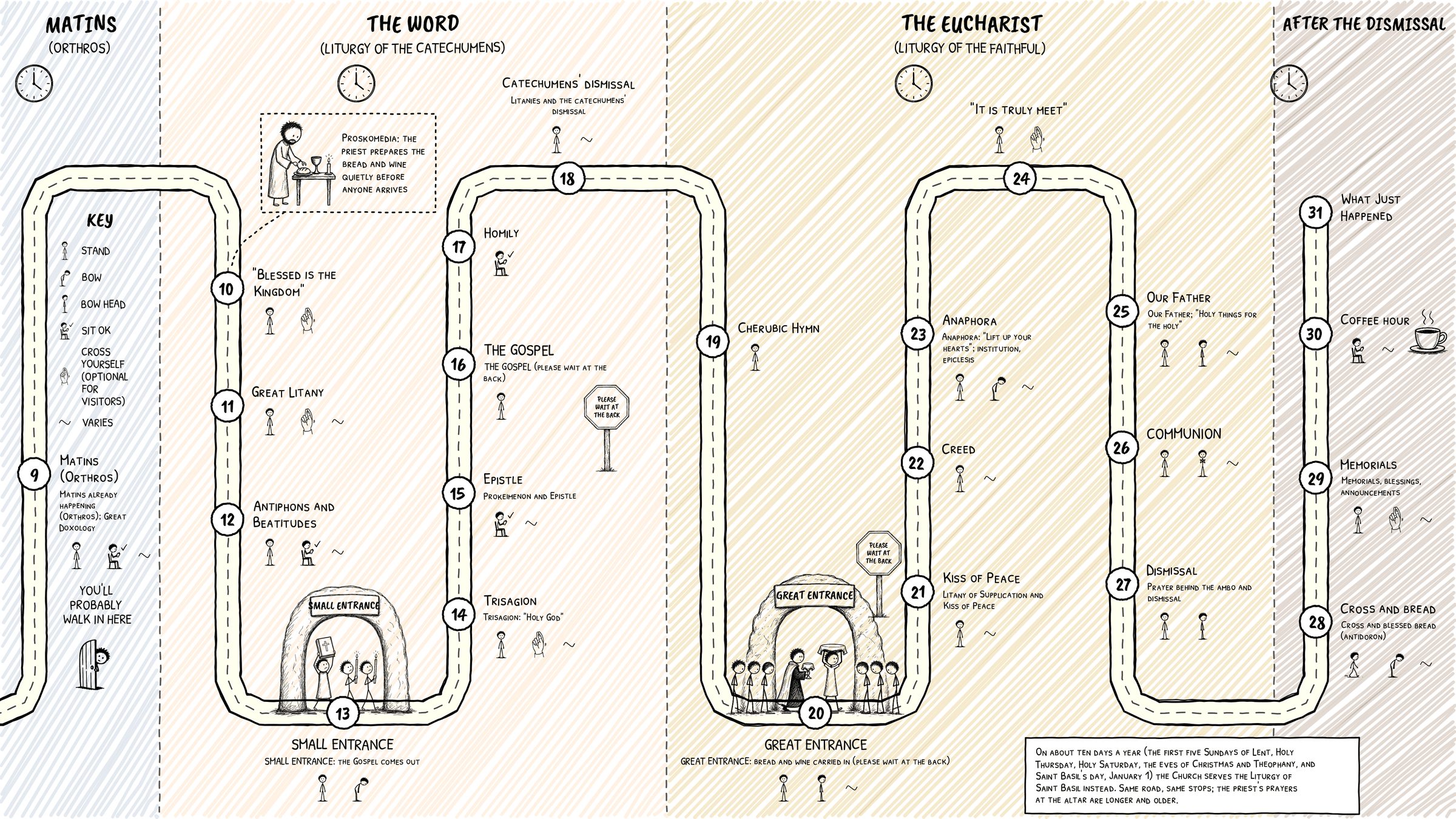
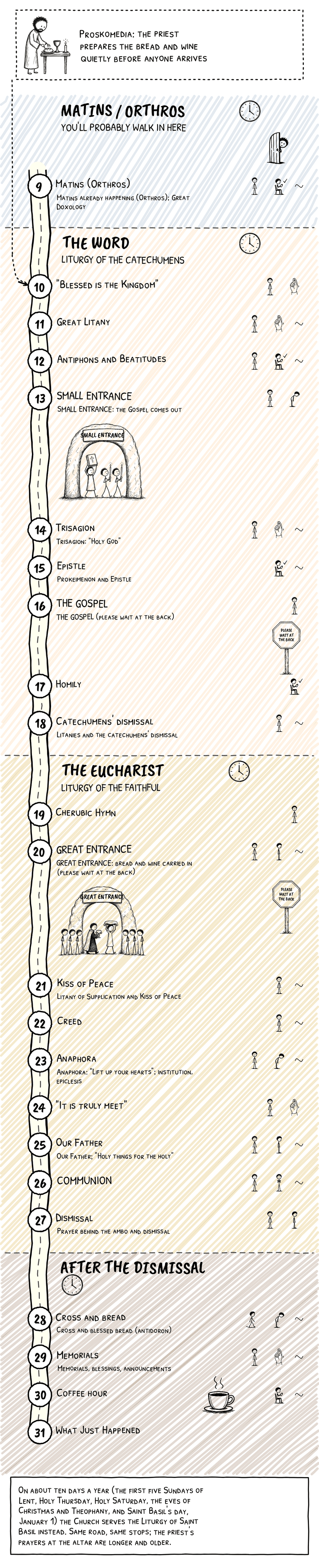
The arches are landmarks on this road, not a plan of the church doors. In the usual parish sequence, the Gospel book comes out through the north side door at the Small Entrance and returns through the Royal Doors in the center. At the Great Entrance the bread and wine enter through the Royal Doors. A bishop's service can differ.
An Orthodox Sunday morning looks like one long service, but it moves in four stretches, and once you know where the joins are you'll always know roughly where you are. Part Two walks the road one stop at a time; this page shows the whole road first.
Before you go in
The first seven stops are places and people, not moments in the service: the courtyard and the steps, the narthex, the room itself, the iconostasis and its doors, standing, sitting, and kneeling, who's who, and the vestments. Before any of it, while the building is still quiet, the priest has already prepared the bread and wine at a side table, and Stop 30 tells you how.
Matins
The road we're following starts in the half-light with Matins, called Orthros in Greek practice. The Great Doxology, "Glory to God in the highest," comes near its end. In many Slavic-practice parishes Matins belongs to the Saturday-night Vigil, and the short Hours are read before Sunday Liturgy instead. Check the local schedule; the Liturgy begins with "Blessed is the Kingdom."
The Liturgy of the Word
The Liturgy proper begins when the priest lifts the Gospel book and blesses the Kingdom. This first half is the Liturgy of the Word, also called the Liturgy of the Catechumens, because in the early Church those still learning the faith stayed for this part: "Blessed Is the Kingdom", the Great Litany, the Antiphons and the Beatitudes, the Small Entrance, the Trisagion, the Prokeimenon and the Epistle, the Gospel, the Homily, and the Litany of the Catechumens.
The homily commonly follows the Gospel, but it may come later in the service or after the dismissal; follow the parish's order.
The Liturgy of the Faithful
The second half belongs to the baptized, and it's the Eucharist itself: the Cherubic Hymn, the Great Entrance, the Litany of Supplication, the Kiss of Peace, the Creed, "Lift Up Your Hearts", the Words of Institution and the Epiclesis, "It Is Truly Meet", the Lord's Prayer, "Holy Things Are for the Holy", Communion, and the Prayer Behind the Ambo and the Dismissal.
After the dismissal
The service ends and the morning doesn't: the cross and the bread, memorials, blessings, and announcements, coffee hour, and finally what just happened to you.
The two entrances
Two processions are the landmarks of the road, and both are easy to spot. At the Small Entrance in the usual parish sequence the clergy carry the Gospel book out through the side door and back in through the center (a bishop's service differs), and the Word half of the Liturgy gathers around it. At the Great Entrance they carry the bread and wine out the same way and take them to the altar for the Eucharist. Find those two, and you can find everything else.
On about ten days a year, among them the first five Sundays of Lent, the Church serves the Liturgy of Saint Basil instead of Saint John Chrysostom's. It's the same road with the same stops; the priest's prayers at the altar are longer.1
Notes
-
Hapgood, Service Book, p. 64. ↩