
What you'll notice
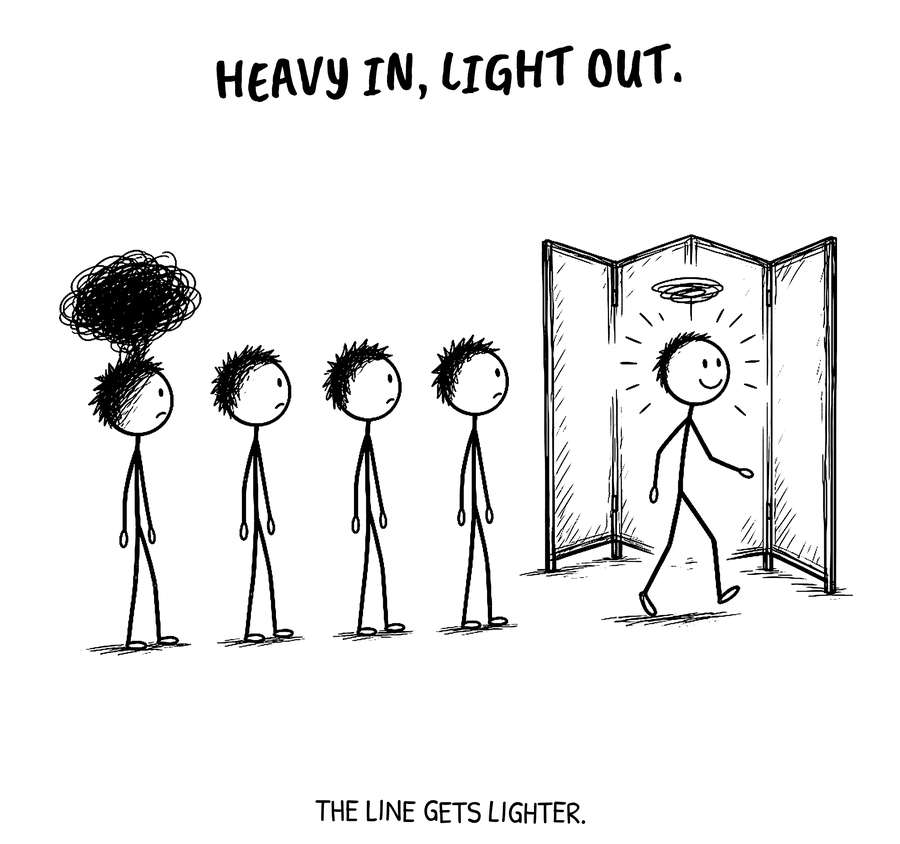
After Vespers on a Saturday, or on a weeknight in Lent, a short line forms near the front of the church. There's no booth and no screen. The priest stands to one side, near an icon of Christ, wearing his stole. One person at a time goes up and stands beside him, both facing the icon, and they talk quietly for a few minutes. The others wait at a polite distance, looking at the floor or saying their prayers.
At the end the person kneels or bows their head. The priest lays the end of his stole over it, reads a prayer, and makes the sign of the cross. The person gets up, and the next one goes.
What you can't see from the back is that nobody in that line is enjoying it, and almost everyone leaves lighter than they came.
What it's called
The sacrament is confession. The priest who hears you regularly is your confessor or spiritual father; Hapgood's rubric begins, "The Spiritual Father leadeth the Person who desireth to confess before the holy image of our Lord Jesus Christ."1 The stole is the epitrachelion (the priest's stole; "on the neck").
What's actually happening
The prayers
In Hapgood's book the rite opens with the ordinary beginning prayers, Psalm 51 (50 in the Septuagint), and two prayers. The first remembers that God "by thy Prophet Nathan didst grant unto repentant David pardon of his transgressions"; the second asks Christ to "loose, remit, forgive" every sin, "whether voluntary or involuntary."2
The witness
Then the priest says what's really going on: "Behold, my child, Christ standeth here invisibly, and receiveth thy confession... Lo, his holy image is before us: and I am but a witness, bearing testimony before him of all things which thou dost say to me." It ends with a line worth remembering: "Take heed, therefore, lest, having come to the physician, thou depart unhealed."3
The full Russian ritual still prints a long questionnaire; Hapgood notes that priests don't use "the questions of olden days" but ask "discreetly."4 In practice you do most of the talking. You aren't producing an exhaustive inventory of every failure since kindergarten. You're naming what you know, plainly, so you can turn from it. Confession isn't therapy, though it may be therapeutic, and the priest isn't a prosecutor. He's there to help you tell the truth and to pronounce Christ's forgiveness. Think of a dark basement: he isn't there to grade the mess, only to hold the flashlight while you carry things up into the light.
The prayer of forgiveness
Then you kneel or bow, and the priest prays. Here the service books differ. Hapgood's Russian book has the priest pray that Christ forgive you and then say in the first person, "And I, his unworthy Priest, through the power given unto me by him, do forgive and absolve thee from all thy sins."5 Patriarch Ignatius IV of Antioch, in a Lenten letter, quoted the prayer of forgiveness ("May God who, through Nathan the prophet forgave David... may the same God forgive you") and said flatly that the Orthodox priest doesn't say "I absolve you" or "I forgive you."6 Both put the forgiveness where it comes from. Which words you hear depends on the book your parish uses.
Why it matters
The risen Christ gave his apostles this: "If you forgive the sins of any, they are forgiven them; if you retain the sins of any, they are retained" (John 20:23). And Saint James, in the reading the Church uses at Holy Unction: "Confess your faults one to another, and pray one for another, that ye may be healed."7 Healed is the word. If the Eucharist is food, confession is medicine.
People ask why they need a priest when God already knows. Cradle Orthodox ask it too, more often than you'd think: "But the priest is just a human like me!" Exactly. You need a witness. Repentance kept entirely inside your head can stay there forever; said out loud, to a person in the flesh, before the icon of Christ, it becomes real. That's also why this sacrament is hands-on in the most literal way. Under ordinary circumstances you can't be absolved by video call or by solitary meditation.
Hapgood's exhortation calls confession "a second Baptism."8 It isn't a repeat of the font; it's the way back to it.
Where it came from
Repentance has always been the Church's business, but its shape has changed. In Saint Basil's fourth-century canons, penance was public and could take years. A man in a third marriage, for instance, was barred from Communion, allowed back first to hear the Scriptures, then to stand with the faithful without receiving, and only after that restored to the chalice.9 The Russian Church's 2015 document on Communion traces the discipline of confession before Communion to Byzantine monasteries of the eleventh and twelfth centuries.10 No canon requires confession before every Communion; that's custom and local rule. Hapgood's Russian notes, for their part, make confession obligatory from age seven.11
How often
How often people go differs across the Orthodox world, and all of it is within the Church's normal practice. Some Slavic parishes expect confession before each Communion. Many Greek and Antiochian parishes expect it periodically, especially in the fasts. The OCA's Holy Synod ruled in 1972 that "the common practice of confession just prior to Liturgy is harmful and should be permitted only in very special cases," and asked that those receiving Communion be in church at least on the eve.12 Patriarch Ignatius warned against the opposite extreme, where the stole and the prayer of absolution become the "only obligatory path toward the Holy Chalice."13 Both come from the same reverence. Neither is the "real" Orthodox way. Most Orthodox Christians keep a confessor, a priest who knows the shape of their life, and the rhythm of confession and of Communion is something the two of them keep together.
What you do
If you're Orthodox: prepare. One simple way is to walk through the Ten Commandments (The Christian Life has them) and ask where you've failed to love God and your neighbor. Say what you did, not what other people did to provoke it. Listen to what the priest says back. If he gives you something to do, extra prayer, prostrations, fasting, almsgiving, that's medicine, not a fine.14 Then go to Communion. Confession and Communion aren't two separate chores; they're breathing out and breathing in.
If you're visiting: the sacrament is for Orthodox Christians, so you won't be in the line. Give it some room; you're watching someone's private conversation with God. If you're a catechumen, your first confession may not be far off, and it's less terrifying than you've imagined (The Path In).
Field Note: the hitman. Bishop Nikolai Soraich tells of his first parish, where he became confessor to a man who had been baptized Orthodox and had become a hired killer: he'd get an envelope with a photograph, a gun, and an address, and he didn't want to know anything else. His life spiraled into misery and alcoholism, which killed him. "But he had true repentance," the bishop says. "I believe he had true repentance, and at that point, he could die."15 If the Church has room to witness that confession, she has room for your pride, your temper, and your quiet betrayals.
Go deeper
- Hapgood, Service Book, The Rite of Confession, pp. 287–291.
- Psalm 51 (50 in the Septuagint); Luke 15:11–32.
- Holy Synod of the OCA, "On Confession and Communion" (1972), with Father Alexander Schmemann's report (oca.org).
- "The Hitman, the Chalice, and the Trap of False Piety," Simply Orthodox; and The Communion Fast.
Notes
-
Hapgood, Service Book, p. 287. ↩
-
Hapgood, Service Book, pp. 287–289. ↩
-
Hapgood, Service Book, p. 289. ↩
-
Hapgood, Service Book, p. 290. ↩
-
Hapgood, Service Book, p. 291. ↩
-
Ignatius IV, Patriarch of Antioch, "Lenten Message," The Word, April 1999, pp. 4–5. ↩
-
Hapgood, Service Book, p. 343, from James 5:16. ↩
-
Hapgood, Service Book, p. 290. ↩
-
Basil, canon 4, with the Rudder's interpretation (The Rudder, Cummings trans.). ↩
-
Russian Orthodox Church, "On the Participation of the Faithful in the Eucharist" (2015). ↩
-
Hapgood, Service Book, p. 600 note 22; p. 603 note 6. ↩
-
OCA Holy Synod, "On Confession and Communion" (1972). ↩
-
Ignatius IV, "Lenten Message," The Word, April 1999. ↩
-
Ignatius IV, "Lenten Message," The Word, April 1999. ↩
-
Bishop Nikolai Soraich, in conversation with Father Dimitri Kulp; recounted in Bennett, "The Hitman, the Chalice, and the Trap of False Piety," Simply Orthodox. ↩