
What you'll notice
If you're anywhere near a Greek parish on March 25, you know the drill. Schoolkids in traditional folk costumes, flags bigger than they are, a parade. It's Greek Independence Day, celebrating the revolution of 1821 against the Ottoman Empire.1
The date wasn't random. March 25 was already the Feast of the Annunciation, and the leader of the revolutionary society, Alexander Ypsilantis, chose that feast as the day to begin. When Athens began building its cathedral in 1842, it dedicated it to the Annunciation. A nation picked the day it would say "yes" to freedom, and it picked the day Mary said "yes" to God.1
Inside the church, listen for a swap at the Liturgy. The usual hymn to the Theotokos after the consecration gets replaced by a line from the feast's canon: "Let no hand profane in anywise touch the living Ark of God."2 She's the Ark now, the place where God chose to live.1
What it's called
The Annunciation is kept on March 25, one of the twelve Great Feasts. March 24 is the forefeast, and March 26 is the Synaxis of the Archangel Gabriel: the day after, the Church thanks the messenger.1 Do the math. Nine months from March 25 is December 25. The Incarnation begins here, in Lent, with snow still on the ground in plenty of the country.1
The troparion, in Isabel Hapgood's 1906 English:
To-day is the crown of our salvation, and the manifestation of that mystery which is from everlasting: The Son of God becometh the son of a Virgin, and Gabriel announceth the glad tidings of grace. Wherefore let us also cry aloud with him unto the Birth-giver of God: Hail, thou that art full of grace, the Lord is with thee!2
The kontakion is the hymn that ends, "Hail, O Bride unwedded!"2
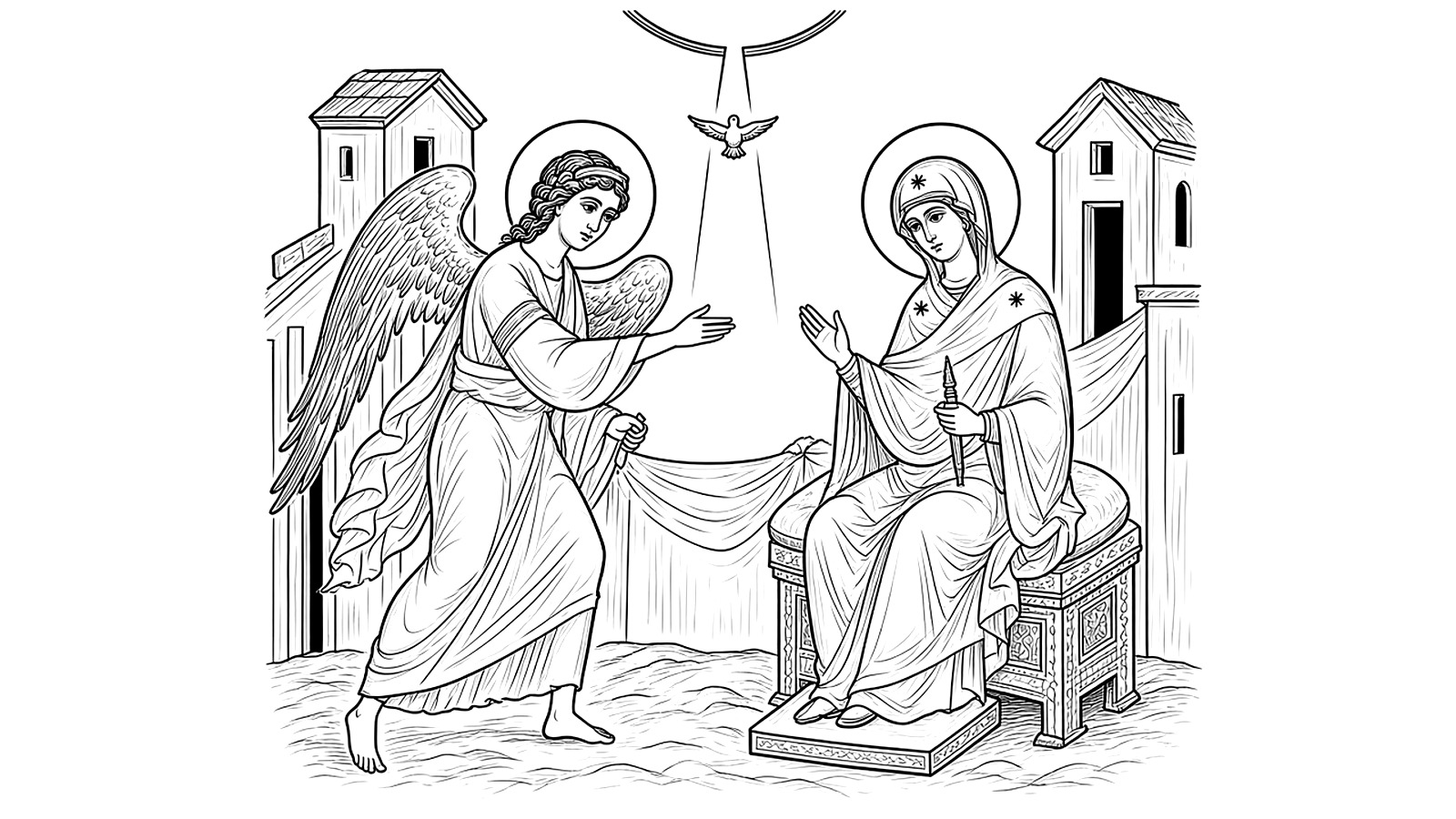
What's actually happening
One question, one answer
Saint Luke tells it with almost no scenery. The angel Gabriel is sent "to a virgin betrothed to a man whose name was Joseph, of the house of David. The virgin's name was Mary" (Luke 1:27). He says, "Rejoice, highly favored one, the Lord is with you; blessed are you among women!" (Luke 1:28).
She's troubled, and honestly, who wouldn't be? Gabriel tells her she'll conceive and bear a Son. Mary asks exactly one question, and it's a practical one: "How can this be, since I do not know a man?" (Luke 1:34). Gabriel tells her the Holy Spirit will come upon her, and adds, "For with God nothing will be impossible" (Luke 1:37). And then she answers: "Behold the maidservant of the Lord! Let it be to me according to your word" (Luke 1:38).1
Let there be, let it be
Saint Philaret, Metropolitan of Moscow, preached a sermon on this feast in the nineteenth century, one that Father Georges Florovsky quoted at length. Philaret starts in Genesis. When God first spoke, "Let there be light"; and there was light (Genesis 1:3). Nobody was asked. There was nobody yet to ask.1 Then Philaret turns to Nazareth:
But on the day, unique in the existence of the world, when Holy Mary uttered her humble and obedient Let it be, I would hardly dare to express what took place then—the word of the creature caused the Creator to descend into the world.3
And:
But again that which is divine and incomprehensible occurs—the word of God itself defers its action, allowing itself to be delayed by the word of Mary: How can this be? Her humble Let it be was necessary for the realization of God's mighty Let it be.3
The God who said "Let there be light" and got light stood at the door of a house in Nazareth and waited for an answer. He'd made galaxies without asking anybody's permission. He wouldn't make Himself a man without hers.1
Why it matters
Because God doesn't install grace like a software update while you sleep. He knocks, and He waits.1 Florovsky draws the conclusion plainly: "Man is never dealt with by God as if he was but a tool in the hands of a master." Mary's yes was "freedom of obedience, not of initiative—and yet a true freedom, freedom of love and adoration, of humility and trust—and freedom of co-operation." And: "The grace of God can never be simply superadded, mechanically as it were. It has to be received in a free obedience and submission."3
You can hear that freedom a few verses later, when Mary visits Elizabeth and sings: "My soul magnifies the Lord, And my spirit has rejoiced in God my Savior. For He has regarded the lowly state of His maidservant" (Luke 1:46-48). Florovsky points to the Magnificat for exactly this reason. That's somebody who said yes and meant it.1
Saint Irenaeus of Lyons saw the same thing in the second century:
And thus also it was that the knot of Eve's disobedience was loosed by the obedience of Mary. For what the virgin Eve had bound fast through unbelief, this did the virgin Mary set free through faith.4
If you've ever pulled a pair of earbuds out of your pocket, you know a knot takes about two seconds to tangle and twenty minutes to work loose. Eve's no took one bite. Untying it took a woman's whole life: her yes in Nazareth, then the cave in Bethlehem, the flight to Egypt, and the foot of the Cross.1
That's why the Church has been so stubborn about her title. Saint John of Damascus says, "Hence it is with justice and truth that we call the holy Mary the Mother of God. For this name embraces the whole mystery of the dispensation."5 Say Theotokos, Birth-giver of God, and you've said the whole thing: God really became man, and a real woman really said yes.1
Field Note: an anticipated Pentecost. Florovsky has one more line: "The Annunciation was for her, as it were, an anticipated Pentecost."3 The Spirit came down on Mary before He came down on the apostles.1 The canon, credited to the Blessed Theophanius and Saint John of Damascus, puts these words in Gabriel's mouth: "Make thou ready to receive God; for through thee the Uncontainable shall dwell among men."2 The Epistle at that day's Liturgy says it in plain prose: since we "have partaken of flesh and blood, He Himself likewise shared in the same" (Hebrews 2:14).1
What you do
The Annunciation almost always lands in Great Lent, and the Church makes room for it. Fish is allowed that day, along with wine and oil.1 And even on a Lenten weekday the old service book is clear: the Liturgy that day is a full one, Saint John Chrysostom's or Saint Basil's, "never" the Presanctified.2
If you're Orthodox: go. Take the morning off if you can. It's a feast in the middle of a fast, and the Church wants you to taste the difference.1 Fasting has the rest of the Lenten rules.
If you're visiting: listen for "Let no hand profane" in place of the usual hymn to the Theotokos, and learn the kontakion that ends "Hail, O Bride unwedded!" Mary and the Saints is a good next step.1
And if you're Greek, march in the parade. Wave the flag. Just remember, while the band plays, whose yes the date belonged to first.1
Notes
-
Adapted from a Simply Orthodox article by Jamey Bennett, "The Day God Waited for a Yes" (not yet published). Scripture quotations are from the New King James Version (NKJV), as in the article. Greek Independence Day details from Wikipedia, "Celebration of the Greek Revolution," as given in the article. ↩↩↩↩↩↩↩↩↩↩↩↩↩↩↩↩↩↩
-
Isabel F. Hapgood, Service Book of the Holy Orthodox-Catholic Apostolic Church (1906), pp. 42 (kontakion), 202 (troparion; canon, Ode VIII), and 203 (Ode IX, sung "in place of: Meet is it"; Liturgy rubric), as quoted in "The Day God Waited for a Yes." ↩↩↩↩↩
-
Georges Florovsky, Collected Works, vol. III, Creation and Redemption, "The Ever-Virgin Mother of God," pp. 177 and 180-181, including his quotation of Saint Philaret of Moscow (translation by R. Haugh), as quoted in "The Day God Waited for a Yes." ↩↩↩↩
-
Saint Irenaeus of Lyons, Against Heresies III.22.4, Ante-Nicene Fathers, vol. 1, as quoted in "The Day God Waited for a Yes." ↩
-
Saint John of Damascus, An Exact Exposition of the Orthodox Faith III.12, Nicene and Post-Nicene Fathers, 2nd series, vol. 9, as quoted in "The Day God Waited for a Yes." ↩