
What you'll notice
You're two weeks into Lent, deep in the fasting and the prostrations. Last Sunday the Church celebrated the icons. This Sunday it hands you not a martyr, not a desert hermit, but a theologian (also a monk and a bishop), whose name most of us know just well enough to mispronounce with confidence.1
It's fair to ask why.
What it's called
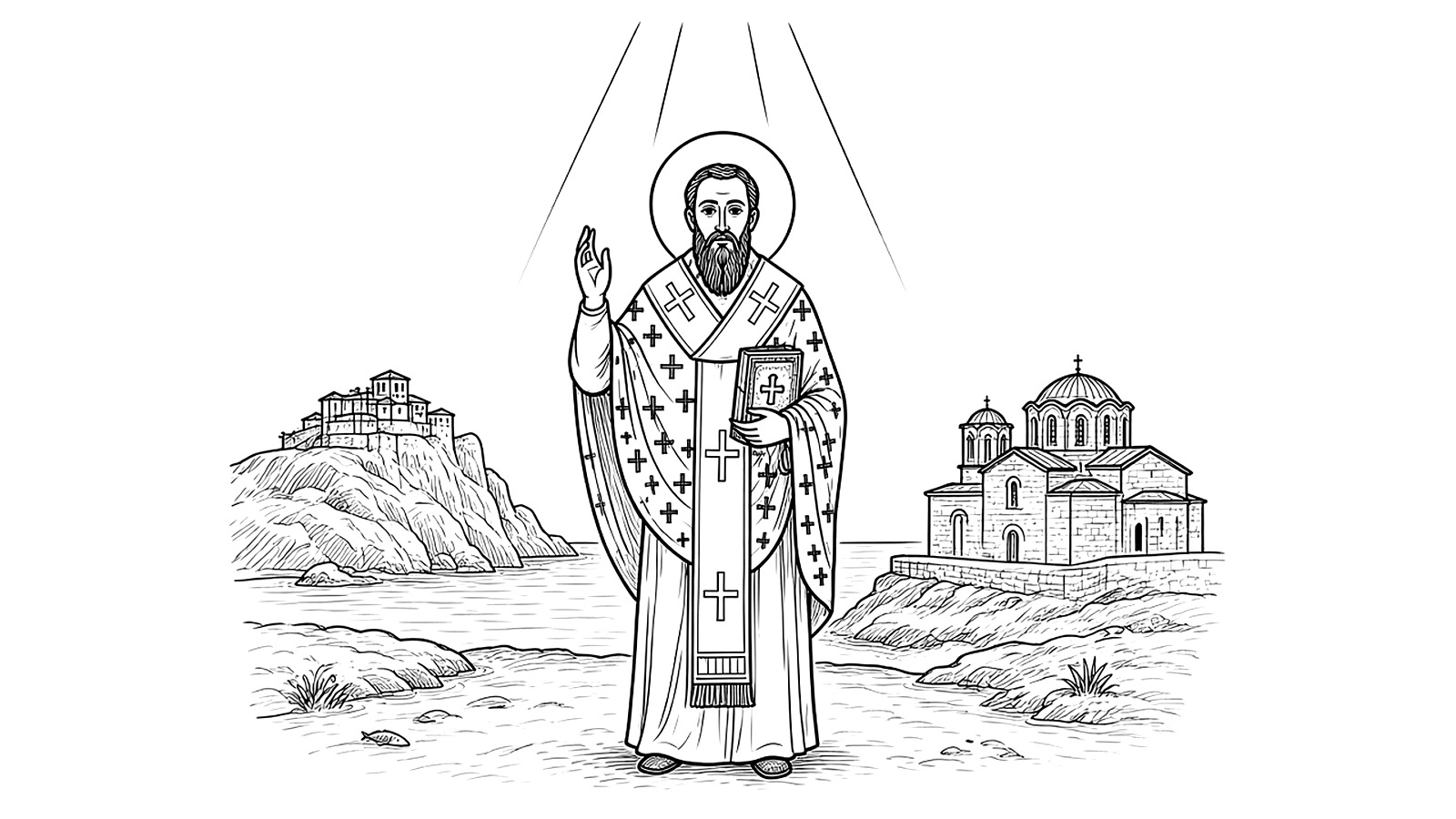
The Second Sunday of Great Lent keeps the memory of Saint Gregory Palamas, a monk from Mount Athos.1 It comes right after the Sunday of Orthodoxy, the restoration of the icons.1
His story is a historical whiplash. In 1344 a council in Constantinople condemned him and threw him in prison. Three years later a different council completely vindicated him. Nine years after his death the Church declared him a saint.1 His crime was defending the bold claim that ordinary human beings can actually experience the living God.1
What's actually happening
He was defending a life, not starting a school
Palamas didn't write theology to build a career or win an abstract argument. He was dragged into controversy because something precious needed defending.1
His opponent was a philosopher, Barlaam of Calabria. Barlaam looked at the hesychast monks on Mount Athos, men who prayed with heads bowed, regulating their breathing, trying to bring the mind down into the heart, and he scoffed. For Barlaam, God is so utterly beyond us that any "experience" of God a monk claims must be a created symbol: a nice feeling, maybe, but not God. The body wasn't invited to the party.1
Dr. Alexander Titus, whose translation work is opening up Palamas's Triads to more readers, says the Triads ask a basic question: "What is the role of the mind… in the spiritual life?" His answer for Palamas: "the nous needs to be integrated into the spiritual life… involved in prayer… centered in the heart."2 Not the mind floating above us and the body dragging behind. The whole person.
Fire and sunlight: what "divine energies" means
If Barlaam was right, real communion with God is impossible, and we're just down here thinking hard thoughts about a God who stays strictly upstairs.1 So Palamas leaned on a distinction that sits at the bedrock of Orthodox spiritual life: God's essence and God's energies.1
By energies Palamas means, in Dr. Titus's words, "the self manifestation of God… the experience of God himself."2 Not a created buffer, not a symbolic glow. God Himself, as He gives Himself to be known. That holds two truths together. In His essence God stays beyond comprehension; we don't master or capture Him. And God really is experienced; we truly share in His life.1
Dr. Titus uses the picture of the sun. We can't grab the sun in our hands, but we really do feel its light and heat, and the light and heat aren't a fake, lesser sun. They're the sun as it reaches us.1 Father Bogdan Bucur adds: "The words are negotiable; what is defended by the words is non-negotiable."2 What's non-negotiable is that God truly gives Himself to us. Not a postcard of Himself. Himself. It's theology in defense of prayer.1
The whole person, and the light of Tabor
Palamas refused to treat the body as an inconvenience. "The body is not excluded from the life of prayer," Dr. Titus says, and Father Bogdan puts it more sharply: "the whole human person is the locus of divine encounter."2 We fast with our stomachs, make prostrations with our knees, and cross ourselves with our hands.1
That's why the Transfiguration sits near the center of his thought. Christ's light on Mount Tabor isn't stage lighting. It's the truest revelation of who He is, and the vision is of Christ Himself, not of something around Him.1 Father Bogdan: "there is no way to have an experience of the Divine energies" apart from an experience of Christ.2
Why it matters
Because Lent isn't only about restraint. It's about transformation: what a human being is for, what prayer is doing to us, and whether communion with God is real or merely religious talk with candles around it.1
Last week the Church affirmed that the invisible God became visible flesh. This week it takes the next step: if God took on human flesh, then human flesh can hold God.1 We're tempted to make Christianity merely moral, or merely intellectual, or merely emotional, or a matter of being nice and feeling good. Palamas won't let us.1 And he isn't a freelance mystic off to the side. Dr. Titus is careful to say the same uncreated grace at work in hesychast prayer is what we meet "in the life of the church including in the sacraments."2
So repentance isn't just feeling bad, and we don't fast and pray to become good little citizens. We're after theosis, re-integration in Christ.1 Salvation as Healing has more on that word.
Field Note: the professor. Father Bogdan Bucur taught me in the Master of Orthodox Theology program at the Antiochian House of Studies, and he was one of my favorites. He has a gift for making high-level theology feel like a five-alarm fire in your own living room, and his specialty, in my opinion, is the Transfiguration.1
What you do
If you're Orthodox: let this Sunday reset your Lent. You're not managing your behavior; you're being healed, so the whole person can be flooded with light.1 Keep the fast, the prostrations, the Liturgy, and confession, not because bodies are embarrassing or holiness is for specialists, but because in Christ a human being can actually be illumined.1
If you're visiting: you'll hear hymns about light and about a saint you may never have heard of. That's normal. The short version: the Orthodox believe you can really meet God, body and soul, and this Sunday is the Church saying so out loud.
Field Note: a summary in one line. Father Bogdan closes his conversation on Palamas with a line from the hymns of the Transfiguration: "all of mortal nature now divinely shines."2 It's as good a summary of Lent as any.1
Notes
-
Jamey Bennett, "St. Gregory Palamas Sunday: Why the Church Pauses Lent for a Condemned Man," Simply Orthodox, March 7, 2026. ↩↩↩↩↩↩↩↩↩↩↩↩↩↩↩↩↩↩↩↩↩↩
-
Rev. Dr. Bogdan Bucur and Dr. Alexander Titus, Saint Vladimir's Seminary (SVS Press) webinar on Palamas's Triads, as quoted in Bennett, "St. Gregory Palamas Sunday." ↩↩↩↩↩↩↩