
What you'll notice
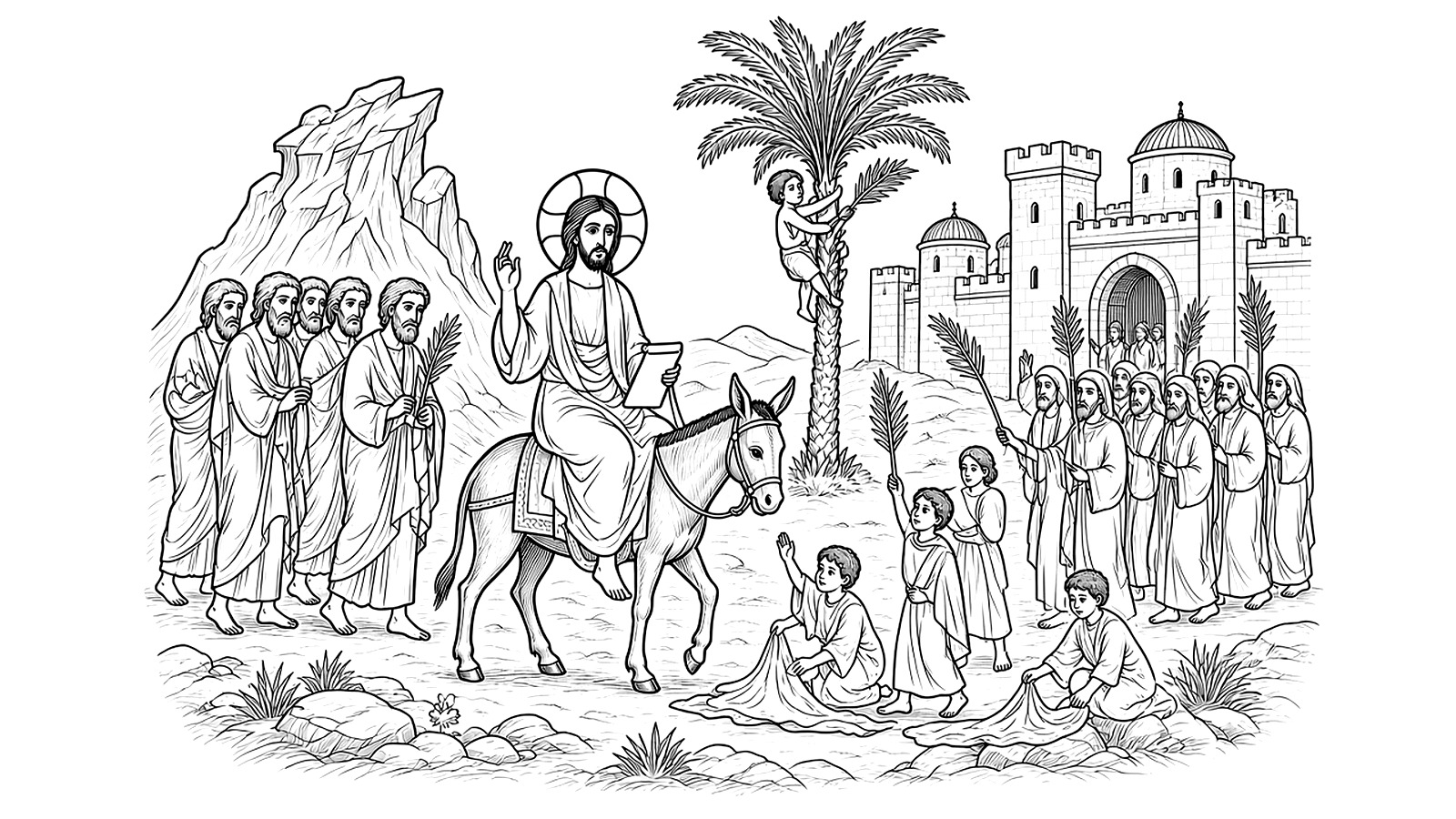
At the Vigil on Saturday night the palms are blessed. The old prayer calls them "symbols of victory, even boughs of trees and branches of palms, emblematical of the Resurrection."1 After the priest hands them out, the people light their candles and stand holding palms and candles until the end of the service. Try it with a five-year-old. It's an experience.2
The Church keeps the crowd's song word for word. At Vespers it sings that "the Hebrew children, taking branches of trees in their hands, exalted him with the shout: Hosanna in the highest! Blessed is he that cometh in the Name of the Lord."1 Then it hands everybody a branch and lets us do it again.2
What it's called
Palm Sunday is the Sunday before Pascha, one of the twelve Great Feasts: Christ's entry into Jerusalem. The day before is Lazarus Saturday, when the Church keeps the raising of Lazarus at a tomb in Bethany.2 Holy Week and Pascha walks through the whole week that follows.
The troparion ties Saturday and Sunday together:
Thou didst raise Lazarus from the dead, O Christ our God, making certain the universal resurrection, before thy Passion. For which cause we also, like unto the children, bearing the emblems of victory, cry aloud unto thee, the Conqueror of Death: Hosanna in the highest! Blessed is he that cometh in the Name of the Lord.1
The kontakion:
O Christ-God, who in heaven art borne upon the throne, and on earth upon the foal of an ass, thou didst accept the praises of the Angels, and the hymns of the children that cried unto thee: Blessed art thou who art come to recall Adam from the dead!1
A throne in heaven, a donkey on earth, and it's the same Rider.2
What's actually happening
The borrowed colt
Picture two guys you've never seen walking up your driveway, opening your car door, and starting to back it out. You come running out in your socks, and one of them says, very calmly, "The Lord needs it." I'd call the police, and then I'd post the doorbell footage.2
That's more or less what happened in a village outside Jerusalem. Jesus sent two disciples ahead: "Go into the village opposite you, where as you enter you will find a colt tied, on which no one has ever sat. Loose it and bring it here" (Luke 19:30). "But as they were loosing the colt, the owners of it said to them, 'Why are you loosing the colt?' And they said, 'The Lord has need of him.' Then they brought him to Jesus" (Luke 19:33-35). No argument. The owners just let it go.
Saint John Chrysostom won't let you skip that part. "And do not account what was done to be a small thing," he tells his congregation. "For who persuaded them, when their own property was taken from them, and that, when they were perhaps poor men and husbandmen, not to forbid it?" Christ was teaching His disciples "to give whatever He should ask; and, though he should require them to yield up their very life, to give even this, and not to gainsay."3
Loose him, loose it
The day before, at Lazarus's tomb, Jesus cries out, "Lazarus, come forth!" The dead man walks out "bound hand and foot with graveclothes," and Jesus says, "Loose him, and let him go" (John 11:43-44). The next morning He sends His disciples to untie a colt. Two days in a row, the Lord is in the business of untying things.2
Chrysostom goes further: "For here the church is signified by the colt, and the new people, which was once unclean, but which, after Jesus sat on them, became clean." And the disciples doing the untying? "For by the apostles, both they and we were called; by the apostles were we brought near."3 So, yes. You're the colt. Tied up outside somebody's door, never been ridden, not much to look at. And the Lord sent His apostles to untie you, because He had need of you.2
Why the crowd showed up
It wasn't the donkey. "The people, who were with Him when He called Lazarus out of his tomb and raised him from the dead, bore witness. For this reason the people also met Him, because they heard that He had done this sign" (John 12:17-18). They "took branches of palm trees and went out to meet Him, and cried out: 'Hosanna! "Blessed is He who comes in the name of the Lord!" The King of Israel!'" (John 12:13). Others "spread their clothes on the road; others cut down branches from the trees and spread them on the road" (Matthew 21:8). When some Pharisees asked Him to quiet His disciples, He said, "I tell you that if these should keep silent, the stones would immediately cry out" (Luke 19:40).
Why it matters
The prophet Zechariah had called it: "Behold, your King is coming to you; He is just and having salvation, Lowly and riding on a donkey, A colt, the foal of a donkey" (Zechariah 9:9). Chrysostom thinks Christ chose the donkey on purpose, "as affording us a standard of self-denial," a Lord who "requires no throne nor pillow, but sits on the ground."3 A Vespers stanza can't stop staring at the contrast:
He who hath the heavens for his throne, and the earth for his footstool, the coeternal Word and Son of God the Father, to-day is come to Bethany, to humble himself upon the dumb foal of an ass.1
And the most honest verse in the story: "His disciples did not understand these things at first; but when Jesus was glorified, then they remembered that these things were written about Him" (John 12:16). The city didn't get it either. Matthew says "all the city was moved, saying, 'Who is this?'" (Matthew 21:10). The crowd answered, "This is Jesus, the prophet from Nazareth of Galilee" (Matthew 21:11). True, as far as it went.2 Father Georges Florovsky quotes Chrysostom on the answer that came five days later: "I call Him King, because I see Him crucified, for it is appropriate for a King to die for His subjects."4 The crowd waved palms at a King. They didn't know yet what kind of throne He was riding toward.2
What you do
If you're Orthodox: start Saturday. Go to Lazarus Saturday and hear "Loose him, and let him go," then come back that night for the Vigil and the palms. On Palm Sunday itself the Church allows fish, wine and oil in the middle of the fast. Enjoy it. You'll need the strength, because that evening Holy Week starts.2 (Fasting has the Lenten rules.)
If you're visiting: take a palm and a candle and stand with everybody else.
And sometime between the palms and the Cross, ask yourself Chrysostom's question. What's tied up outside your door that you haven't let go of yet? One of these days somebody is going to walk up your driveway with a message from the King, and it won't be long. Six words: "The Lord has need of it."2
Notes
-
Isabel F. Hapgood, Service Book of the Holy Orthodox-Catholic Apostolic Church (1906), pp. 204 (troparion; Vespers stanza), 205 (prayer at the blessing of the palms), and 207 (kontakion), as quoted in "The Lord Has Need of It." ↩↩↩↩↩
-
Adapted from a Simply Orthodox article by Jamey Bennett, "The Lord Has Need of It" (not yet published). Scripture quotations are from the New King James Version (NKJV), as in the article. ↩↩↩↩↩↩↩↩↩↩↩
-
Saint John Chrysostom, Homily 66 on Matthew, §2, trans. George Prevost, rev. M. B. Riddle, Nicene and Post-Nicene Fathers, 1st series, vol. 10, as quoted in "The Lord Has Need of It." ↩↩↩
-
Saint John Chrysostom, Homily I on the Cross and the Thief (De cruce et latrone), in the translation of Georges Florovsky, Collected Works, vol. III, Creation and Redemption, p. 138, as quoted in "The Lord Has Need of It." Florovsky gives the source in vol. IV, Aspects of Church History, "Patristic Theology and the Ethos of the Orthodox Church," p. 27. ↩