
What you'll notice
Most people who sit in an Orthodox church every Sunday couldn't tell you when this fast starts. (No judgment. It moves.)1
It goes back to a dinner party. Matthew has just walked away from his tax booth, and Jesus is at dinner in a house packed with "many tax collectors and sinners" (Matthew 9:10). The disciples of John the Baptist, followers of a man whose food was "locusts and wild honey" (Matthew 3:4), want to know why the party is still going: "Why do we and the Pharisees fast often, but Your disciples do not fast?" Jesus doesn't tell them fasting is outdated. He tells them it's early: "Can the friends of the bridegroom mourn as long as the bridegroom is with them? But the days will come when the bridegroom will be taken away from them, and then they will fast" (Matthew 9:14-15).
Then they will fast. The Church took Him at His word. Every summer there's a fast named for the men at that table.1
What it's called
The Apostles' Fast is one of the four fasting seasons of the Church year (Fasting lists them all).
Here's how the Church gets there. Forty days after Pascha comes the Ascension, when the Bridegroom is taken up, and ten days after that, Pentecost. Then the Church takes a whole week off from fasting, not even Wednesday and Friday, before the Sunday of All Saints. The Monday after that, the Apostles' Fast begins, and it runs up to the feast of Saints Peter and Paul on June 29.1
That order is older than you'd think. A church manual compiled in Syria around 375 to 380, the Apostolic Constitutions, lays it out almost exactly:
Therefore, after you have kept the festival of Pentecost, keep one week more festival, and after that fast; for it is reasonable to rejoice for the gift of God, and to fast after that relaxation.2
I love the honesty of "after that relaxation." The Church has just spent fifty days of Pascha eating like it's a wedding, because it is one.1
What's actually happening
Why it won't hold still
Isabel Hapgood's 1906 service book explains the catch: "The length of this fast is regulated by the date of Easter and of Pentecost; and therefore it varies from two weeks to five weeks and five days."3 The start date floats with Pascha. The finish line doesn't: Peter and Paul are always June 29.1
Today the range can be even wider. The Greek Orthodox Metropolis of San Francisco says, "In some years it can be as long as five weeks and in other years it may only be one or two days in length, or not occur at all."4 It's the accordion of the Church year.1 (Why Is Orthodox Easter on a Different Date? explains why Pascha moves so much in the first place.)
Field Note: the fast in 2028. Pascha is April 16 and Pentecost is June 4. The Sunday of All Saints is June 11, so the fast starts on Monday, June 12, and runs seventeen days to the feast on Thursday, June 29.1
What the apostles actually did
So what did the friends of the Bridegroom do once He was taken away? In Antioch, a handful of prophets and teachers were at prayer:1
As they ministered to the Lord and fasted, the Holy Spirit said, "Now separate to Me Barnabas and Saul for the work to which I have called them." Then, having fasted and prayed, and laid hands on them, they sent them away. (Acts 13:2-3)
That's the launch of Saint Paul's first missionary journey, and it starts with an empty stomach. When Paul and Barnabas plant churches on that trip, they do it the same way: "So when they had appointed elders in every church, and prayed with fasting, they commended them to the Lord in whom they had believed" (Acts 14:23).1 Saint John Chrysostom noticed the pattern: "A great, yes a great good is fasting: it is circumscribed by no limits. When need was to ordain, then they fast: and to them while fasting, the Spirit spoke."5
Call it a sending fast. Pentecost gave the Church the Spirit, and the Apostles' Fast is the Church remembering what the Spirit gave it for.1
Why it matters
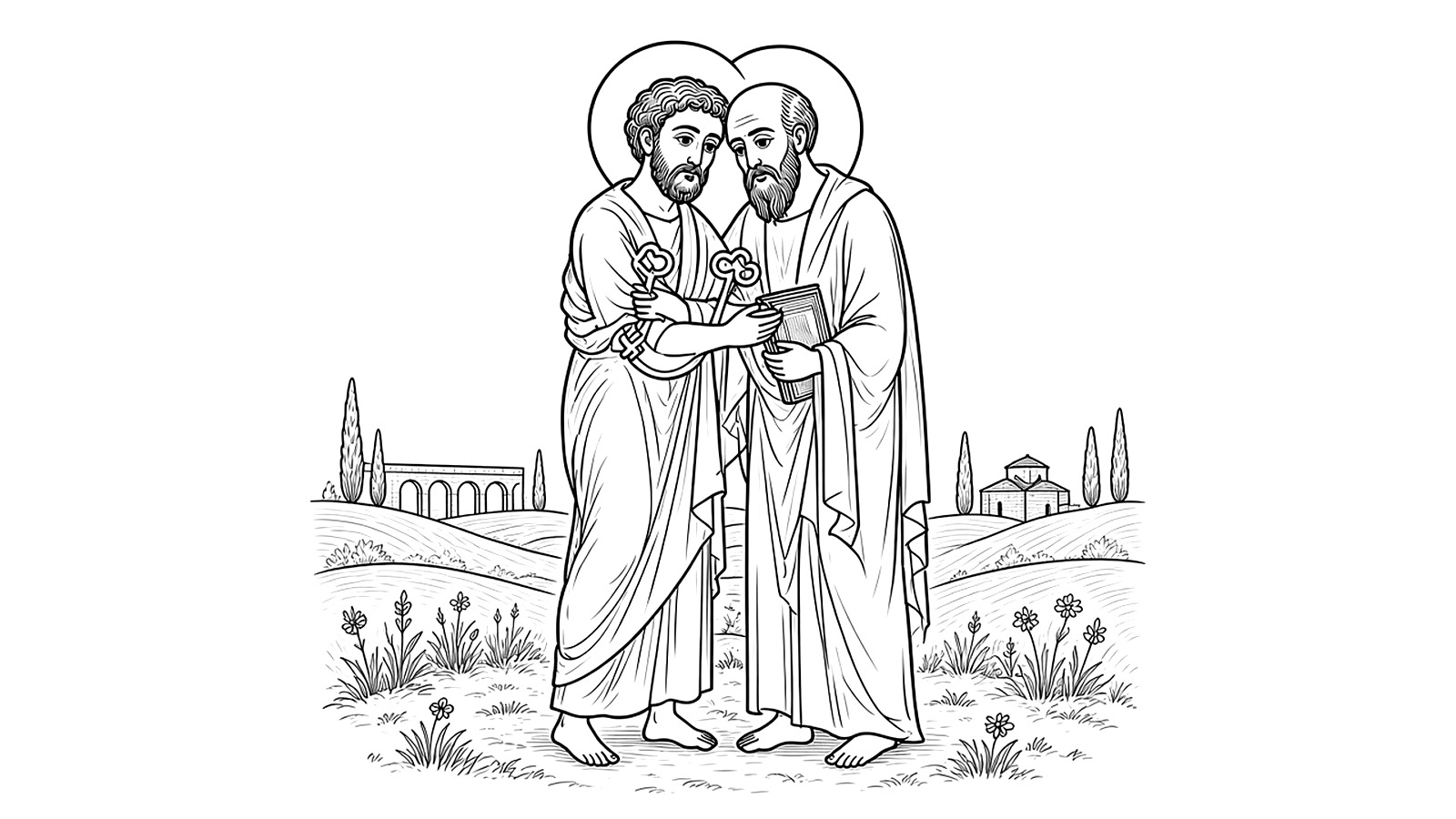
The fast ends on the feast of the two apostles the Church calls its pillars, and they're an odd pair. One denied Christ three times beside "a fire of coals" (John 18:18). The other spent his early career hunting Christians down.1 Christ restored Peter by the Sea of Tiberias with three questions, and Peter answered, "Lord, You know all things; You know that I love You" (John 21:17). Paul never got over the mercy shown to him: "This is a faithful saying and worthy of all acceptance, that Christ Jesus came into the world to save sinners, of whom I am chief" (1 Timothy 1:15).
You meet both of them at every Liturgy. Before it begins, while the priest prepares the bread at the side altar (see the proskomedia), he cuts out small particles in honor of the saints, and over one of them says, "Of the holy, glorious and all-laudable Apostles, Peter and Paul; and of all the other holy Apostles."3 The denier and the persecutor, named together on the paten, every single week.1
Father Georges Florovsky explains why that matters. The Spirit who came at Pentecost didn't drop by and leave:
The Holy Ghost does not descend upon earth again and again, but abides in the "visible" and historical Church.6
And that Church has a job: "The Church is more than a company of preachers, or a teaching society, or a missionary board." Then: "It is a missionary body indeed, and its missionfield is the whole world."6
What you do
If you're Orthodox: keep the fast as your priest blesses. In Greek practice it's one of the gentler ones. Father Peter Chamberas, writing for the Greek Orthodox Archdiocese, says that when it runs several weeks, meat, dairy and eggs are set aside, and "Fish is allowed on all days except Wednesdays and Fridays." For the short years: "If the Fast of the Holy Apostles is only a few days in duration, then it should be kept as strictly as possible."7
Since it's a sending fast, add a sending habit. The Metropolis of San Francisco suggests praying for the Church's missionaries during these weeks, and reminds everyone that "we too have an obligation to be a missionary for our Lord."4 Saint Peter put it this way: "always be ready to give a defense to everyone who asks you a reason for the hope that is in you, with meekness and fear" (1 Peter 3:15). Note the last four words. Nobody's asking you to stand on a milk crate in the parking lot at Publix.1
If you're visiting: pick one person. Pray for them by name every day of the fast, however long it is this year. Then, sometime before June 29, tell them why you go to church.1
The disciples of John asked why nobody at that table was fasting. Jesus told them to wait. Then the Bridegroom was taken up, the Spirit came down, and the men from that table fasted, prayed, laid hands on two of their own, and "sent them away." The Church is still sending.1
Notes
-
Adapted from a Simply Orthodox article by Jamey Bennett, "The Fast That Changes Size" (not yet published). Scripture quotations are from the New King James Version (NKJV), as in the article. The 2028 dates are from the Orthodox Church in America's daily readings, June 4-29, 2028, as given in the article. ↩↩↩↩↩↩↩↩↩↩↩↩↩↩↩
-
Apostolic Constitutions, Book V, ch. 20, trans. James Donaldson, Ante-Nicene Fathers, vol. 7, as quoted in "The Fast That Changes Size." The Constitutions are an anonymous compilation, usually dated about 375 to 380 and placed in Syria. They witness to early practice but aren't a canonical rule: the Council in Trullo (692), canon 2, rejected them because "those who erred from the faith" had added to them, while keeping the 85 Apostolic Canons. ↩
-
Isabel F. Hapgood, Service Book of the Holy Orthodox-Catholic Apostolic Church (1906), pp. xvi (the length of the fast) and 73 (the proskomedia), as quoted in "The Fast That Changes Size." ↩↩
-
Greek Orthodox Metropolis of San Francisco, "The Apostles Fast" (2017), as quoted in "The Fast That Changes Size." ↩↩
-
Saint John Chrysostom, Homily 27 on Acts, Nicene and Post-Nicene Fathers, 1st series, vol. 11, as quoted in "The Fast That Changes Size." ↩
-
Georges Florovsky, Collected Works, vol. I, Bible, Church, Tradition, pp. 45 and 69, as quoted in "The Fast That Changes Size." ↩↩
-
Rev. Peter A. Chamberas, "Not by Bread Alone" (Greek Orthodox Archdiocese of America, 2015), as quoted in "The Fast That Changes Size." ↩