
What you'll notice
Stay after the Liturgy on Pentecost and you'll see something you haven't seen in fifty days: the whole church on its knees.
From Pascha to Pentecost, the Church doesn't kneel. That rule is old. The Council of Nicaea in 325 noticed "certain persons who kneel on the Lord's Day and in the days of Pentecost," and ruled "that prayer be made to God standing."1 The old service book gives the reason: "The joy of the worshippers at that season is held to outweigh even their sense of lowly penitence for sin, which prompts to kneeling."2
Then, on Pentecost itself, comes a Vespers that "as a rule, immediately followeth the Liturgy." The Church asks God to accept "this, the bending of our knees, as incense before him," and the long prayers that follow are said on bended knees.2 That's why many people call it Kneeling Vespers. The joy hasn't run out. The Spirit has come to stay, and there's work to do: repentance, prayer, the long slow business of being made holy.3 (Standing, Sitting, Kneeling explains the posture rules for the rest of the year.)
What it's called
Pentecost is the fiftieth day of Pascha, a Sunday (Calendar of Feasts has the math), and one of the twelve Great Feasts. The old service book notes that the next day, Monday, "is called the Day of the Spirit."2 The leave-taking comes the following Saturday.3
The troparion:
Blessed art thou, O Christ our God, who hast revealed fishers most wise, sending down upon them the Holy Spirit, and thereby catching the universe as in a net. O Christ our God, who lovest mankind, glory to thee.2
The kontakion:
When the Most High confounded the tongues, he dispersed the nations: but when he distributed the tongues of fire, he called all men unto unity. Wherefore, with one accord, we glorify the All-holy Spirit.2
What's actually happening
Nine in the morning
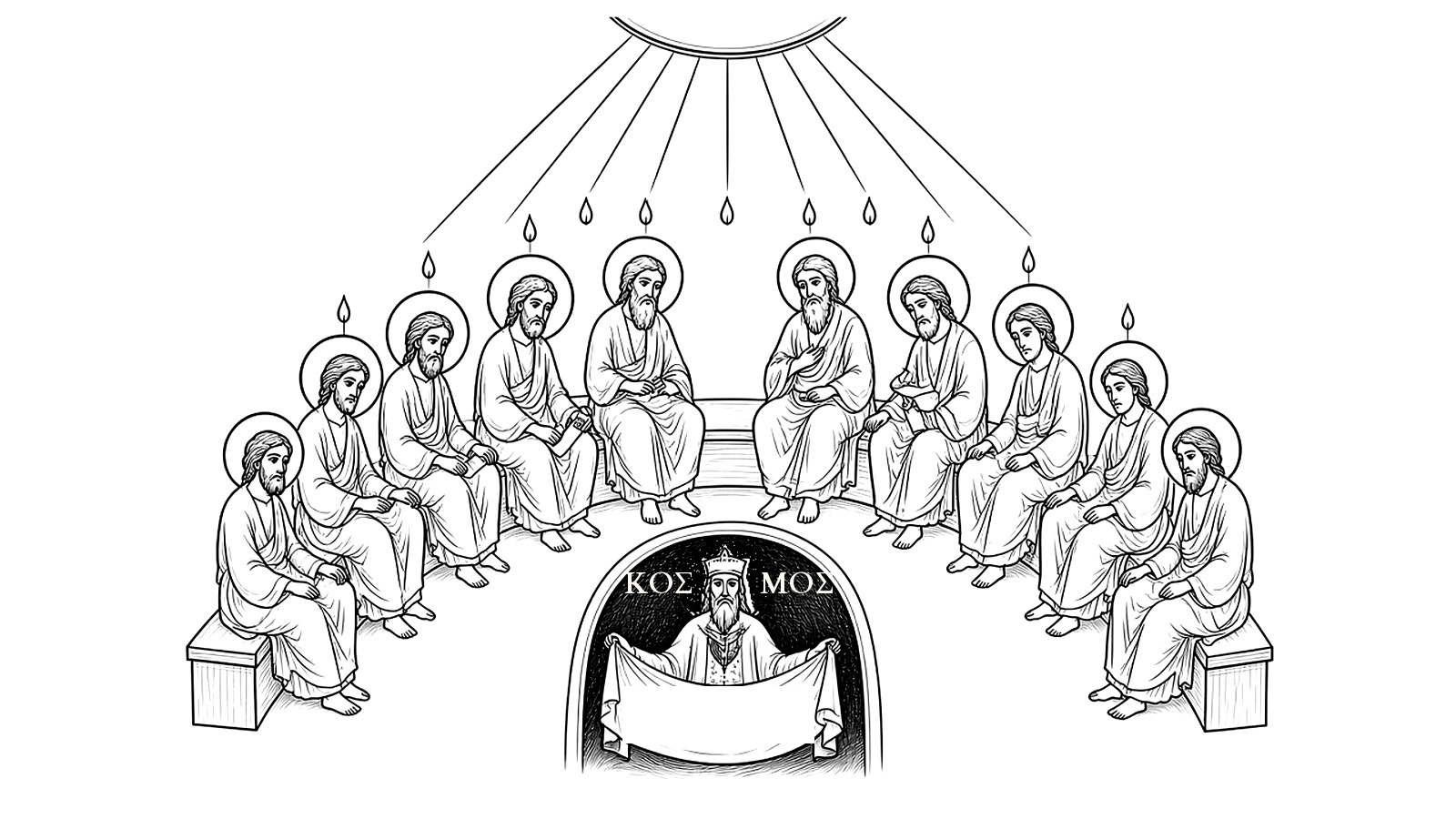
It's nine in the morning in Jerusalem, and the city is packed for a festival. Then comes "a sound from heaven, as of a rushing mighty wind" (Acts 2:2), and a crowd finds a roomful of Galileans speaking in every language in the crowd. "There appeared to them divided tongues, as of fire, and one sat upon each of them. And they were all filled with the Holy Spirit and began to speak with other tongues, as the Spirit gave them utterance" (Acts 2:3-4).
Some are "amazed and perplexed, saying to one another, 'Whatever could this mean?'" Some have already made up their minds: "They are full of new wine" (Acts 2:12-13). So Peter stands up with the other eleven to make the first sermon of the Church, and his opening argument is, essentially, it's too early: "For these are not drunk, as you suppose, since it is only the third hour of the day" (Acts 2:15). Not the alibi I'd have led with. But by the end of the day, the people who received his word have been baptized, "about three thousand souls" (Acts 2:41).3
A preacher finds his hometown on the list
More than three centuries later, Saint Gregory the Theologian preached on that morning in what's now Oration 41:
We are keeping the feast of Pentecost and of the Coming of the Spirit, and the appointed time of the Promise, and the fulfilment of our hope. And how great, how august, is the Mystery.4
If that sounds familiar, you've sung something very close to it. The first hymn at Vespers for the feast begins: "Let us celebrate Pentecost, and the coming of the Spirit, and the appointed day of the promise, and the fulfilment of hope, and the mystery which is as great as it is precious."2 Gregory's sermon and the Church's hymn walk in step.3
Gregory has fun with the drunk charge. The apostles "were reproached for drunkenness, evidently because they by the Spirit wrought a miracle in the matter of the tongues." And when he gets to Luke's list of nations, the tongues spoke to "Parthians, Medes, and Elamites, Egyptians, and Libyans, Cretans too, and Arabians, and Mesopotamians, and my own Cappadocians."4 It's the feeling you get when your little hometown gets mentioned on national television. Cappadocia is right there in Acts 2:9, and the boy from Cappadocia noticed.3
Why it matters
Babel, run backward
At Babel, "there the LORD confused the language of all the earth; and from there the LORD scattered them abroad over the face of all the earth" (Genesis 11:9). At Pentecost the arithmetic runs the other way, which is what the kontakion says.3 Gregory agrees: at Babel "the unity of their intention was broken up," but the new miracle, "being poured from One Spirit upon many men, it brings them again into harmony."4
Notice what God doesn't do. He doesn't make everyone speak Hebrew, or Greek, or Church Slavonic: "everyone heard them speak in his own language" (Acts 2:6). One Spirit, a lot of accents. Which is why an Orthodox parish in America can serve the Liturgy in Greek and English on the same morning and still be one Church.3
Fishermen, and a very big net
Fishers most wise. These were men who smelled like the Sea of Galilee. Another hymn of the feast says that "though unlearned they were made wise."2 Saint John of Damascus, praying before a sermon, asks for the grace of the Spirit, "through whom fishermen became orators, and ignorant men spoke supernatural wisdom."5 Christ had told them, "Follow Me, and I will make you fishers of men" (Matthew 4:19). At Pentecost He handed them a net big enough for the universe.3
The Gospel at the Liturgy tells you what's in the net. Jesus "stood and cried out, saying, 'If anyone thirsts, let him come to Me and drink. He who believes in Me, as the Scripture has said, out of his heart will flow rivers of living water.' But this He spoke concerning the Spirit" (John 7:37-39). Father Georges Florovsky called Pentecost "the day of the mysterious foundation and consecration of the Church," and picked up John's image: "On that day, in a moment, an inexhaustible source of living water and Life Eternal was disclosed here on earth."6
Field Note: branches in church. The old service book mentions a custom you may or may not see in your own parish: "It is customary to decorate churches and houses at this Feast with freshly cut trees and flowers," branches that "typify also the renewal of mankind through the indwelling of the Holy Spirit."2
What you do
Listen at the Liturgy for the hymn that replaces the Trisagion, "Holy God," on this feast: "As many as have been baptized into Christ have put on Christ."2 It's the baptismal hymn. On the day three thousand people were baptized, the Church sings it again, to you.3
If you're Orthodox: stay for Kneeling Vespers. Your knees will notice, and that's part of the point. The week after Pentecost is fast-free, even on Wednesday and Friday, and then the Apostles' Fast begins after the Sunday of All Saints, and the fishermen go to work.3 Fasting has the whole list.
If you're visiting: Pentecost didn't stay in that house in Jerusalem. Everyone baptized and chrismated in the Orthodox Church since has received the same Spirit (Baptism and Chrismation calls Chrismation "your personal Pentecost"). So when you look at the people in the parish this Sunday and wonder what's gotten into them, you're asking the crowd's question, "Whatever could this mean?" And it's still too early in the morning for the answer to be wine.3
Notes
-
First Council of Nicaea, Canon 20, trans. Henry Percival, Nicene and Post-Nicene Fathers, 2nd series, vol. 14, as quoted in "Drunk at Nine in the Morning." ↩
-
Isabel F. Hapgood, Service Book of the Holy Orthodox-Catholic Apostolic Church (1906), pp. xxxiii (Introduction), 246 (Vespers hymns and rubrics), 247 (troparion, kontakion), and 249 (Liturgy; Kneeling Vespers litany), as quoted in "Drunk at Nine in the Morning." ↩↩↩↩↩↩↩↩↩
-
Adapted from a Simply Orthodox article by Jamey Bennett, "Drunk at Nine in the Morning" (not yet published). Scripture quotations are from the New King James Version (NKJV), as in the article. ↩↩↩↩↩↩↩↩↩↩↩
-
Saint Gregory the Theologian, Oration 41 (On Pentecost), §§5, 15-17, trans. Browne and Swallow, Nicene and Post-Nicene Fathers, 2nd series, vol. 7, as quoted in "Drunk at Nine in the Morning." ↩↩↩
-
Saint John of Damascus, Sermon I on the Dormition, trans. Mary H. Allies (1898), as quoted in "Drunk at Nine in the Morning." ↩
-
Georges Florovsky, Collected Works, vol. III, Creation and Redemption, "The Sacrament of Pentecost," p. 189, as quoted in "Drunk at Nine in the Morning." ↩