
What you'll notice
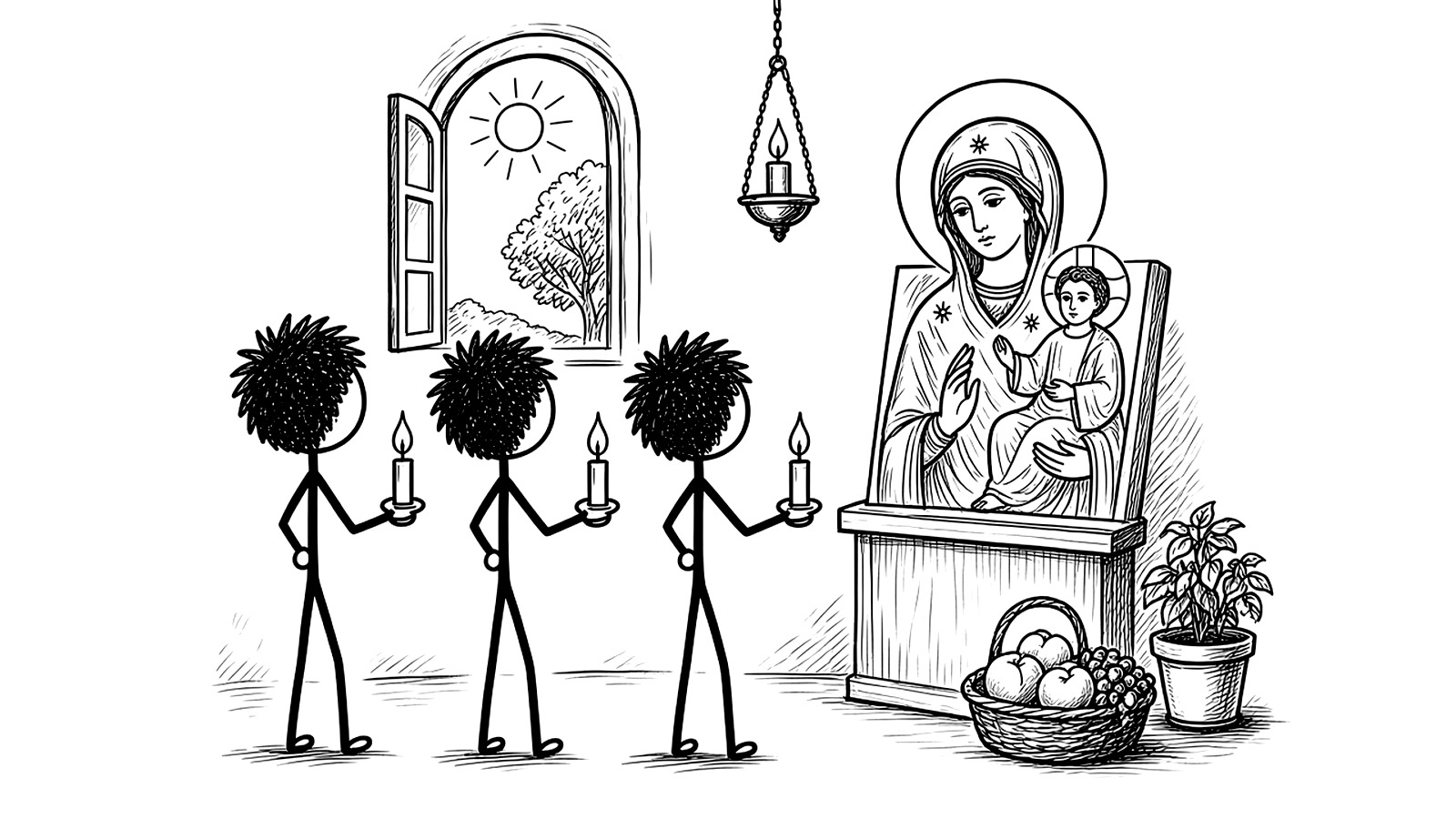
Just when summer feels like it's coasting, the calendar says "fast" again. On August 1 the Orthodox Church begins one of its four fasting seasons, the Dormition Fast.1 Services of supplication to the Theotokos show up on the parish calendar, and in some parishes there's a class tacked onto the end of one.2
What it's called
The Dormition Fast is the two-week fast before the feast of the Dormition, the falling asleep of the Theotokos, Mary the Mother of God.2 It begins on August 1.1 The services you'll meet are the Paraklesis, the "Supplications" to the Theotokos;2 Other Services You'll Meet describes them.
Isabel Hapgood's 1906 service book puts the whole fast in one parenthesis at the top of the feast: "(This Feast is preceded by a Fast of two weeks' duration.)"3 August 1 is also the day the Church carries out the Precious Cross in procession.4 "On the weekdays before the Feast," the Greek Orthodox Archdiocese says, "Paraklesis services are held in most parishes," in two forms, the Small and the Great, both "services of supplication and prayer for the intercessions of the Theotokos."5
What's actually happening
Like every fast, this is a season when the Church calls us to turn our hearts and minds toward God, through prayer, fasting, and repentance, and to line ourselves up with God's will and our duties to Him and our neighbors.1 It's a time for honest introspection: facing our misplaced pride, our dragons, our sins, and casting them out by repentance.1
What's on the table
It's short, but it isn't light. The Archdiocese says: "A strict fast is followed on most of the days (no meat, dairy, oil, or wine), with the exceptions of fish on the Feast of the Transfiguration (August 6) and the day of the Dormition. Oil and Wine are allowed on Saturdays and Sundays."5 Father Peter Chamberas, writing for the Archdiocese, agrees: "olive oil and wine are partaken only on the Saturdays and Sundays."6 So if your Greek friends are suddenly very into grilled fish on August 6, now you know. The Transfiguration lands in the middle of the fast like a cool front.7
Wisdom and repentance
Repentance isn't only a turning away. It's a turning toward something, and during these two weeks the Church points us toward the Wisdom of God.1
Wisdom poured out: reading Sirach
That's why many people spend the fast with the Wisdom of Sirach (also called Ecclesiasticus), a book of the Orthodox Old Testament. At Saint Mark Greek Orthodox Church in Boca Raton, the parish has encouraged its faithful, catechumens, and inquirers to read it during the two-week Dormition Fast.2
Sirach was written by Jesus ben Sirach around 190 BC in Jerusalem and translated into Greek by his grandson around 132 BC in Egypt. It became widely read among Jewish believers and was embraced by the early Church as part of the biblical canon. In fifty-one chapters it mixes theological depth with everyday advice on friendship, humility, the dangers of idolatry, the power of words, and the pursuit of wisdom.1 For some of the early Church Fathers it was a cornerstone of catechesis, used to teach virtue to catechumens preparing for baptism.1 It's the longest book of the so-called Apocrypha, and unusual among them for its prologue and for an author who signs his name (Sirach 50:27).2
Sirach doesn't pretend wisdom comes without effort. In its last chapter it says: "Why do you say you are lacking in these things, and why are your souls very thirsty?... Put your neck under the yoke and let your souls receive instruction; it is to be found close by…. May your soul rejoice in his mercy, and may you not be put to shame when you praise him. Do your work before the appointed time, and in God's time he will give you your reward" (Sirach 51:24, 26, 29-30, RSV).1 Wisdom is free, but it asks for our participation.
The house that Wisdom built
For Orthodox Christians, Wisdom finds its fullest expression in Christ, the incarnate Word, and Christ's mother became Wisdom's human dwelling place.1 The Church honors Mary as the living Ark of God's presence: as the old Ark held the tablets of the Law, her womb held the Word made flesh.1
The hymns say this outright. At the Vespers of the Dormition the Church reads Proverbs 9:1, "Wisdom has built her house."1
The Paraklesis sings to her: "Most holy Theotokos, save us! Do not neglect those who seek the help you grant. They hymn you, O Virgin Maiden, and they do exalt you throughout the many ages."8
Why we keep asking her
From the Cross, Christ gave His mother to the beloved disciple: "Woman, behold your son!" and "Behold your mother!" And "from that hour that disciple took her to his own home" (John 19:26-27). After the Ascension she's in the upper room with the Apostles, and they "all continued with one accord in prayer and supplication" (Acts 1:14). That's the Paraklesis in one verse: the Church gathered with Mary, praying. Father Georges Florovsky calls her "truly the common mother of all living, of the whole Christian race."9 So for two weeks her children bring her their lists. The Small Paraklesis, in the Archdiocese's English, sings:7
The doors of caring do now open unto us, O most blessed Theotokos, So that hoping in you we shall not fail.5
The Gospel about the other Mary
On the feast itself the Gospel joins Luke 10:38-42 to Luke 11:27-28.3 Martha is running the kitchen; Mary of Bethany sits at Jesus' feet. "Martha, Martha, you are worried and troubled about many things. But one thing is needed, and Mary has chosen that good part, which will not be taken away from her" (Luke 10:41-42). Then a woman in the crowd calls out, "Blessed is the womb that bore You, and the breasts which nursed You!" And Jesus answers, "More than that, blessed are those who hear the word of God and keep it!" (Luke 11:27-28). That's no put-down of His mother. She's the one who said, "Let it be to me according to your word" (Luke 1:38), and who "kept all these things and pondered them in her heart" (Luke 2:19). Mary of Bethany chose the good part for an afternoon. The Mother of God chose it for her whole life.7
Field Note: the icon of the feast. The icon shows her on her deathbed with the Apostles gathered around and Christ standing in the center, holding, as the Archdiocese explains, "a small child clothed in white representing the soul of the Virgin Mary."5 When He was born into this world, she held Him. Now He holds her.7 Saint John of Damascus said of all the saints that "the death of saints is more like falling asleep than death," in Father Georges Florovsky's quotation;9 the icon shows what that looks like.
Why it matters
The fast leads to the feast. The Dormition is sometimes called a "second Pascha," a passage from death to life that mirrors Christ's own Resurrection.1 After she fell asleep and was buried, the Church sings, her Son took her to Himself: "You were translated to life, O Mother of Life, and by your prayers, you deliver our souls from death" (Troparion of the Dormition, OCA translation).10 Christ did not abandon His mother, and He will not forsake us either. Christ said it Himself: "Most assuredly, I say to you, he who hears My word and believes in Him who sent Me has everlasting life, and shall not come into judgment, but has passed from death into life" (John 5:24).
The Church keeps the Dormition quietly and reverently, not with the trumpet blast of Pascha, but with the same certainty that Christ will come for us on the last day.1 The kontakion of the feast sings: "Neither the tomb, nor death could hold the Theotokos, who is constant in prayer and our firm hope in her intercessions. For being the Mother of Life, she was translated to life by the One who dwelt in her virginal womb."10
We honor Mary not only because she's Christ's mother, but for her obedience to God's will, for keeping His word in her heart, and for bearing fruit in holiness.1 Mary and the Saints has more on how the Orthodox honor her.
What you do
If you're Orthodox: keep the fast by the rule you've worked out with your priest (Fasting has the range). Go to Paraklesis. Not every night: pick two. If your parish has a sign-up sheet or a basket for names, bring the names of people you love who need help, and let the Church ask the Mother of God for them.7 Pick up Sirach and read along through the two weeks. Wisdom is a living thing that asks for prayer, repentance, obedience, and love.1
If you're visiting: a Paraklesis during the fast is a good first service to try. You'll hear "Most holy Theotokos, save us" many times. Mary and the Saints explains what the Orthodox mean by it.
Notes
-
Jamey Bennett, "The Wisdom of God: From Sirach to the Theotokos," Simply Orthodox, August 1, 2025. ↩↩↩↩↩↩↩↩↩↩↩↩↩↩↩
-
Jamey Bennett, "Dormition Fast & Wisdom of Sirach," Simply Orthodox, August 5, 2024. ↩↩↩↩↩
-
Isabel F. Hapgood, Service Book of the Holy Orthodox-Catholic Apostolic Church (1906), pp. 264-266. ↩↩
-
Orthodox Church in America, daily readings for August 1 (Procession of the Precious Wood of the Cross). ↩
-
Greek Orthodox Archdiocese of America, "The Dormition of the Theotokos" (goarch.org), including the Small Paraklesis in the Archdiocese's translation. ↩↩↩↩
-
Rev. Peter A. Chamberas, "Not by Bread Alone" (Greek Orthodox Archdiocese of America, 2015). ↩
-
Adapted from Jamey Bennett, "Fourteen Evenings with the Mother of God," Simply Orthodox (not yet published). Scripture quotations are from the NKJV. ↩↩↩↩↩
-
Small Paraklesis, Ode 8 (GOARCH translation), as quoted in Bennett, "The Wisdom of God." ↩
-
Georges Florovsky, Collected Works, vol. III, Creation and Redemption, p. 187 ("the common mother") and p. 205 ("On the Veneration of the Saints," quoting Saint John of Damascus). ↩↩
-
Troparion of the Dormition (Tone 1) and Kontakion of the Dormition (Tone 2), Orthodox Church in America translation (oca.org, Troparia and Kontakia for August 15, as archived July 17, 2019). OCA's current site gives a revised wording. ↩↩