
What you'll notice
Grapes. After the Liturgy on August 6 the priest blesses "this new fruit of the vine," and you take them home.1 Blessings explains the custom.
And the hymns keep talking about light. At the Lity of the Vigil, the Church sings to the One "who didst illumine the whole universe with thy light," not just three men on a hilltop. The Communion hymn is the walking-down song: "O Lord, in the light of thy countenance will we walk, and in thy Name will we rejoice forevermore."1
What it's called
The Transfiguration is kept on August 6, one of the twelve Great Feasts, and its afterfeast runs to the leave-taking on August 13.2 The Church has long named the mountain Tabor, and the prokeimenon before the Gospel at Matins sings, "Tabor and Hermon shall rejoice in thy Name."1
The troparion, in Isabel Hapgood's 1906 English:
Thou wast transfigured upon the Mount, O Christ-God, revealing unto thy disciples thy glory in so far as they were able to bear it. Let thy light everlasting illumine us sinners also; through the prayers of the Birth-giver of God. O Light-giver, glory to thee!1
God doesn't overload His people. He gives the light we can bear and then asks for that same light to keep shining on "us sinners also." That's a prayer for people with ordinary eyes.2
What's actually happening
Up top
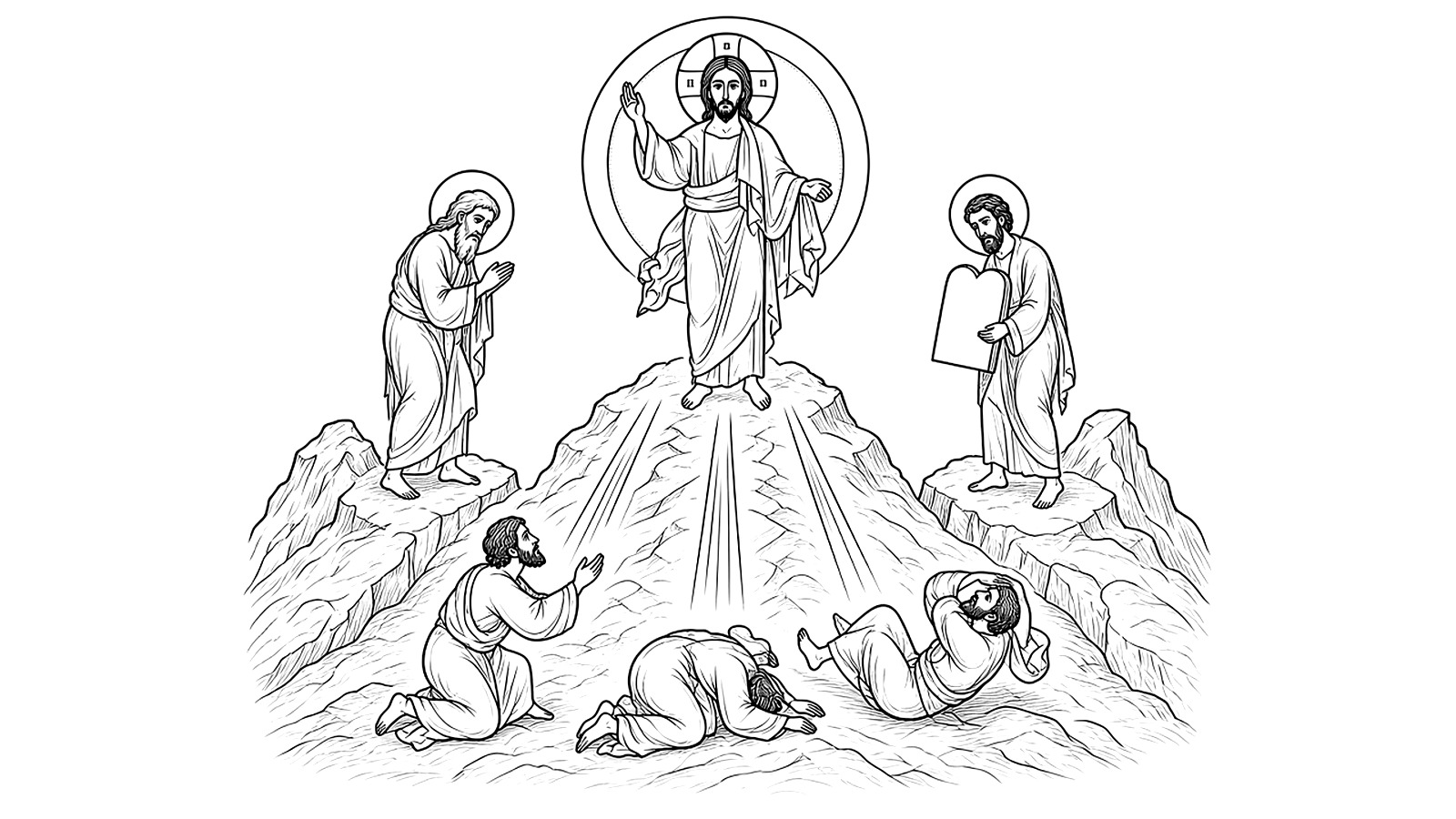
Jesus "took Peter, James, and John his brother, led them up on a high mountain by themselves" (Matthew 17:1). He "was transfigured before them. His face shone like the sun, and His clothes became as white as the light" (Matthew 17:2). Moses and Elijah appear and talk with Him. Then a bright cloud comes down, and the Father speaks: "This is My beloved Son, in whom I am well pleased. Hear Him!" (Matthew 17:5).
Why "Hear Him" in particular? One chapter earlier, when Jesus said He would suffer and be killed in Jerusalem, Peter "took Him aside and began to rebuke Him, saying, 'Far be it from You, Lord; this shall not happen to You!'" (Matthew 16:22).2 Saint John Chrysostom connects the dots: "Hear ye Him. So that although He choose to be crucified, you are not to oppose Him." He also notices the kind of cloud. Sinai's was dark and smoky, but here, "because it was His desire not to alarm, but to teach, it is a bright cloud."3
The kontakion says Christ was transfigured so that His disciples, "when they should see thee crucified they might comprehend that thy suffering was voluntary, and proclaim it unto the world."1 Father Georges Florovsky: "salvation is completed on Golgotha, not on Tabor."4 Tabor is the preview. Golgotha is the work.2
Down below
Every heist movie has the guys who stay in the van. On the day of the Transfiguration, nine of the twelve apostles were in the van.2 While the three were seeing glory, a father brought the nine his son, a boy who kept falling "into the fire and often into the water" (Matthew 17:15). Nothing happened. By the time Jesus came back down there was "a great multitude around them, and scribes disputing with them" (Mark 9:14). The father's report is short and brutal: "So I brought him to Your disciples, but they could not cure him" (Matthew 17:16).
Jesus heals the boy "from that very hour" (Matthew 17:18). Mark keeps one more detail: "immediately the father of the child cried out and said with tears, 'Lord, I believe; help my unbelief!'" (Mark 9:24). About as unpolished as prayers get, and it was enough.2
Afterward the nine come to Him privately: "Why could we not cast it out?" First, "Because of your unbelief," and then the line every Orthodox Christian should know by heart: "this kind does not go out except by prayer and fasting" (Matthew 17:19-21). Chrysostom is gentle with them: "even the disciples were weak; but not all; for the pillars were not present there."3
Why it matters
Because the Church keeps the Transfiguration on August 6, right in the middle of the Dormition Fast. Every year we celebrate the mountaintop while we're down at the bottom, praying and fasting. The calendar puts us with the nine.2
And the light wasn't only for the three who climbed. Jesus promised that "the righteous will shine forth as the sun in the kingdom of their Father" (Matthew 13:43). Florovsky quotes Saint Macarius of Egypt: "As the body of the Lord, when he ascended the mountain, was glorified and transformed into God's glory and endless light, so, too, the bodies of the saints are glorified and become shining." And: "As many lamps are lit by one fire."5
The feast's Epistle, from Saint Peter, who was there, tells us to hold onto the prophetic word "as a light that shines in a dark place, until the day dawns and the morning star rises in your hearts" (2 Peter 1:19). A dark place is where we live most days, with somebody's suffering kid in front of us and a crowd of critics nearby. The light of Tabor is meant to come down the mountain with us.2
Field Note: the light of Tabor. If you want the theology of that light, Saint Gregory Palamas Sunday picks up where this page leaves off.
What you do
If you're Orthodox: go to the Liturgy on August 6. Since it falls during the Dormition Fast, the fast is relaxed for the feast: fish, wine and oil are allowed. Bring grapes. Then keep the fast for the rest of those two weeks, and don't be embarrassed by it. (Your coworkers will assume it's a diet. Let them.)2 Fasting and the Calendar of Feasts have the details.
If you're visiting: bring grapes too. Prayer and fasting is the answer Jesus gave the nine when they asked why they had failed, and the whole Church does it together, the climbers and the van crew.2
Most of us will spend most of our lives at the bottom of the mountain. The good news of this feast is that Christ came down too.2
Notes
-
Isabel F. Hapgood, Service Book of the Holy Orthodox-Catholic Apostolic Church (1906), pp. 260 (troparion, kontakion, Lity hymn, Matins prokeimenon) and 262 (Communion hymn; blessing of grapes), as quoted in "Meanwhile, at the Bottom of the Mountain." ↩↩↩↩↩
-
Adapted from a Simply Orthodox article by Jamey Bennett, "Meanwhile, at the Bottom of the Mountain" (not yet published). Scripture quotations are from the New King James Version (NKJV), as in the article. ↩↩↩↩↩↩↩↩↩↩↩
-
Saint John Chrysostom, Homilies 56 (§5) and 57 (§3) on Matthew, trans. George Prevost, rev. M. B. Riddle, Nicene and Post-Nicene Fathers, 1st series, vol. 10, as quoted in "Meanwhile, at the Bottom of the Mountain." ↩↩
-
Georges Florovsky, Collected Works, vol. III, Creation and Redemption, "Redemption," p. 99, as quoted in "Meanwhile, at the Bottom of the Mountain." ↩
-
Florovsky, Collected Works, vol. X, The Byzantine Ascetic and Spiritual Fathers, p. 168 (quoting the Homilies of Saint Macarius), as quoted in "Meanwhile, at the Bottom of the Mountain." ↩