
What you'll notice
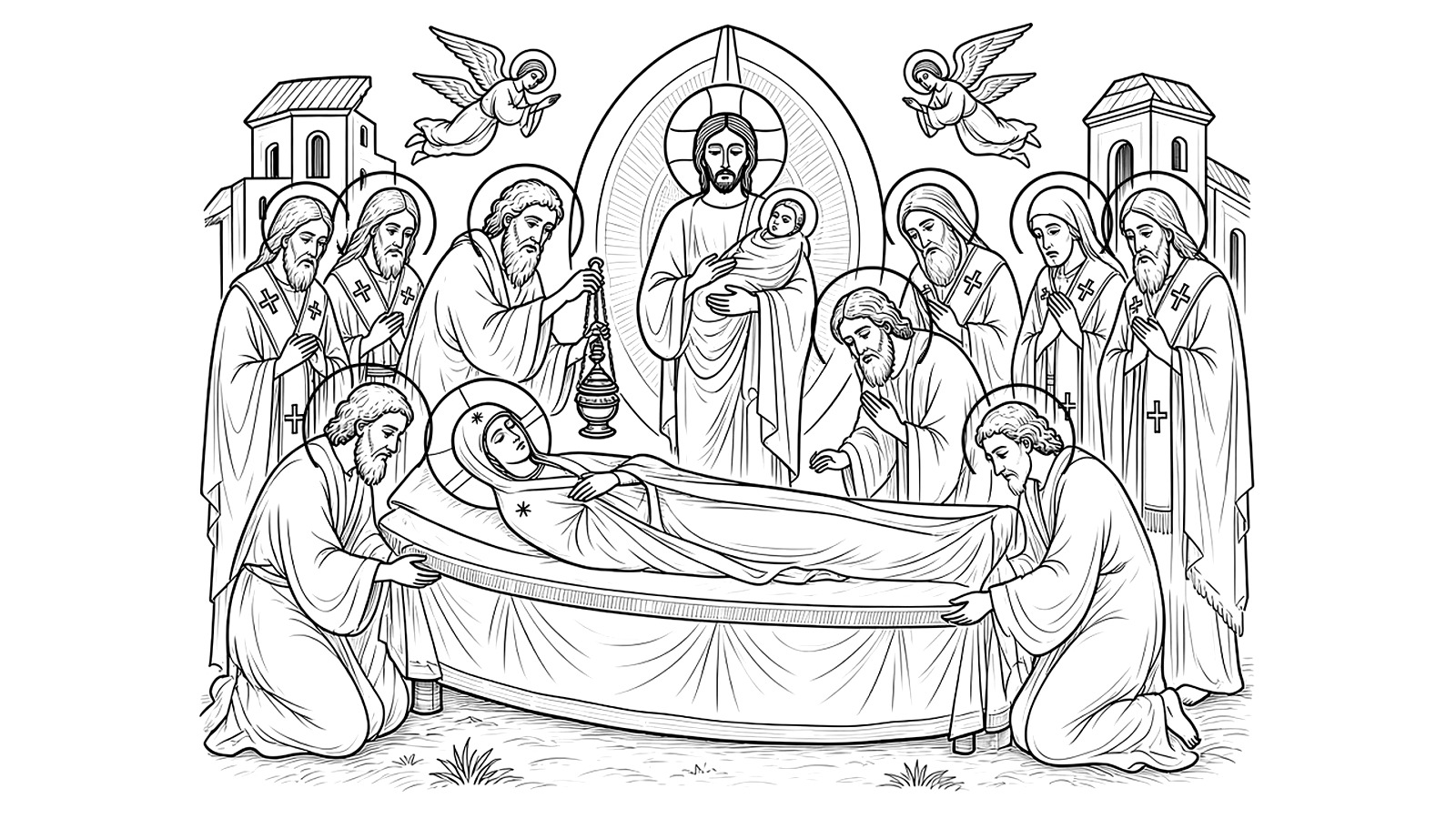
Every family has the scene at the end of the hospital hallway. One group of relatives is standing around the bed saying, "Stay with us." And somewhere, if you believe what Christians believe, another group is waiting on the other side saying, "Come home."1
Saint John of Damascus, preaching on this feast in the eighth century, puts both groups in the same room. He imagines the bedside of the Mother of God crowded with apostles, prophets and angels, all praising her at once. (It was, he assures us, "not as if each was seeking to outdo the other—for this is vainglorious and far from pleasing to God." Anyone who has sat through a parish council meeting will find that reassuring.) Then the oldest people in the human family speak up: "Then Adam and Eve, our first parents, opened their lips to exclaim, 'Thou blessed daughter of ours, who hast removed the penalty of our disobedience!'" And the saints still on earth answer from the other side: "Remain with us, our comfort, our sole joy in this world. O Mother leave us not orphans."2
By the end of the feast, the Church will tell you both sides won.1
What it's called
The Greek name for the feast, Koimesis, means "falling asleep," and Dormition is the Latin-rooted English for the same thing. Older English books often say "Assumption." Isabel Hapgood's 1906 service book heads the feast "The Falling-asleep (Assumption)," and the 1898 English translation of Saint John's sermons is titled Three Sermons on the Assumption. Both names point to one mystery.1 Mary and the Saints calls the Dormition "the Church's received liturgical confession of Mary's death and her resurrection and glorification, body and soul, by her Son."
It's kept on August 15, the last Great Feast of the Church's year,3 after the two-week Dormition Fast. The afterfeast runs through the leave-taking on August 23.1
The troparion answers the saints who begged her to stay: "In falling asleep you did not forsake the world, O Theotokos." It ends by telling her, "by your prayers, you deliver our souls from death."4
What's actually happening
Where the story comes from
The New Testament doesn't tell us how the Theotokos died. The last time Scripture names her, the apostles are praying in the upper room "with the women and Mary the mother of Jesus" (Acts 1:14). What the Church knows about her falling-asleep comes through Tradition, and we meet it mostly in the hymns of the feast and the sermons of the Fathers. Saint John's three sermons for the feast are some of the oldest and best.1
Father Georges Florovsky says the Church is deliberately quiet here: "The Church does not dogmatize much about these mysteries of her own existence." She "speaks of her rather in the language of devotional poetry," he writes, "in the language of antinomical metaphors and images."5 So that's where to look: the poetry.1
A real death, and a going home
Here's the line from Saint John's first sermon:
Therefore I will not call thy sacred transformation death, but rest or going home, and it is more truly a going home.2
That's how both sides of the bedside get what they asked for. Adam and Eve get her. And she went home without leaving us orphans.1 The saints in the sermon had one more request: "May we have thee as a refuge and refreshment in our labours and weariness."2 That's still the Church's prayer. Every time an Orthodox Christian asks the Mother of God for her prayers, we're standing at that bedside, asking her not to forget us.1
Saint John sounds almost giddy about it: "O wonder surpassing nature and creating wonder! Death, which of old was feared and hated, is a matter of praise and blessing." But he never pretends she didn't die. "She dies according to the flesh," he says. "Thy blessed soul is naturally parted from thy blissful and undefiled body, and the body is delivered to the grave, yet it does not endure in death, nor is it the prey of corruption." Her body was laid in the tomb, and her Son took her to Himself: "The body of her, whose virginity remained unspotted in child-birth, was preserved in its incorruption, and was taken to a better, diviner place, where death is not, but eternal life."2 The troparion says it in one line: "You were translated to life, O Mother of Life."4 At Matins the Church sings that "the all-holy Angels beheld thine Assumption" and "marvelled how a Virgin should ascend from earth into heaven."6 Even the angels didn't see that coming.1
The living ladder
The first Vespers reading is the same one the Church reads on the eve of Mary's Nativity: Jacob asleep on a stone, dreaming that "a ladder was set up on the earth, and its top reached to heaven; and there the angels of God were ascending and descending on it" (Genesis 28:12). The Church reads it at the beginning of her life and again at the end.1
Saint John calls her "the living ladder, through whom the Most High descended and was seen on earth, and conversed with men." In the second sermon, Adam and Eve say it to her face: "Thou art the gate of life and the ladder to heaven."2 God came down to us by way of her. On the Dormition the ladder goes the other direction.1
Why it matters
Because what happens to her is what's promised to us.1 Saint Paul says Christ "has become the firstfruits of those who have fallen asleep" (1 Corinthians 15:20). The Church still calls her departed "those who have fallen asleep" (After Death explains why). Jesus told His disciples, "I go to prepare a place for you. And if I go and prepare a place for you, I will come again and receive you to Myself" (John 14:2-3). The Dormition is that promise kept, first, for His mother.1
The Epistle at the Liturgy is the great hymn in Philippians 2. Christ "humbled Himself and became obedient to the point of death, even the death of the cross. Therefore God also has highly exalted Him" (Philippians 2:8-9). The Mother follows the Son down, and the Son brings the Mother up. Florovsky can say that "the mystery of Mary is precisely the mystery of the Church" because where she has gone, the Church is going.5
Field Note: the hymn in place of "It Is Truly Meet." At the Liturgy, in place of the usual hymn to the Theotokos, the Church sings: "The laws of Nature were conquered in thee, O Virgin pure; for in birth-giving was virginity preserved, and with death is life conjoined. Thou who, after birth-giving, a Virgin didst remain, though dead, art yet alive, O Birth-giver of God, and savest always thine inheritance."6 Though dead, yet alive. If that's true of her, it can be true of everyone who belongs to her Son.1
What you do
If you're Orthodox: start two weeks early. Hapgood's service book opens the feast with a one-line rubric, "This Feast is preceded by a Fast of two weeks' duration," and the Church means it. Keep the Dormition Fast, August 1 to 14 (Fasting has the rules; The Dormition Fast has the season). Then come to the feast, and stay with it: the Church keeps singing about this homecoming until the leave-taking on August 23.1
If you're visiting: listen for "The laws of Nature were conquered in thee" where you'd normally hear "It Is Truly Meet."
And the next time you're standing in that hospital hallway, or at a graveside, remember who's on the other side of the door. Adam and Eve were waiting for their daughter. The Son who received His mother has promised to receive us, too. Saint John said it first: it is more truly a going home.1
Notes
-
Adapted from a Simply Orthodox article by Jamey Bennett, "More Truly a Going Home" (not yet published). Scripture quotations are from the New King James Version (NKJV), as in the article. ↩↩↩↩↩↩↩↩↩↩↩↩↩↩↩↩
-
Saint John of Damascus, Sermons I, II and III on the Dormition, trans. Mary H. Allies, St. John Damascene on Holy Images, followed by Three Sermons on the Assumption (1898), as quoted in "More Truly a Going Home." "She dies according to the flesh" and "Thy blessed soul is naturally parted…" are from Sermon I. ↩↩↩↩↩
-
The Church year begins September 1, so the Nativity of the Theotokos comes first and the Dormition last: Jamey Bennett, "A Sparrow's Nest and a Baby Girl," a Simply Orthodox article (not yet published). ↩
-
Troparion of the Dormition, Tone 1, Orthodox Church in America translation (oca.org, Troparia and Kontakia for August 15, as archived July 17, 2019), the same text quoted on The Dormition Fast. OCA's current site gives a revised wording ("You passed into life as the Mother of Life"). ↩↩
-
Georges Florovsky, Collected Works, vol. III, Creation and Redemption, "The Ever-Virgin Mother of God," pp. 183 and 187, as quoted in "More Truly a Going Home." ↩↩
-
Isabel F. Hapgood, Service Book of the Holy Orthodox-Catholic Apostolic Church (1906), pp. 264-266 (heading and rubric; Ode IX and its refrain, sung "in place of: Meet is it"), as quoted in "More Truly a Going Home." ↩↩