
What you'll notice
Right around the time the Cheesefare Sunday Gospel is read, a low-grade panic sets in. You can see it in people's eyes at coffee hour. Everyone is mentally scanning their pantry, wondering if there's enough almond milk to survive the dairy-free winter, or whether a Costco run to hoard shrimp is in order.1
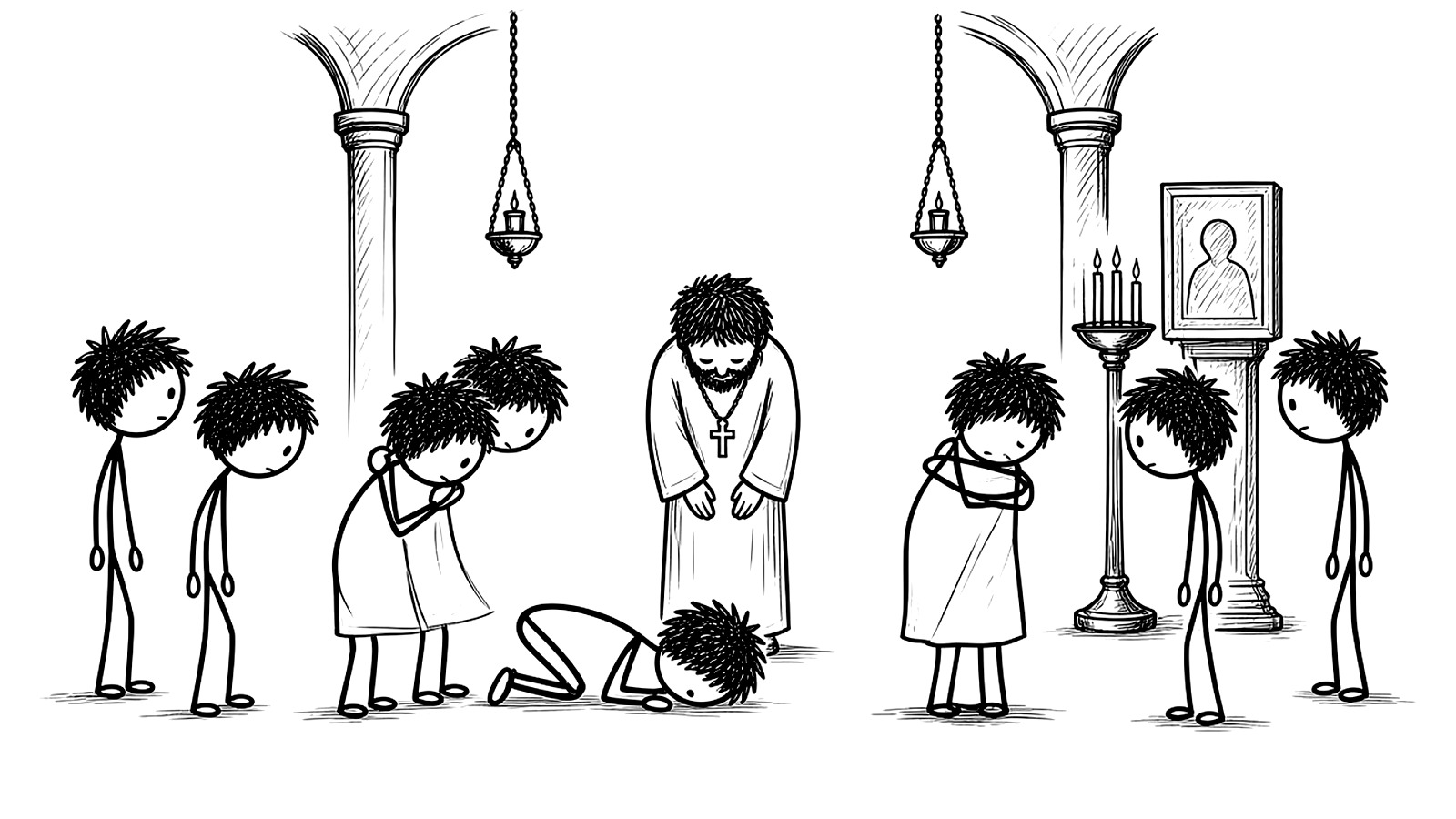
Then something stranger happens. People start asking each other for forgiveness, sometimes literally every person in the parish who came that day.1 It's beautiful. If you're socially anxious, or holding a particularly cozy grudge, it can also be terrifying.
What it's called
Forgiveness Sunday opens Great Lent. At Forgiveness Vespers that evening the faithful ask one another's forgiveness, and the fast begins the next day, Clean Monday.2 It's the last of the four pre-Lenten Sundays, the one also called Cheesefare (Great Lent has all four). The Gospel is Matthew 6:14-21.1 Isabel Hapgood's 1906 service book gives the custom in one line: "It is customary on this day to ask and accord mutual forgiveness, and to effect mutual reconciliation."3
What's actually happening
We tend to treat Great Lent like an obstacle course, forty days of trying to reach the finish line without accidentally eating a cheeseburger or strangling a coworker. Father Mark Leondis, preaching at Saint Mark Greek Orthodox Church in Boca Raton, offered a saner picture: a pilgrimage. "Think of yourself as a pilgrim stepping onto holy ground," he said. "Lent is not merely a date on the church calendar. It is an invitation. It is a refocusing of the whole person."4 Heart, mind, body, and soul.
A pilgrim doesn't need a survival kit. A pilgrim needs a map, and the day's Gospel gives one with three coordinates: forgiveness, fasting, and treasure.1
Forgiveness: check your baggage
This one comes first, and it's the heaviest lift. You can't walk a long road dragging a steamer trunk of resentment. Father Mark put it bluntly: "Before we fast from food, we must fast from resentment. Before we abstain from meat and dairy, we must abstain from bitterness and pride."4
It's much easier to give up a hamburger than to give up the right to be angry at your brother-in-law for his political posts. But Christ is clear: if you forgive people their trespasses, your heavenly Father will forgive you too (Matthew 6:14). Father Mark calls forgiveness "the doorway into the Kingdom of God."4 Start the road carrying anger, and you won't make it to the empty tomb. You'll just be hungry and angry, which is a terrible combination for spiritual growth.1
Saint John Chrysostom made the same point to a city that badly needed a pardon. In Lent of 387, Antioch was waiting to hear whether the emperor would punish it for a riot, and people were saying he might forgive the city out of respect for Pascha. Chrysostom turned the rumor on them: "those same favours which we think to obtain from the Emperor on account of the feast, let us ourselves enable others to enjoy." And he held the Lord's Prayer up like a contract they'd already signed: "For when you say, Forgive us, as we forgive, and afterwards dost not forgive, you are supplicating of God nothing else than that He would entirely deprive you of all excuse or indulgence."5 You can't ask the King for a pardon while you're still holding somebody else's.6
Fasting: don't out-monk the monks
Jesus says "when you fast," not "if you fast." "Fasting is assumed," Father Mark notes. "It is normal. It is expected."4 For the early Christians, and for the Orthodox today, fasting isn't a mark of being a spiritual Navy SEAL. It's just what Christians do.1
But it isn't supposed to be theatrical. Nobody should be sighing loudly about the lack of cheese, hoping someone at the office asks about their piety. "Lent is not about appearing spiritual," Father Mark said. "It is about becoming spiritual."4 Fasting is a tool, not performance art. If yours makes you proud, or you catch yourself side-eyeing someone else's plate, keep your eyes on your own plate, and your own heart.1 Fasting covers the rules themselves.
Treasure: the hunt
"Where your treasure is, there your heart will be also" (Matthew 6:21). Lent is designed to make us a little uncomfortable, because it shows what we actually love. Take away the comfort food, the extra entertainment, and the distractions, and what do you miss? Prayer, or scrolling? "Do we treasure comfort? Do we treasure control, convenience, or do we treasure Christ?" Father Mark asks.4
That's the season of metanoia, a Greek word we translate "repentance" that literally means a change of mind, a turning around. It's checking the compass and getting back on course toward the Father.1
Why it matters
Because Lent is a group trip. One of the most dangerous myths about the spiritual life is that it's a solo sport, just you and Jesus white-knuckling your way to holiness. Orthodoxy fasts together, prays together, and struggles together.1 "The enemy wants isolation," Father Mark warns. "The Church offers communion."4
There's real comfort in standing in a dark church at a Presanctified Liturgy, hungrier than you'd like, and realizing everyone else is in the same boat. "When you wake up and choose prayer instead of scrolling, someone else in the parish is doing the same," Father Mark says. "When you choose forgiveness instead of resentment, grace not only flows into your heart, but into the life of the community."4 When you stumble, and you will, there's a whole line of pilgrims beside you to help you up.1
And because the goal isn't self-improvement. If you want to lose weight or be more mindful, there are apps for that. The goal is a prepared you, not a better you.1 "Every year," Father Mark says, "we rehearse what it means to stand before the empty tomb."4 We're packing for the Kingdom, and it turns out we can't bring the resentment or the pride. Drift through the forty days eating shrimp and keeping grudges, and we'll arrive at Pascha the same people, only slightly more irritable. Use the tools, and, in Father Mark's words, "We will arrive at Pascha lighter, clearer, softer, and stronger in our faith."4
What you do
If you're Orthodox: go to the service on Forgiveness Sunday and stay for the forgiveness. Ask, and grant it, even to the people you'd rather skip. Then work the map: forgive, fast, and find your treasure. Simple, though not easy.1
If you're visiting: you may be asked for forgiveness by people you've never met. Nobody is accusing you of anything. It's the parish starting Lent together, and you won't be the only one who feels awkward.
Field Note: Father Mark's last word. "Let us refocus. Let us return. Let us prepare."4 The pilgrimage has begun.
Notes
-
Jamey Bennett, "Packing for Pascha: What to Carry, What to Drop, & Why the Hardest Part of Lent Isn't the Burger," Simply Orthodox, February 27, 2026. ↩↩↩↩↩↩↩↩↩↩↩↩
-
St. Michael Antiochian Church, "What is Cheesefare Week?"; OrthodoxWiki, "Cheesefare Week." ↩
-
Isabel F. Hapgood, Service Book of the Holy Orthodox-Catholic Apostolic Church (1906), p. xv. ↩
-
Father Mark Leondis, sermon at Saint Mark Greek Orthodox Church, Boca Raton, Florida (February 2026), as quoted in Bennett, "Packing for Pascha." ↩↩↩↩↩↩↩↩↩↩↩
-
Saint John Chrysostom, Homilies on the Statues, Homily 20, trans. W. R. W. Stephens, Nicene and Post-Nicene Fathers, 1st series, vol. 9; the setting is from Philip Schaff's prolegomena in the same volume. ↩
-
Adapted from Jamey Bennett, "The Lent That Saved Antioch," Simply Orthodox (not yet published). ↩