
What you'll notice
Sometime in late winter the conversation at coffee hour changes. People toss around words like Triodion and Presanctified as if everyone was born knowing them. Somebody jokingly calls Lent "Byzantine CrossFit." Somebody else mentions giving up oil and alcohol, then clarifies, "No, not that oil and not that alcohol," and you start wondering if you need a degree to buy groceries.1
Then the church itself shifts gears. There are more services, the music turns more penitential, and the whole parish seems to be walking in the same direction at once.1
What it's called
Great Lent is the season before Holy Week and Pascha. In plain terms it's a focused, intensive time the Church sets aside every year for repentance, prayer, fasting, and almsgiving, to get ready for the great celebration of Holy Week and Pascha.1
The Triodion is the liturgical book the Church uses from the first pre-Lenten Sunday all the way through Holy Week. Think of it as the Church's Lenten playlist, curated over centuries. When someone says "We've entered the Triodion," it sounds like a pilot announcing you're over Kansas, but it just means the countdown has started.1
A few more words you'll hear: Meatfare and Cheesefare (the last two Sundays before Lent: Meatfare Sunday is the last day for meat, and Cheesefare Sunday, also called Forgiveness Sunday, is the last day for dairy)2, Clean Monday (the first day of Lent), and Presanctified (the weekday Communion service).
Notice that Lent starts on a Monday. Isabel Hapgood, translating the service book in 1906, put it bluntly: "The Great Fast (Lent) begins on Monday; not, as in the Western Church, on Ash Wednesday. (There is no Ash Wednesday.)"3 I came from the other side of that line. More than twenty years ago, in the PCA, I attended an "Ash" Wednesday service with no ashes and a sermon warning against fasting, because we cannot earn salvation. Afterward I asked the pastor if he really thought our biggest problem was being too disciplined around food.4
What's actually happening
The countdown: four Sundays
Before Lent proper starts, the Church spends four Sundays getting hearts ready, each one striking a different chord.1 Hapgood explains why: "As a chieftain, before the battle, encourages his warriors with wise and timely words, so the Church prepares us in advance for feats of fasting and penitence, and then bids us to the performance of those feats."3
- The Publican and the Pharisee. Two men pray in the Temple. The religious one thanks God he isn't like other people. The tax collector just says, "God, be merciful to me a sinner," and he's the one who goes home right with God. Lent opens here to blow up the idea that this is about spiritual performance. If Lent makes you impressed with yourself, you're doing it wrong.
- The Prodigal Son. A son wastes his inheritance and crawls home rehearsing an apology, and the father runs to meet him and throws a feast before he can finish. Repentance is coming home to the Father who runs to meet you. You can't out-sin His hospitality.
- The Last Judgment (Meatfare). Christ separates the nations by how they treated the hungry, the stranger, the sick, and the prisoner. Fasting without mercy fails the test.
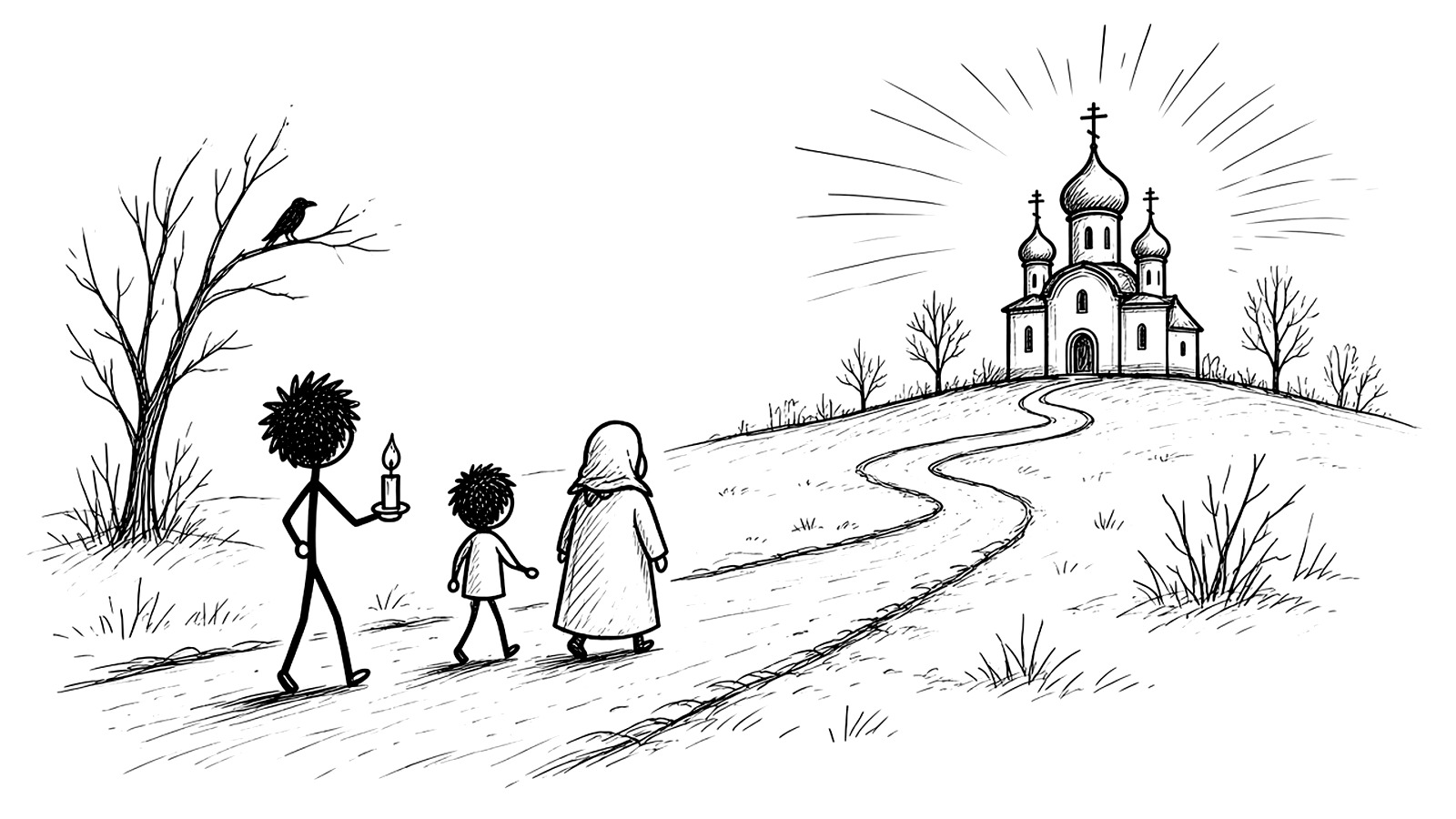
- The Expulsion from Paradise (Cheesefare). Adam and Eve are cast out, and the hymns put words in Adam's mouth as he weeps outside the closed gates. Lent begins with that picture so we know where we're standing: outside Eden, looking in, starting the walk back. We don't walk it alone.1
Greek, Slavic, Antiochian, Romanian, Old Calendar, or New Calendar, the melodies and local customs differ in small ways, but these four Sundays are a shared grammar across the Orthodox world.1 The last of them is Forgiveness Sunday.
Clean Monday
On the first day of Lent the Church reads Isaiah: "Wash yourselves, make yourselves clean; Put away the evil of your doings from before My eyes. Cease to do evil, Learn to do good" (Isaiah 1:16-17). And right after it: "'Come now, and let us reason together,' Says the LORD, 'Though your sins are like scarlet, They shall be as white as snow'" (Isaiah 1:18).5 Father Peter Chamberas, writing for the Greek Orthodox Archdiocese, describes Clean Monday as "a day of spiritual retreat, spending most of the time in prayer and reflection, while food intake is kept to a minimum, consisting of uncooked vegetables, fruit, dry nuts, bread, water and fruit juices." The rest of that first week "excludes even the use of olive oil and wine," and Saturdays and Sundays "are never to be strict fasting days, except for Holy Saturday."6
The forty days
Great Lent proper runs from Clean Monday through the Friday before Lazarus Saturday. The number forty echoes Israel's forty years in the wilderness and Christ's forty-day fast. The tone is sober but not despairing, more like focused training. Each Sunday of Lent has its own theme too.1 Calendar details vary, especially between Old and New Calendar jurisdictions, but the basic structure is common.1
Along the way you'll meet:
- The Great Canon of Saint Andrew of Crete, in the first week and again in full later on. It's a long poem that walks through Scripture, putting you in the shoes of people who repented and people who refused. You say "I have become like…" this or that figure. The Church won't let you keep your sins at arm's length, but it's always in conversation with God's mercy.1
- The Liturgy of the Presanctified Gifts, traditionally on Wednesdays and Fridays. The Eucharist is consecrated on Sunday and reserved, so the faithful can receive Communion in the middle of the fasting week. It feels different: more prostrations, more psalms, a sense of pilgrims at dusk stopping at a roadside spring. Lent isn't starvation; it's a different kind of food.1 Other Services You'll Meet has the service.
- The Akathist Hymn to the Theotokos, on Fridays in many parishes, especially Greek and Arab ones: a long, joyful poem of praise to the Mother of God in the middle of all the penitence. Even in Lent, joy keeps breaking through the floorboards.1
The finish: Lazarus, Palm Sunday, Holy Week
At the end of the forty days comes Lazarus Saturday, when Christ calls His friend out of the tomb, and then Palm Sunday, when we follow Christ into Jerusalem with palms and branches. He comes as the King who conquers by being slain.1 Many parishes serve Holy Unction for everyone, most commonly on Holy Wednesday evening, and every Orthodox Christian present is anointed, not only those who look sick.1 Then Holy Week, the Bridegroom services, the Cross, the tomb, and Pascha night. Holy Week and Pascha walks through it day by day.
Field Note: forty days or seventy? People say "forty days," but the whole road to Pascha is closer to seventy. About three weeks of pre-Lenten warm-up come first. The week after the Publican and Pharisee is fast-free, with no fasting even on Wednesday or Friday, as a reminder that we're not saved by our own effort. Normal Wednesday and Friday fasting comes back the week of the Prodigal Son. Meatfare Sunday says goodbye to meat, and the week after it, Cheesefare Week, keeps dairy all week to ease in.2 Then come the forty days, from Clean Monday to the Friday of the sixth week, and unlike in the West, the Orthodox count the Sundays. Lazarus Saturday and Palm Sunday make a bridge (on Palm Sunday fish, wine, and oil are typically allowed), and Holy Week follows as its own, stricter fast.7
Why it matters
Three things are hiding inside that one-line definition.1
- Lent is ecclesial. It isn't a private affair or a personal spiritual challenge. The whole Church does it together: parishes, monasteries, catechumens, longtime faithful, all carried along by the same current. Think of it as a training ground.
- Lent is baptismal. In the ancient Church this season was tied to people preparing for baptism. The catechumens were being exorcised, instructed, and examined, and the faithful fasted and prayed with them and for them. You can still hear it in the prayers and hymns. If you're preparing for baptism or chrismation this year, you're not a side project. You're part of the reason the season exists.
- Lent is Paschal. The fasting and prostrations aren't there to prove we can suffer. They're there so we can walk with Christ into His death and Resurrection.
If you remember nothing else, remember this: Great Lent is the Church walking you somberly into the tomb and out again in victory.1 It's the Church's yearly catechumenate. Even if you were baptized as a baby and don't remember it, the Church brings you back to the water every year.1
Father Alexander Schmemann, in Great Lent: Journey to Pascha, names where it's all going:
As we make the first step into the ‘bright sadness’ of Lent, we see—far, far away—the destination. It is the joy of Easter, it is the entrance into the glory of the Kingdom. And it is this vision, the foretaste of Easter, that makes Lent’s sadness bright and our lenten effort a ‘spiritual spring.’ The night may be dark and long, but all along the way a mysterious and radiant dawn seems to shine on the horizon.8
That's also why the food isn't the point. Saint Basil the Great: "You do not eat meat, but you devour your brother. You abstain from wine, but do not restrain yourself from insulting others."9 And Saint John Chrysostom: "For what does it profit if we abstain from birds and fishes; and yet bite and devour our brethren?"10 Father Georges Florovsky, summing up Saint Gregory of Nyssa, puts it positively: "The true goal of continence and fasting is not to overcome the body but to turn it to the service of the soul."11
Field Note: the Lent that saved Antioch. In 387, a few days before Lent, a crowd in Antioch rioted over a new tax and dragged the statues of the Emperor Theodosius and his late wife through the streets. The emperor, the old editors write, "was so exasperated, as even to think of destroying the city entirely."12 Bishop Flavian set out for Constantinople to beg for mercy, and the city kept Lent not knowing the answer. Its preacher, John Chrysostom, began: "What shall I say, or what shall I speak of? The present season is one for tears, and not for words." Then he preached all through Lent anyway: the twenty-one Homilies on the Statues. Lent didn't get cancelled because of the crisis; it was the answer to it. "We have this fast too as an ally, and as an assistant in this good intercession," he told them, and he called the fast "a kind of spiritual summer," the season when soldiers burnish their weapons and farmers sharpen their sickles.13 Flavian made it back before Pascha, and on Easter Chrysostom stood up and said: "Blessed be God, Who has granted us this day to celebrate this holy Feast with much joy and gladness; and has restored the head to the body, the shepherd to the sheep."13
What you do
A blog post isn't spiritual direction, and neither is a field guide. Think of your priest as your spiritual trainer: he knows your health, your job, your family, and your temptations, and any concrete rule for Lent (what you eat, how you pray, how often you go to confession) belongs in that relationship.1 The Greek Archdiocese's guide says the same: the Church "allows for certain personal exceptions to be made for the very old, the very young, the sick, the nursing mothers and other people in extraordinary circumstances or with special needs," made "with discretion and appropriate guidance by the parish priest."6 What you can bring him is questions.
If you're Orthodox:
- Fasting. Instead of asking "How hardcore do I have to go?" ask what keeps you enslaved to your appetites, where you can practice simplicity, and how fasting can free up time, money, and attention for prayer and mercy. Then let your priest set the dose. Fasting isn't a dare; it's medicine.1 The rules themselves are in Fasting: The Rules, the Range, and the Point.
- Services. Treat Sunday Liturgy as non-negotiable. Add one Lenten service a week if you can, often a Presanctified. Start or strengthen a short daily prayer rule. Better a small, honest rule you keep than an imaginary monastic schedule you abandon eight days in.1
- Almsgiving. Redirect some of what simpler eating saves toward real charity. Ask whether there's someone you've been avoiding who needs your time or your forgiveness.1
- Confession. Lent is the main season many Orthodox Christians go. It isn't guilt management. It's naming where we keep siding with the old Adam, receiving forgiveness, and learning to live more truthfully. Go at the pace obedience and honesty require, not the pace your religious ego demands.1
If you're visiting: Lent is a good time to come. Try a Presanctified Liturgy on a weekday evening, or the Akathist on a Friday. Nobody will check your lunch.
Field Note: four ways to get Lent wrong. Overzealous Convert Syndrome: you decide to out-monk the monks, and by week three you're exhausted, irritable, and judging everyone's oil intake. Lent as religious diet: you know what's allowed on every day, but you haven't prayed, given, or forgiven any more. Background Lent: it's liturgical wallpaper and nothing changes; pick one concrete next step and do it. Weaponizing the fast: you use it to measure other people. Keep your eyes on your own plate, and remember the Publican and the Pharisee.1
Notes
-
Jamey Bennett, "Great Lent: A Field Guide for New Orthodox Christians (and the Rest of Us)," Simply Orthodox, February 9, 2026. ↩↩↩↩↩↩↩↩↩↩↩↩↩↩↩↩↩↩↩↩↩↩↩
-
St. Michael Antiochian Church, "What is Cheesefare Week?"; OrthodoxWiki, "Cheesefare Week." ↩↩
-
Isabel F. Hapgood, Service Book of the Holy Orthodox-Catholic Apostolic Church (1906), p. xv. ↩↩
-
Jamey Bennett (@jameybennett), post on X, October 9, 2026. ↩
-
Orthodox Church in America, daily readings for Clean Monday, February 28, 2028 (Isaiah 1:1-20). ↩
-
Rev. Peter A. Chamberas, "Not by Bread Alone" (Greek Orthodox Archdiocese of America, 2015). ↩↩
-
Bennett, "Great Lent," sidebar "The 70-Day Journey to Pascha." ↩
-
Alexander Schmemann, Great Lent: Journey to Pascha (St Vladimir's Seminary Press), "Introduction." ↩
-
Saint Basil the Great, Homily I on Fasting, §10, trans. in Orthodox Tradition vol. XXIII, no. 3 (2006), pp. 6-16. ↩
-
Saint John Chrysostom, Homilies on the Statues, Homily 3, §12, Nicene and Post-Nicene Fathers, 1st series, vol. 9. ↩
-
Georges Florovsky, Collected Works, vol. VII, The Eastern Fathers of the Fourth Century, p. 202. ↩
-
The Benedictine preface and Philip Schaff's prolegomena to the Homilies on the Statues, Nicene and Post-Nicene Fathers, 1st series, vol. 9. The Field Note is adapted from Jamey Bennett, "The Lent That Saved Antioch," Simply Orthodox (not yet published). ↩
-
Saint John Chrysostom, Homilies on the Statues 2.1, 3.7 and 21.1, trans. W. R. W. Stephens, Nicene and Post-Nicene Fathers, 1st series, vol. 9. ↩↩