
What you'll notice
You may have already seen this feast without knowing it. Picture a mother at the door of a church with a baby about six weeks old. (Six weeks of no sleep. She deserves a chair. She's standing anyway.) In the old Russian order of the forty-day blessing, the priest meets her at the door and prays for her by name. Then he carries the child in a few steps at a time, at the door, in the middle of the church, in front of the icon screen, saying each time, "The servant of God, N., is churched."1 At the front he holds the child up and says words you've heard at every Vespers you've ever stayed awake through: "Lord, now lettest thou thy servant depart in peace, according to thy word."1
Plenty of parishes do a simpler version on the Sunday nearest the fortieth day, after Liturgy, with both parents up front (Family Life, Name Days, and Godparents has the details). Either way, one of the prayers tells you whose footsteps everybody is walking in. It remembers Christ, "who wast brought, on the fortieth day, as an infant into the Temple according to the Law, by Mary the Bride Unwedded, who also was thy holy Mother; and wast borne in the arms of Simeon the Just."1
Every forty-day blessing is February 2 again, with a smaller cast.2
What it's called
The Meeting of the Lord is kept on February 2, forty days after Christmas, with a forefeast the day before and an afterfeast that runs about a week.2 It's one of the twelve Great Feasts (The Church Year has the list). The old service book heads it "The Meeting of the Lord" and adds "the Purification."1
The troparion greets two people at once:
Hail, O Virgin Birth-giver of God: for from thee hath shone forth the Sun of Righteousness, Christ our God, who giveth light to those who are in darkness. And rejoice, thou aged, righteous man, that didst receive in thine arms the Redeemer of our souls, who giveth unto us resurrection.1
What's actually happening
Two pigeons
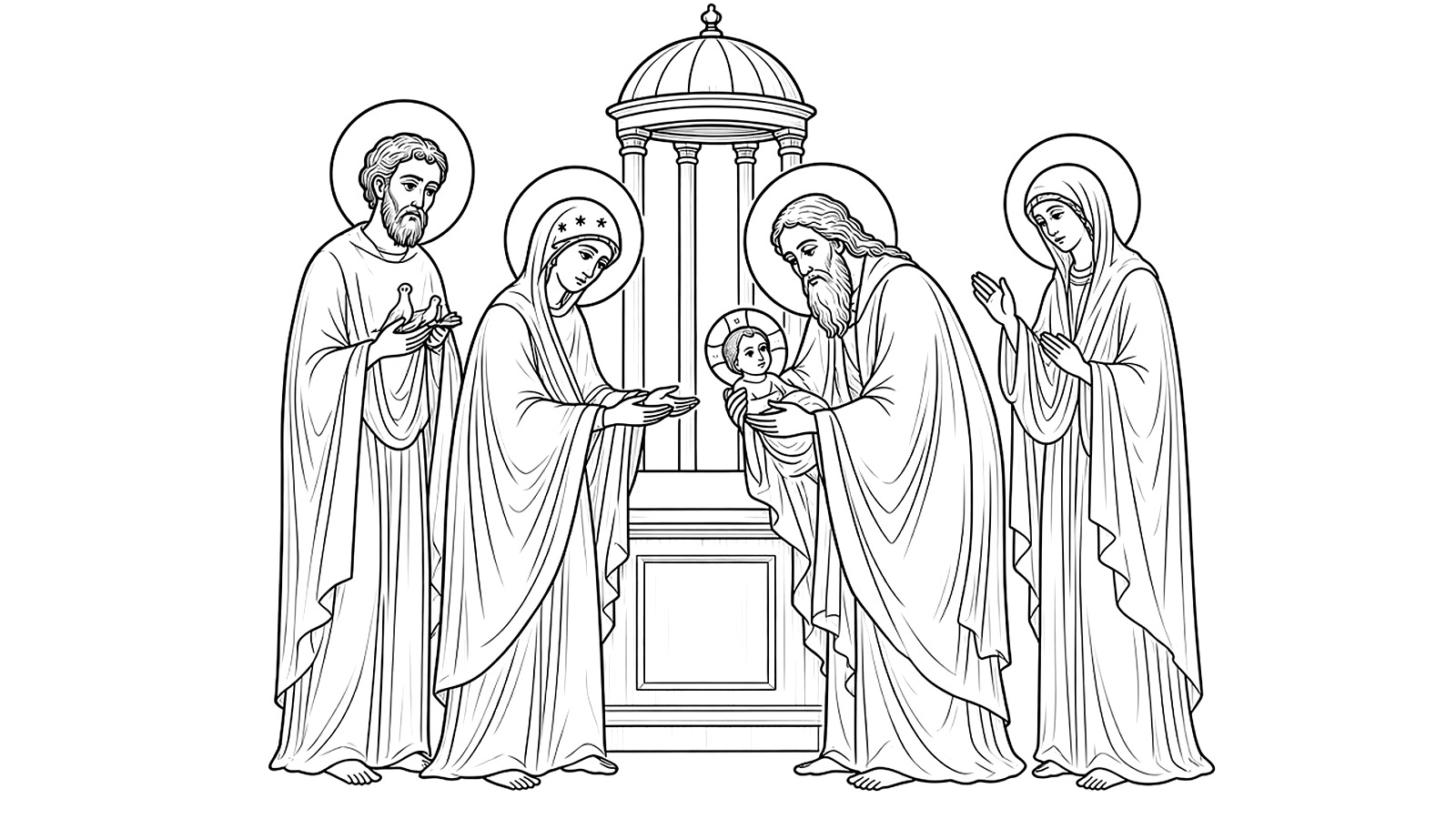
Saint Luke tells it. Forty days after the birth, Mary and Joseph bring Jesus up to the Temple "to present Him to the Lord," and "to offer a sacrifice according to what is said in the law of the Lord, 'A pair of turtledoves or two young pigeons'" (Luke 2:22-24).
That line is the price tag. The Law of Moses asked a new mother for a lamb, then made room for people who couldn't swing it: "if she is not able to bring a lamb, then she may bring two turtledoves or two young pigeons" (Leviticus 12:8). The Lamb of God came into His Father's house, and His parents couldn't afford a lamb.2
The old man with the promise
"And behold, there was a man in Jerusalem whose name was Simeon, and this man was just and devout, waiting for the Consolation of Israel, and the Holy Spirit was upon him. And it had been revealed to him by the Holy Spirit that he would not see death before he had seen the Lord's Christ" (Luke 2:25-26).
Luke never gives his age. The hymns just call him "the Aged Man."1 Simeon had a promise and no date. Tom Petty put it on the radio in 1981: the waiting is the hardest part.2 Then one day the Spirit moves him to go up to the Temple, and the parents walk in. Saint Cyril of Alexandria tells it with real delight: "Christ therefore was carried into the temple, being yet a little child at the breast: and the blessed Symeon being endowed with the grace of prophecy, takes Him in his arms, and filled with the highest joy, blessed God."3
What comes out of Simeon's mouth is the song the Church has sung ever since: "Lord, now You are letting Your servant depart in peace, According to Your word; For my eyes have seen Your salvation Which You have prepared before the face of all peoples, A light to bring revelation to the Gentiles, And the glory of Your people Israel" (Luke 2:29-32). He's holding a baby, and he asks to be dismissed. That's how you know what he was holding.2
The sword, and Anna
Then Simeon says something nobody wants to hear at a baby blessing. He turns to Mary: "Behold, this Child is destined for the fall and rising of many in Israel, and for a sign which will be spoken against (yes, a sword will pierce through your own soul also), that the thoughts of many hearts may be revealed" (Luke 2:34-35). Forty days old, and already there's a Cross in the room.2 Father Georges Florovsky says the Mother of God "had her own share in the sacrifice of the Cross," and quotes this verse to show it.4
And then Anna, "a widow of about eighty-four years, who did not depart from the temple, but served God with fastings and prayers night and day" (Luke 2:37). She comes up "in that instant," gives thanks, and starts telling everybody "who looked for redemption in Jerusalem" (Luke 2:38). Two old saints who'd spent years in that building praying for this, and God let both of them be there for it.2
Why it matters
The prophet Malachi had promised, "And the Lord, whom you seek, Will suddenly come to His temple" (Malachi 3:1). He did. He came in His mother's arms, and His parents were carrying two birds.2 A stanza at Vespers on the eve can't get over it:
The Ancient of Days, who of old gave the Law unto Moses, on Sinai, to-day is seen as a little Child; and in accordance with the Law, as the creator of the Law, fulfilling the Law, is brought into the temple, and given to an aged man.1
The One who handed Moses the Law is carried in to keep it. Then the canon of the feast, by Saint Cosmas, turns the picture around and gives the Child the line: "The Aged Man holdeth not Me, but I hold him: for he entreateth of Me that he may depart in peace."1 Simeon thinks he's the one doing the holding. He's wrong, and he's happy to be wrong.2
Field Note: tongs for the coal. When Isaiah saw the Lord in the Temple, a seraph flew to him "having in his hand a live coal which he had taken with the tongs from the altar. And he touched my mouth with it, and said: 'Behold, this has touched your lips; Your iniquity is taken away, And your sin purged'" (Isaiah 6:6-7). The canon looks at Simeon's arms and sees those tongs: "Ye Pincers mystical, how shall ye bear the coal of fire? How shall ye nourish the Nourisher of all?" The kontakion sings to Christ: "Thou who by thy birth didst sanctify the Virgin's womb, and didst bless the arms of Simeon..."1 A seraph wouldn't touch that coal with his bare hands. The arms that held the Fire came away blessed.2
What you do
If you're Orthodox: go to Vespers, and make it a habit. Near the end of every Vespers the Church sings Simeon's song, the same words the priest says over a forty-day-old baby (Vespers, Vigil, and the Daily Round walks through it). The service ends the day, and every evening you get to borrow an old man's words for going home in peace. If you've just had a baby, ask your priest about the forty-day blessing.2
If you're visiting: show up when someone else's baby is churched. Be the Anna in the room, the one who's been praying in that building for years and is glad to see a new face.2
And the next time you're stuck in the waiting room with God, think about Simeon in the Temple, year after year, watching strangers carry babies past him. One day the Spirit nudged him, and he went. He held the Promise in his arms. And all he asked for was permission to go home.2
Notes
-
Isabel F. Hapgood, Service Book of the Holy Orthodox-Catholic Apostolic Church (1906), pp. 198 (troparion; Vespers stanza), 200 (canon of Saint Cosmas; kontakion), and 270-271 ("For a Woman on the Fortieth Day after Child-birth"), as quoted in "The Waiting Is the Hardest Part." The kontakion is quoted from its opening; Hapgood's text continues "as it was meet, having preserved us in anticipation from condemnation, hast now also saved us, O Christ-God," and closes with a petition for "our Emperor." ↩↩↩↩↩↩↩↩↩
-
Adapted from a Simply Orthodox article by Jamey Bennett, "The Waiting Is the Hardest Part" (not yet published). Scripture quotations are from the New King James Version (NKJV), as in the article. ↩↩↩↩↩↩↩↩↩↩↩↩↩
-
Saint Cyril of Alexandria, Commentary on the Gospel of Saint Luke, Sermon 4, trans. R. Payne Smith (1859), as quoted in "The Waiting Is the Hardest Part." ↩
-
Georges Florovsky, Collected Works, vol. III, Creation and Redemption, p. 183, as quoted in "The Waiting Is the Hardest Part." ↩