
What you'll notice
The church bookstore is a dangerous place if you're in a hurry. You run in to grab a baptismal gift and come out forty-five minutes later, arms full of incense, a children's Bible, and, if you're new, a lingering question about the icon wall you just walked past. It's beautiful. But there's a voice in the back of your mind: didn't God say something about not making images?
Then you look closer. The faces are calm and turned toward you. The backgrounds are gold, or a flat, deep color, and there are almost no shadows. The figures have their names written beside them, often in Greek or Slavonic letters. Some are painted on the walls and ceiling; some stand on wooden stands with candles burning in front of them; a whole wall of them divides the altar from the nave (The Iconostasis and Its Doors). People stop in front of them, cross themselves, bow, and kiss them.
What it's called
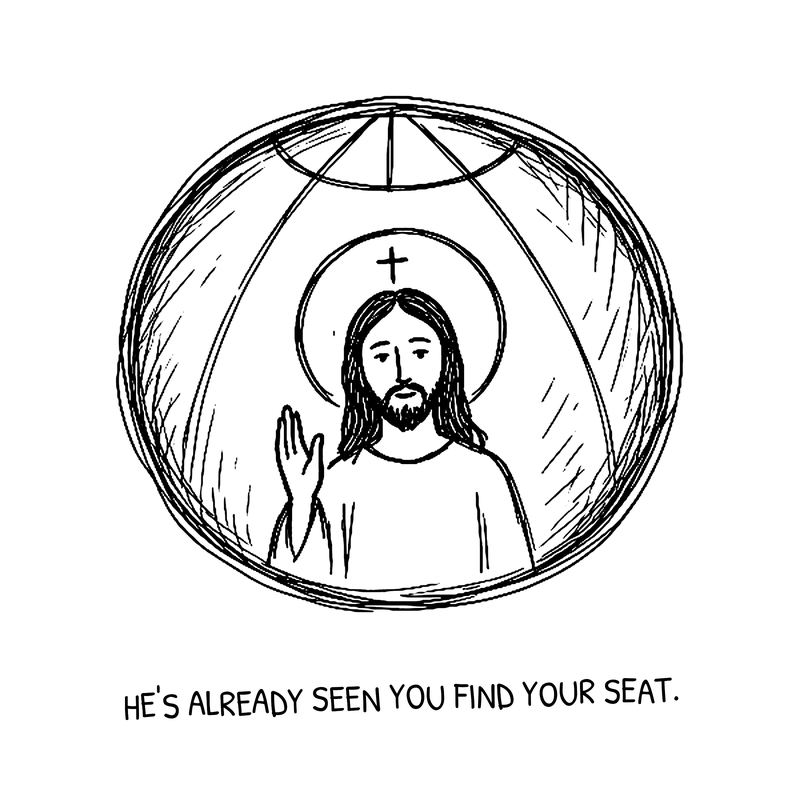
An icon (Greek eikon, "image") is a holy image of Christ, the Theotokos, the angels, the saints, or an event from the Gospel or the Church's life. You'll hear that icons are "written" rather than painted. The Greek verb grapho means both to write and to draw, so an iconographer is literally an "image-writer." Both words are fine in English.
The Church's vocabulary keeps two kinds of honor apart. Latreia (worship) belongs to God alone. Proskynesis (veneration, honor shown by bowing and kissing) is what you give an icon, a saint, the cross, and the Gospel book.
What's actually happening
What the commandment says
The objection usually rests on Exodus: "You shall not make for yourself a carved image—any likeness of anything that is in heaven above, or that is in the earth beneath, or that is in the water under the earth; you shall not bow down to them nor serve them" (Exodus 20:4–5). On a quick reading, that sounds like a ban on pictures of anything at all.
But read it to the end. The commandment forbids making images "for yourself," as stand-ins for God, and it forbids bowing down to them and serving them. The target is idolatry. And only a few chapters later God orders Moses to make images: "And you shall make two cherubim of gold" (Exodus 25:18), to stand on the Ark of the Covenant. Cherubim are heavenly beings, exactly the category the commandment seemed to rule out. Solomon's Temple was carved with "cherubim, palm trees, and open flowers" (1 Kings 6:29 (3 Kingdoms 6:29 in the Septuagint)). If the commandment banned every image, God would be contradicting himself within a few pages.
The golden calf (Exodus 32) shows what the commandment is aimed at. Israel worshiped it and credited it with their rescue from Egypt; it replaced the living God. The cherubim were never worshiped. They pointed to the God who dwelt among his people. Saint John of Damascus made the same argument in the eighth century: "The Cherubim, too, which o'ershadow the mercy seat, are they not the work of men's hands?"1 So the question isn't images or no images. It's faithful depiction of what God has revealed, or a substitute god of our own making.
Why the Incarnation changes everything
The deeper reason is Christ. Saint John of Damascus asks, "who can make an imitation of the invisible, incorporeal, uncircumscribed, formless God?" The answer is nobody. But the same chapter says the invisible God "in His bowels of pity became in truth man for our salvation," and a man can be seen and painted.2 Saint Paul calls Christ "the image of the invisible God" (Colossians 1:15), and Saint John says "the Word became flesh and dwelt among us" (John 1:14). In his treatise on the images, John of Damascus adds that he doesn't worship matter but the Creator of matter, who became matter for our sake.3 An icon is a confession that God really took flesh. If he did, he can be painted.
What makes it an icon
An icon shows a real person or a real event, as the Church has handed it down, and it names who it shows; that's why the names are on the panel. Painted by hand or printed on a board, it's honored for the same reason, because the honor goes to the person and not to the materials.
Why it matters
The Church settled the question at the Seventh Ecumenical Council, at Nicaea in 787. It gave icons "due salutation and honourable reverence," but "not indeed that true worship of faith (latreian) which pertains alone to the divine nature." Then it gave the reason in one sentence: "For the honour which is paid to the image passes on to that which the image represents, and he who reveres the image reveres in it the subject represented."4 The council set icons in churches, on sacred vessels and vestments, "in houses and by the wayside."
The principle is older than the council. Four centuries earlier, Saint Basil the Great used it to explain how honoring the Son honors the Father. "We speak of a king, and of the king's image, and not of two kings," he wrote, "because the honour paid to the image passes on to the prototype."5 Saint John of Damascus quoted that line by name in his defense of the icons.6 The council's definition doesn't name Basil, but the principle is his.
So when someone kisses an icon, they aren't in love with wood. Kiss a photograph of your grandmother and you're sending something to her, not to the cardstock. Honor is something you already give to your mother, your country's flag and a friend's picture; worship is something you give only to God. The icon receives the first and passes it on.
The Church still makes people say this out loud. In the reception of converts printed in Hapgood's book, the convert confesses that the images of Christ, his mother and the saints are to be honored "not unto idolatry, but that, through contemplation thereof, we may be incited unto piety, and unto emulation of the righteous deeds represented by these images."7 A new bishop, at his consecration, confesses that he honors the icons "relatively, but not in the way of worship."8
Where it came from
The argument over images is old. John of Damascus repeats an older story, that when Abgar "was king over the city of the Edessenes, he sent a portrait painter to paint a likeness of the Lord."9 Nobody can check it now, and the case for icons doesn't rest on it; the case rests on the Incarnation.
The fight came in the eighth century. The iconoclasts ("image-breakers") made the charge first, in two waves, roughly 730–787 and 814–843. The Seventh Council restored the icons in 787; the second wave ended with their final restoration in 843, which the Church still keeps on the first Sunday of Great Lent as the Sunday of Orthodoxy.10 The council's answer is still the answer.
What you do
If you're Orthodox: venerate the icons the way your parish does: two bows and the sign of the cross, a kiss on the hand or the feet of the person shown (never the face), and a third bow (The Narthex walks through it). Keep an icon corner at home and pray there (Prayer at Home). When someone asks whether you worship icons, you can answer with the council: honor, yes; worship, only God.
If you're visiting: look closely. Read the names. Notice who's in the room with you: the Theotokos, the saints of that parish, the feast of the day. You don't have to kiss anything; a slight bow is a kind gesture and entirely optional. If you're wrestling with the Second Commandment, you're in good company. The Church spent a century on it.
Field Note: avoiding the absurd. Take the commandment as a ban on all images and see where it goes. No angels, since they're in heaven above. No human faces, since they're on the earth beneath. No fish, since they're in the water under the earth (sorry, Jonah-and-the-whale coloring pages). You'd have to say God's own command to make the cherubim was a sin. Most Christians recoil from that, and they're right to. The absurdity is a sign the reading overshot the mark.
Go deeper
- Saint John of Damascus, Exposition of the Orthodox Faith IV.16 (NPNF2 9).
- The Seventh Ecumenical Council's definition on icons (NPNF2 14).
- "Do Icons Break the Second Commandment?", Simply Orthodox.
- Go to the Liturgy on the Sunday of Orthodoxy, the first Sunday of Great Lent, which keeps the restoration of the icons.
Notes
-
John of Damascus, Exposition of the Orthodox Faith IV.16 (NPNF2 9). ↩
-
John of Damascus, Exposition of the Orthodox Faith IV.16 (NPNF2 9). ↩
-
John of Damascus, On the Divine Images I.16. ↩
-
Second Council of Nicaea, definition on icons (NPNF2 14). ↩
-
Basil, On the Holy Spirit 18.45 (NPNF2 8). ↩
-
John of Damascus, Exposition of the Orthodox Faith IV.16 (NPNF2 9). ↩
-
Hapgood, Service Book, pp. 459–460. ↩
-
Hapgood, Service Book, p. 328. ↩
-
John of Damascus, Exposition of the Orthodox Faith IV.16 (NPNF2 9). ↩
-
Hapgood's 1906 calendar gives the year as 842 (Service Book, p. xvi). ↩