
What you'll notice
You come through the front door and you're not in church yet.
You're in a smaller room, and it's busy. There's a stand or a box of thin beeswax candles, and people are taking them, dropping a bill in a slot, and lighting them in a tray of sand. There's an icon on a slanted wooden stand, and everyone who passes it stops, makes the sign of the cross, and kisses it. A table holds bulletins and a sign-up sheet. A grandmother is crossing herself three times with a speed that suggests decades of practice. Somebody is bouncing a baby. Through a second set of doors you can hear singing, because the service started before you arrived, and apparently that's fine.
Nobody checks your ticket. Nobody asks if you're a member. You stand there for a second, holding a candle you're not sure what to do with, and then someone nods at you and goes in.
What it's called
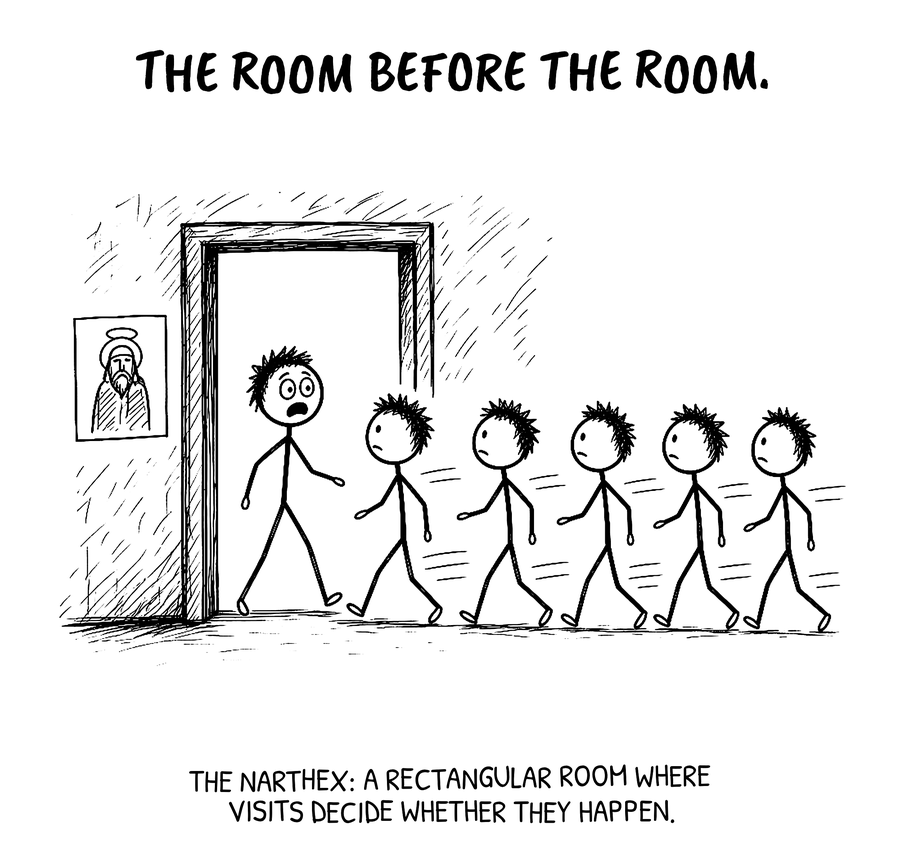
The narthex (the entrance hall; Greek narthex). Slavic parishes may say pritvor. Plenty of Americans just say "the vestibule" or "the back."
The Greek word originally meant giant fennel, the plant with the long hollow stalk. The Greeks used the stalk as a case for carrying small things, and the name stuck to this long, narrow room at the entrance of a church. It is, in effect, the case the church comes in.
What's actually happening
Three things, mostly.
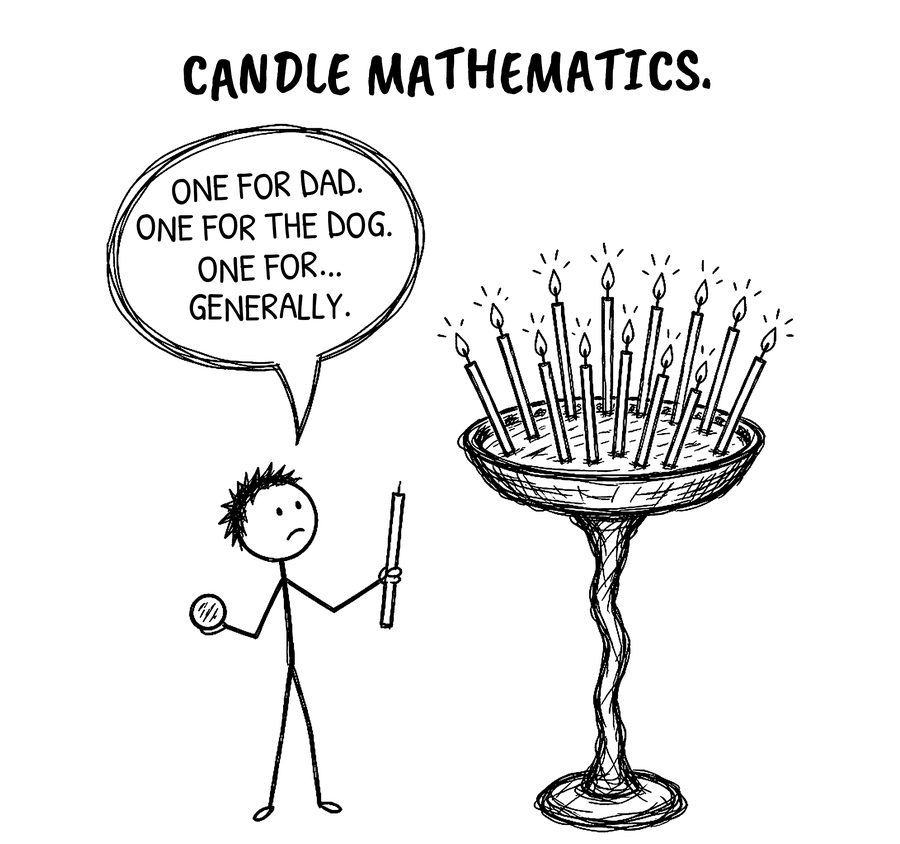
People are lighting candles. A candle is a small prayer with a flame on it: for someone sick, someone dead, someone you're worried about, or just because you're glad to be here. The money is an offering, not a price, and nobody is counting.
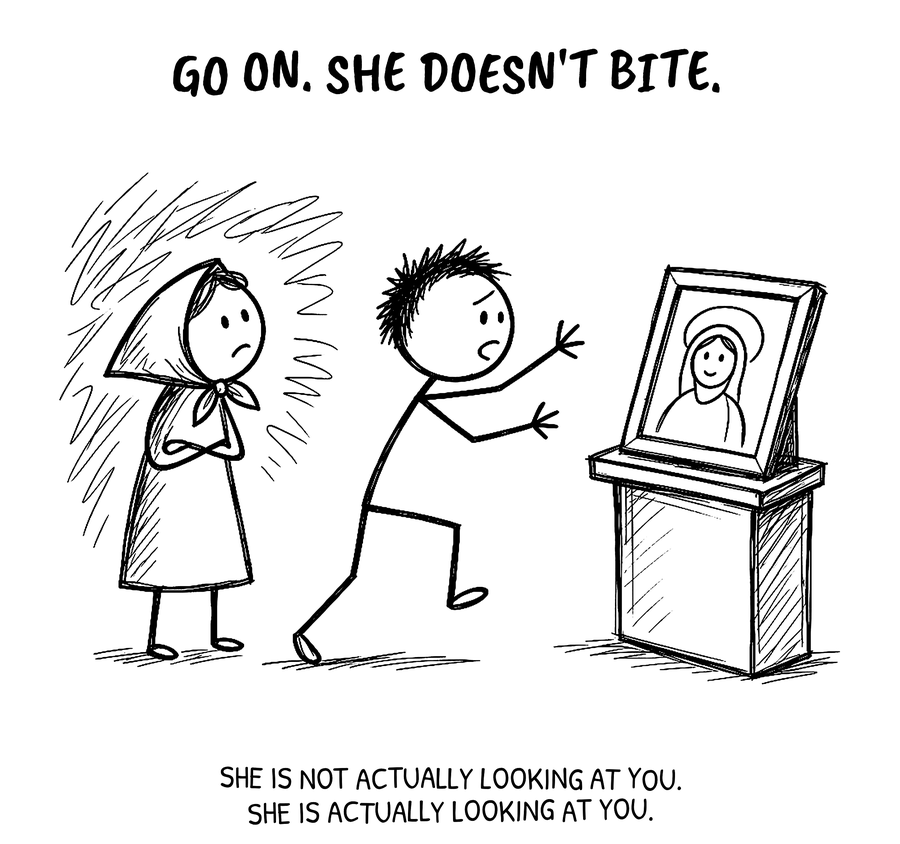
People are venerating the icon, which means honoring it with a kiss the way you'd kiss a photograph of your mother. On Sunday it's usually an icon of the Resurrection or of the saint the parish is named for; on a feast, the feast. The kiss goes to the person pictured, not the paint (Icons has why).
And people are arriving, which in Orthodox terms means slowing down. The narthex is a threshold. You leave the parking lot behind here. You settle. Then you go in.
The narthex has also always been where the Church keeps the people who are on the way in but not yet all the way. In the early centuries the catechumens (those preparing for baptism) stood here, along with penitents working their way back. You can still hear the echo of it halfway through the Liturgy, when the deacon calls, "Depart, all ye Catechumens, depart,"1 and nobody departs. A few services still begin here on purpose: the baptismal rite starts in the narthex, with the priest meeting the candidate at the door, and at Great Vespers on the eve of a feast the clergy may process out here for the litiya (a procession with petitions of fervent prayer), as if to pray from the edge of the world.2
Why it matters
An Orthodox church is a map, and you are standing on its border.
Saint Germanus of Constantinople, writing in the eighth century, opens his commentary on the Liturgy by saying the church is "an earthly heaven in which the super-celestial God dwells and walks about."3 Then he walks the building piece by piece and never draws a room map at all. Nobody else agreed on one either. A century before him, Saint Maximus the Confessor read the church in two: the sanctuary for the world of the mind, the nave for the world of the senses, and the pair again as soul and body.4 Saint Symeon of Thessalonica, in the fifteenth century, counted three: the narthex as earth, the nave as heaven, and the sanctuary as "that which is above the heavens."5 Hapgood's Russian service book counts four: "The Sanctuary (Altar)," the solea, "The Body of the church," and "The Porch."6 The version you'll hear in catechism class is modern and tidy: the narthex stands for the world, the nave for the Church on earth, the altar for the Kingdom of Heaven. Three rooms, one direction of travel.
So the narthex is where the world comes to the edge of heaven and pauses. That's not nothing. When Jacob woke from his dream of the ladder he said, "This is none other than the house of God, and this is the gate of heaven" (Genesis 28:17). The Church reads that verse at the consecration of every church building. The narthex is the gate.
It's also where the Church has always put the people she hasn't finished with yet, and she has never been embarrassed about that. Standing in the back, unsure, is a venerable position. Catechumens stood here for years. The Psalmist asked for the job: "I would rather be a doorkeeper in the house of my God than dwell in the tents of wickedness" (Psalm 84:10 (83:11 in the Septuagint)). You're in good company at the door. Mavropoulos titles his narthex lesson "Teaching and Repentance,"7 which is a fair summary of what this room has always been for: the place where you learn, and the place where you turn around.
Where it came from
The earliest big churches, the basilicas of the fourth and fifth centuries, had a courtyard out front and then a covered porch across the whole west end before you reached the nave. That porch was the narthex. It held the catechumens and penitents during the first half of the service, and they left before the Eucharist; Hapgood's Service Book, a century ago, still describes the vestibule as the catechumens' place.8 Hagia Sophia in Constantinople, finished in 537, has two of them, an outer and an inner.
As infant baptism became the norm and adult catechumens grew rare, the narthex shrank with its job. Mavropoulos notes that from the ninth century on, people who weren't receiving Communion simply stayed in the nave rather than withdrawing here,9 and Father Alexander Schmemann points out that the original "holy doors" were the doors of the church building itself, the ones you just came through.10 (The name later moved inward to the icon screen; The Iconostasis and Its Doors has that story.) Byzantine churches kept a narrow one; Russian churches often stretched it into a long, low room, the trapeza (literally "table," the refectory hall), where the congregation could warm up in winter. American parishes built in the last century tend to make it a lobby with coat racks and a bulletin board, which is less picturesque but keeps the same purpose: it's the room where you stop being outside.
What you do
This is the part most visitors worry about, so here it is slowly.
Candles. Take one from the stand. Most parishes have a slot or a box nearby; put in what you like, and if you have nothing, take the candle anyway. Light it from one already burning, never with a lighter if you can help it, and set it in the sand or the holder. As you do, pray for someone, in your own words or none. Some parishes have two places for candles: one for the living and one, often near a small table with a crucifix, for the departed. If you can't tell which is which, it doesn't matter; God can sort it. Don't blow out anyone else's candle. Someone will come by later and tend them all, and that is a job people fight for. (The candle is an offering and a prayer, not a payment. Hapgood says the wax and oil stand for "the purity and sincerity of the gifts which provide them,"11 and the Greek Archdiocese calls candles before icons "a sign of one's faith and hope in God's help," with a "small offering" customary;12 prices, sizes, and stands are local custom. For the name slips, see Memory Eternal.)
The icon. Walk up to the icon on the stand. Make the sign of the cross (right hand, thumb and first two fingers together, forehead, chest, right shoulder, left shoulder) and bow from the waist. Do it twice. Then kiss the icon, on the hand or the feet of the figure, or the Gospel book if the figure is holding one, and never on the face. Step back, cross yourself and bow once more, and move along. Three crosses, two bows before and one after, one kiss. The number of bows, and whether you kiss the hand or the feet, differ from one tradition and parish to the next; the cross itself, right to left, is the same everywhere. If someone is already there, wait; don't cut in on a person at prayer. If you're wearing lipstick, blot it first. The whole thing takes ten seconds and you'll have it down by the third Sunday.
Going in. Listen before you open the inner doors. If a reading is in progress (one voice, chanting, everyone still), wait at the door until the singing starts again. If a procession is coming toward you, stand aside and let it pass; the clergy will come back. Otherwise, go in. There's no assigned place. Stand or sit wherever there's room; the back is fine and plenty of lifelong Orthodox stand there on purpose. If the parish has pews, use them; if it has a few chairs along the walls, those are for people who need them. Pick up a service book from the rack if there is one. Then look toward the front, at the wall of icons, and breathe. You're in.
If you're Orthodox: this is the routine you already keep.
If you're visiting: you may light a candle for someone; nobody will ask who, and it's the most natural first thing a visitor can do here. You don't have to kiss the icon or cross yourself, and no one will notice if you don't. Stand to the side so people can get past you, wait for a pause in the readings, then go through the inner doors and stand wherever there's room. If you'd rather not go in yet, the narthex is a perfectly good place to stand for a while. People have been doing exactly that for seventeen hundred years.
Field Note: the narthex Orthodox. Every parish has a few people who have stood in the narthex for years, close enough to hear and far enough to leave. Some are new. Some are parents walking a loud baby. Some are just shy. The Church has a long history of letting people stand at the edge until they're ready, and a longer one of eventually waving them in.
Go deeper
- Genesis 28:10–17, and Psalm 84 (83 in the Septuagint).
- Saint Germanus of Constantinople, On the Divine Liturgy, chapter 1.
- Saint Maximus the Confessor, Mystagogy, chapters 2–4.
Notes
-
Hapgood, Service Book, p. 92. ↩
-
Hapgood, Service Book, p. 11 (the Litiya at Great Vespers) and p. 594, note 12 (served "in the porch of the Temple, or on the steps; sometimes inside the Temple"). ↩
-
Germanus, On the Divine Liturgy §1. ↩
-
Maximus the Confessor, Mystagogy 2–4. ↩
-
Symeon of Thessalonica, Explanation of the Divine Temple §16. ↩
-
Hapgood, Service Book, pp. xxvi–xxvii. ↩
-
Mavropoulos, Passing Through the Church, ch. 4, "The Narthex." ↩
-
Hapgood, Service Book, p. xxxii. ↩
-
Mavropoulos, Passing Through the Church, pp. 302–303. ↩
-
Schmemann, Introduction to Liturgical Theology. ↩
-
Hapgood, Service Book, pp. xxxii–xxxiii. ↩
-
GOARCH, "Light a Candle." Mavropoulos walks through the candle and icon stands of a Greek narthex at Passing Through the Church, pp. 62–63. ↩