
What you'll notice
The first time I watched an Orthodox congregation file out of church, I counted. The priest's hand: kissed. The cross he was holding: kissed. The icon by the door: kissed. Two grandmothers meeting in the narthex: kissed, twice each, with a sound effect. Somebody's baby: kissed by at least four people who may or may not have been related to it.
Nothing is safe from an Orthodox kiss. The book gets kissed. The wall gets kissed if there's an icon on it. In some parishes the cup gets kissed. And if you stand still long enough near the front, you will get kissed too.
What it's called
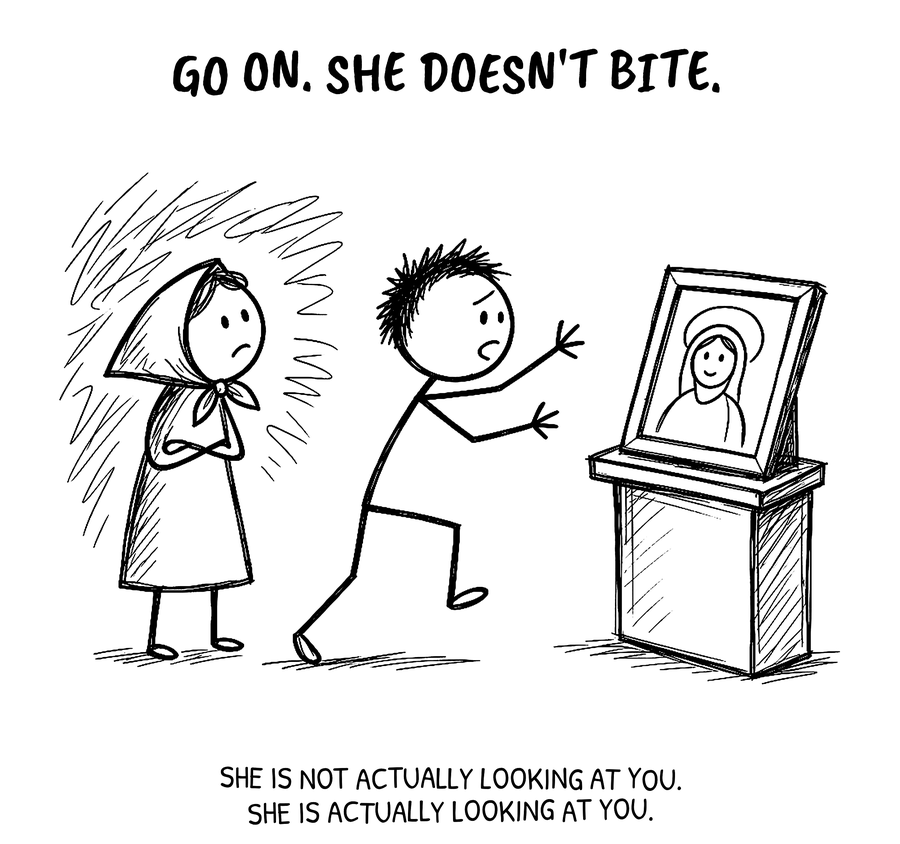
The Church's word for all of this is veneration, in Greek proskynesis (honor shown with the body, usually a bow and a kiss; Slavonic poklonenie). The Greek verb aspazomai, "to greet," is the word Saint Paul uses when he tells churches to greet one another with a holy kiss. The kiss during the Liturgy is the kiss of peace. The hand-kiss has a greeting attached: "Father, bless."
For how to venerate an icon, two bows and a kiss on the hand or feet, never the face, see The Narthex. This entry is about everything else.
What's actually happening
A kiss is the body's way of saying "I love you" and "I honor you" at the same time, and the Orthodox have never found a better one.
The things that get kissed, roughly in the order you'll meet them:
- Icons, on the hand or the feet of the person pictured.
- The Gospel book, when it's brought out for veneration, because the Word of God is in it.
- The cross the priest holds at the end of the Liturgy. You kiss it, then his hand (The Cross and the Bread).
- The priest's hand. When you greet a priest or bishop, you say "Father, bless," hold out your right palm over your left, and when he blesses you, you kiss his hand. You aren't kissing him. You're kissing the hand that holds the chalice every Sunday. A deacon doesn't give the priestly blessing, so his hand isn't normally kissed.
- Relics, the bones of saints, when they're set out on a feast (Relics).
- Each other. On the cheek, in greeting. Greeks kiss twice, once on each cheek; Russians usually three times. Start on the right, or you'll bump noses. Many people only touch cheeks and make the kissing sound, which counts. Do not kiss your priest on the lips unless he's your husband, in which case he's your priest only on Sundays.
Why it matters
The question underneath all this is the one newcomers are too polite to ask out loud: isn't kissing a painting idolatry?
The Church answered that in the eighth century, after a long fight, and the answer has two halves. First, honor is not worship. The Greek Fathers kept two words for a reason. Worship, latreia (adoration), belongs to God alone. Honor is what you give to your mother, your flag, your friend's photograph, and a saint's icon. Second, the honor doesn't stop at the wood. The Seventh Ecumenical Council, at Nicaea in 787, taught that the honor shown to an image passes to the person it represents.1 Saint Basil the Great had said the same about an emperor's portrait four centuries earlier; the council's definition doesn't name him. Icons has both texts. Kiss a photo of your grandmother and you aren't in love with cardstock. You're sending something to her.
And the kiss itself is in the Bible, as a command. "Greet one another with a holy kiss" (Romans 16:16; 1 Corinthians 16:20). "Greet one another with a kiss of love" (1 Peter 5:14). The Orthodox read those lines and did the obvious thing: they kept doing it. If your church tradition shakes hands instead, that's an honest substitute, and nobody here will fault you for it. But the original instruction was a kiss.
Where it came from
The kiss of greeting is older than the Church; the apostles baptized a custom the whole Mediterranean already had. The kiss of peace was part of the Liturgy by the second century, exchanged among the faithful at the end of the prayers, before the gifts were brought.2 Over time it settled into the moment just before the Creed, when the deacon sings, "Let us love one another, that with one accord we may confess."3 The Litany of Supplication and the Kiss of Peace tells who kisses whom at that point today, parish by parish.
The hand-kiss and the icon-kiss grew up with the Church's sense that holy things are physical things: that God became flesh, and flesh can be honored.
What you do
If you're Orthodox: kiss the cross and the priest's hand on your way out. Say "Father, bless" when you meet a priest, right palm over left. Kiss icons the way The Narthex describes. Greet your friends the way your parish does; when in doubt, start on the right and follow their count.
If you're visiting: you may do any of this, or none of it. A small bow toward the cross at the end is a lovely gesture and entirely optional. If the parish greets each other at the kiss of peace, a handshake and "Christ is in our midst" or just "good morning" is perfect. Nobody will mind if you simply watch.
Field Note: the cup. In many Slavic parishes, people kiss the base of the chalice after receiving Communion. In many Greek-practice parishes they wouldn't dream of it; you receive, step aside, and don't touch the cup. Both customs come from the same reverence for the same Gift. Watch the person ahead of you and do what they do.
Go deeper
- Romans 16:16 and 1 Peter 5:14.
- Saint Justin Martyr, First Apology 65 (ANF 1), the earliest description of the kiss in the Liturgy.
- Icons, for the council's teaching on honor and worship.