
What you'll notice
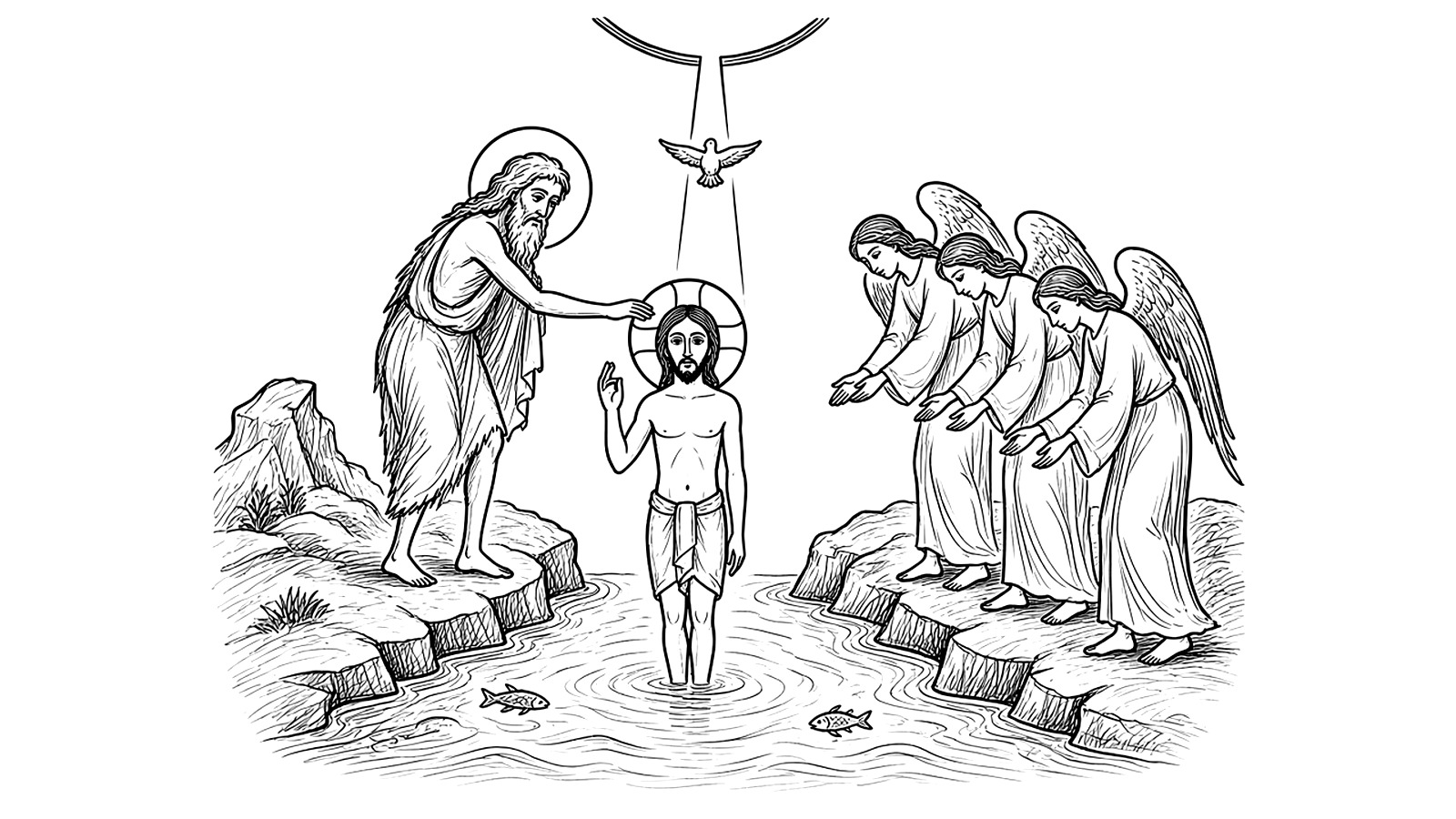
Walk into an Orthodox church on Theophany and you might think the parish is making a very big deal out of a very ordinary thing. A big bowl or font of water sits in the middle of the church. The priest plunges a cross into it three times, breathes on it, and prays over it. Then people line up to drink it, carry it home, and sprinkle it on their walls, their children, and their kitchen sinks.1
That's not a side ritual. It's the feast.
What it's called
Theophany means "the manifestation of God." It's also called Epiphany. It falls on January 6 and keeps Christ's baptism in the Jordan and the revealing of the Holy Trinity.1 (If you grew up hanging the Wise Men on Epiphany: on the Orthodox calendar the Magi belong to Christmas, and January 6 is about the river.)2 In Saint Gregory the Theologian's day the feast seems to have gone by another name, the Holy Lights, because baptism was called Illumination and the newly baptized carried lighted torches.3 The service you've probably never seen is the Great Blessing of Waters.1
Theophany also closes the twelve days of Christmas. Father Anastasios Hallas, preaching at Saint Mark Greek Orthodox Church in Boca Raton, put it simply: "In the Orthodox Church, the 12 days of Christmas begin on Christmas Day, December 25, and end on January 6, the Feast of Epiphany, or Theophany."4 Christmas is the Lord's Nativity; January 1 is His circumcision and naming; then comes Theophany.1 The twelve days aren't a countdown to Christmas. They're more like an Advent calendar in reverse.
Field Note: "good feasts" and Kala fota. I've heard that in Greece people wish each other Kala fota and "good feasts" through this stretch. "Good feasts" blesses the whole run of celebration from the cave in Bethlehem to the Jordan, not just one day. Kala fota means "good lights" or "joyful lights," and it belongs especially to Theophany, when the Church sings of Christ as the Light who has appeared and lit up the world.1
What's actually happening
The services. Father Anastasios walked his parish through the practical side: the Royal Hours, Vespers, and the blessing of the waters on the eve of the feast, then the blessing again after the Divine Liturgy on Theophany itself, with the faithful taking holy water home.4
The troparion. The feast's main hymn, in Isabel Hapgood's 1906 English:
When in Jordan thou wast baptized, O Lord, the worship of the Trinity was made manifest. For the voice of the Father bare witness unto thee, calling thee his beloved Son, and the Spirit, in the form of a dove, confirmed the steadfastness of that word. O Christ our God, who didst manifest thyself, and dost enlighten the world, glory to thee.5
The blessing prayer. The long prayer at the heart of the Great Blessing starts at creation: "Great art thou, O Lord, and marvellous are thy works, and speech sufficeth not to sing the praises of thy wonders." When it reaches the Jordan, it says something that surprises people: "Thou didst hallow, also, the streams of Jordan, in that thou didst send down from heaven thy Holy Spirit, and didst crush the heads of the serpents which lurked there."5 Serpents in the Jordan sound strange until you read the Psalms: "You broke the heads of the sea serpents in the waters" (Psalm 74:13), and "The sea saw it and fled; Jordan turned back" (Psalm 114:3). In Scripture deep water is where the chaos lives, and Christ walked into it on purpose.6 So the prayer asks God to make this water "a fountain of immortality, a gift of sanctification, a remission of sins, a healing of infirmities, a destruction of demons."5
The Gospel. Saint Mark's account starts at the very beginning: "The beginning of the gospel of Jesus Christ, the Son of God" (Mark 1:1). "This is not just the beginning of a book," Father Anastasios said. "It is the beginning of hope, the beginning of healing, the beginning of God entering into our broken world in a way we cannot ignore."4
What the feast shows. "On this day, we see Christ our God entering the waters of the Jordan River. We see the Holy Spirit descending upon Him in the form of a dove. And we hear the voice of the Father saying, 'This is My beloved Son, in whom I am well pleased.'"4 Father, Son, and Spirit, all in one scene. That's why it's called God's manifestation.
John in the wilderness. Before Christ steps into the river, a voice cries in the wilderness. Father Anastasios: "The wilderness is not only a place on a map. It is also a condition of the heart. It is that place in us that feels dry, empty, restless, far from God."4 John's word into that wilderness is "Repent," and the sermon rescues the word from our worst ideas about it: "Repentance is not about shame. It is not about beating ourselves up. It is not about thinking that we are worthless. Repentance is a gift. It means to turn around, to change direction, to come home."4
The crowds came to the Jordan "not as people who had it all together, but as people hungry for God."4 And John knew he wasn't the main event: "There comes One after me who is mightier than I, whose sandal strap I am not worthy to stoop down and loose. I indeed baptized you with water, but He will baptize you with the Holy Spirit" (Mark 1:7-8). Untying sandals was the job of the lowest servant.4
Why Christ went into the water at all. John the Baptist saw the problem right away. In Matthew's account he tries to stop Jesus: "I need to be baptized by You, and are You coming to me?" Jesus answers, "Permit it to be so now, for thus it is fitting for us to fulfill all righteousness" (Matthew 3:14-15). He didn't need to repent. "He did it to stand with us, to stand in the place of sinners, and to make the waters of baptism the place where we die and rise with Him. In Theophany, all of creation begins to be renewed in Christ."4 Saint Gregory the Theologian says Jesus came "to bury the whole of the old Adam in the water; and before this and for the sake of this, to sanctify Jordan; for as He is Spirit and Flesh, so He consecrates us by Spirit and water."3 Or in Father Anastasios's shorthand: "John opens the way; Christ comes to renew all things."4
Why it matters
Theophany is the beginning of the new creation. Father Georges Florovsky wrote that "Scripture begins with the creation of the world and closes with the promise of a new creation," and every event in the Gospel sits inside the tension between those two.7 At the Jordan, the Word through whom everything was made steps down into the river of His own creation, and the Spirit comes down on Him the way the Spirit once moved over the first waters.1 It's one of the places where the first and last pages of the Bible meet.
The oldest witness ties the river to the Cross. Saint Ignatius of Antioch, writing on his way to Rome and the wild beasts, put the whole feast in one line: "He was born and baptized, that by His passion He might purify the water."8 Saint Gregory gives his people their marching orders: "Christ is baptized, let us descend with Him that we may also ascend with Him." And when Christ comes back up out of the river, "with Himself He carries up the world," and "sees the heaven opened which Adam had shut against himself and all his posterity."3 Saint John Chrysostom asks why the heavens opened at all, and answers: "To inform you that at your baptism also this is done, God calling you to your country on high."9
That's why the water matters. Father Alexander Schmemann pointed out that the blessing doesn't treat water as a neutral substance the Church "charges" with power. The prayers remember the whole history of water in God's saving work: the Spirit over the deep in Genesis, the Flood, the Red Sea, the Jordan. The blessing shows what water was always for. It doesn't add something foreign to it.10 The bowl in the middle of the church is a small picture of what God wants for all creation.
And it's about your own baptism. "When Christ went down into the Jordan River, He sanctified the waters and, through them, all of creation. When we bless and drink holy water, we participate in that sanctification. We are reminded of our own baptism and our commitment to live in Christ."4 Father Georges Florovsky, summing up Saint Ephrem the Syrian, says the same thing: "The baptismal font is another Jordan, a boundary between life and death, and only the man who crosses to the other shore becomes a 'citizen of the spiritual world.'"11
Field Note: the cross in the bayou. In Tarpon Springs, Florida, Theophany has gone outdoors since 1903. After Matins and the Liturgy at St. Nicholas Greek Orthodox Cathedral, the clergy and the faithful walk down to Spring Bayou around noon. A dove is released, the archbishop throws a cross into the water, and about sixty young men dive for it. The one who comes up with it is considered blessed for the whole year.12 It's the only contest I know of where the prize gets thrown away first.6
What you do
If you're Orthodox: take holy water home and use it. Father Anastasios was clear that it's no superstition or souvenir: "When we take holy water home, when we drink it and bless our homes with it, we are not playing with magic. We are confessing that, in Christ, no part of our life is outside of His care."4 Bless yourself in the morning and remember your baptism. Sprinkle your home and pray that Christ would be Lord over its conversations, screens, and worries. Bless your kids, drink a little and cross yourself. It's sanctified, and it sanctifies, so use it reverently but freely.1 Blessings: Water, Homes, and Things has more on the house blessings that follow. Start the day before: January 5, the eve of the feast, is kept as a fast day (Fasting has the calendar). The feast runs to its leave-taking on January 14, and on January 7 the Church honors Saint John the Baptist himself, the man who tried to talk Jesus out of the whole thing.2
Then prepare the way, the way John asked. Father Anastasios gave examples: "We prepare the way when we forgive someone we have been holding in our heart with anger. We prepare the way when we turn off the noise of this world and make time for prayer. We prepare the way when we come to confession with honesty and humility."4 Name your wilderness. Treat repentance as coming home. Give ten minutes, phone off, to the opening verses of Mark.1
If you're visiting: stay after the Liturgy for the blessing. You'll see the cross go into the water and the line form. If you're near the front, you may get sprinkled. That's the idea.
Field Note: one sentence for the feast. "Christ does not force Himself into our hearts. He waits. He waits for us to clear away the clutter, the anger, the pride, the fear, the distractions, the sin. When we do, even a little, He comes."4 Clear a little space, and He comes.
Notes
-
Jamey Bennett, "Between Manger and River: Wilderness, Theophany, and New Creation," Simply Orthodox, January 6, 2026. ↩↩↩↩↩↩↩↩
-
Orthodox Church in America, Lives of the Saints: December 25 (Adoration of the Magi), January 7 (Synaxis of Saint John the Baptist), and January 14 (leave-taking of Theophany). ↩↩
-
Saint Gregory the Theologian, Oration 39, On the Holy Lights, §§14-16, trans. Browne and Swallow, Nicene and Post-Nicene Fathers, 2nd series, vol. 7; the name "Holy Lights" and the torches are from the editors' introduction there. ↩↩↩
-
Father Anastasios Hallas, Theophany sermon at Saint Mark Greek Orthodox Church, Boca Raton, Florida, as quoted in Bennett, "Between Manger and River." ↩↩↩↩↩↩↩↩↩↩↩↩↩↩
-
Isabel F. Hapgood, Service Book of the Holy Orthodox-Catholic Apostolic Church (1906), p. 188 (troparion) and pp. 194-195 (Great Blessing of Waters). ↩↩↩
-
Jamey Bennett, "With Himself He Carries Up the World," Simply Orthodox (not yet published). ↩↩
-
Georges Florovsky, "Revelation, Philosophy and Theology," Collected Works, vol. III, Creation and Redemption (1976), p. 23. ↩
-
Saint Ignatius of Antioch, Epistle to the Ephesians 18, Ante-Nicene Fathers, vol. 1. ↩
-
Saint John Chrysostom, Homily 12 on Matthew, §3, Nicene and Post-Nicene Fathers, 1st series, vol. 10. ↩
-
Bennett, "Between Manger and River," summarizing Schmemann's reading of the Theophany rites. ↩
-
Georges Florovsky, Collected Works, vol. VII, The Eastern Fathers of the Fourth Century, p. 273. ↩
-
Spectrum Bay News 9, "120 years on, Epiphany celebration continues to shine," December 30, 2025. ↩