
What you'll notice
At Matins of the feast, listen to the first ode of the Christmas canon, the long cycle of hymns at that service. It opens like a shout:
Christ is born: extol him! Christ from heaven: go to meet him! Christ on earth: be ye lifted up!1
You may have heard them before. Around 380, in Constantinople, a bishop opened his Christmas sermon with the same words, in another translation: "Christ is born, glorify Him. Christ from heaven, go out to meet Him. Christ on earth; be exalted."2 The Church still sings them every Christmas, in the canon Saint Cosmas wrote in the eighth century.1
You'll also notice your Orthodox friends turning down the office cookie tray in early December, and then, from Christmas on, eating everything in sight.3
What it's called
The Nativity of Christ is Christmas, kept on December 25. The Church Year lists it among the twelve Great Feasts.
The hymns you'll hear most:
- The troparion, the feast's main hymn: "Thy Nativity, O Christ our God, hath arisen upon the world as the light of wisdom. For at it, they who worshipped the stars were, by a Star, taught to adore thee, the Sun of Righteousness, and to know thee, the Orient from on high. O Lord, glory to thee."1 Stargazers, taught by a Star. God met them where they were already looking.3
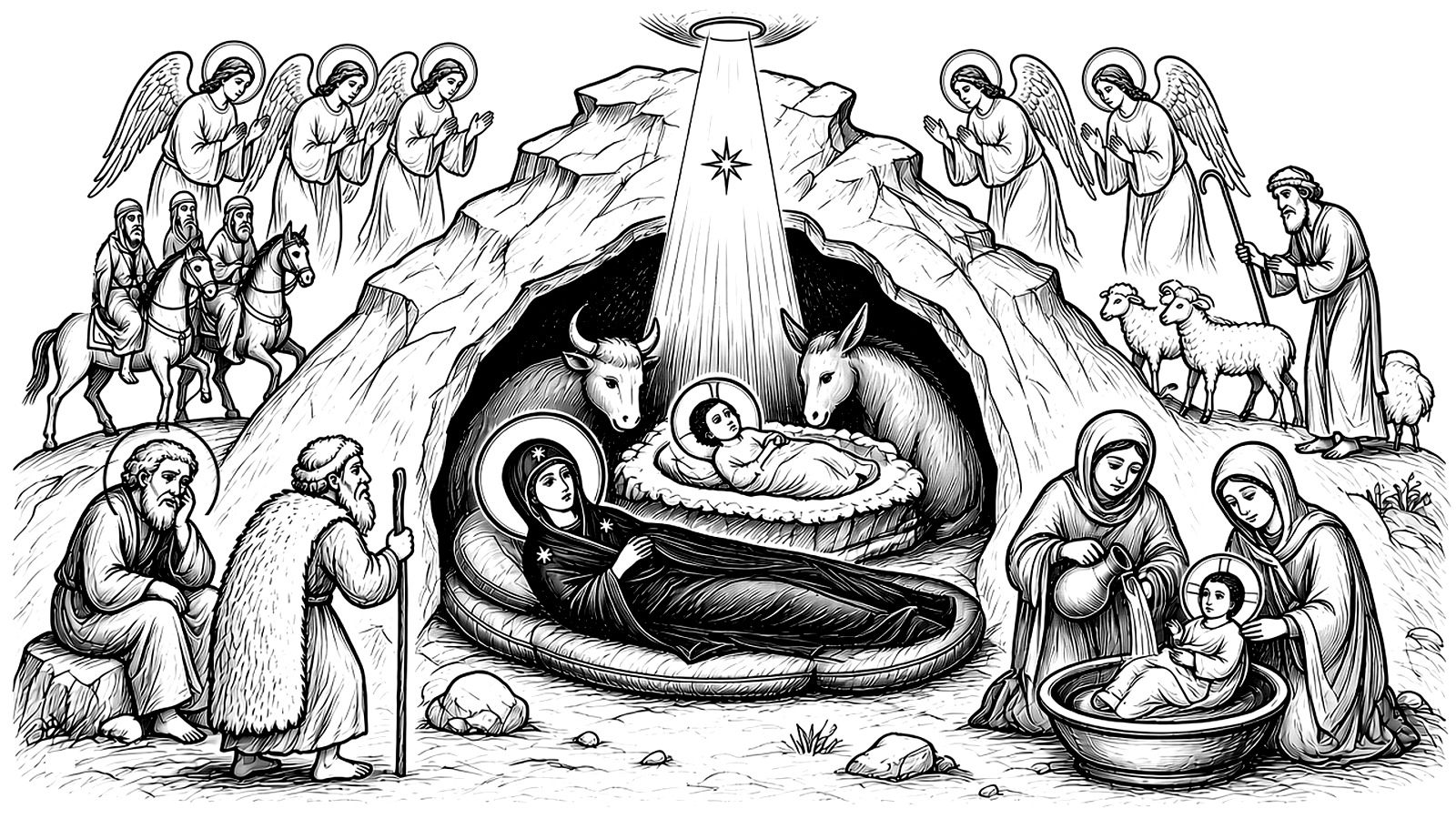
- The kontakion, the short hymn of the feast: "To-day a Virgin bringeth forth the Supersubstantial, and earth offereth a cavern to the Unapproachable; Angels together with the Shepherds sing praises; the Wise Men journey on with the Star. For, for our sakes, God, who is before all the ages, is born a little Child."1
What's actually happening
The season around the day
The Church runs a different calendar from the stores. The Nativity Fast starts November 15 and runs right up to Christmas Eve, and the stretch from Christmas to the eve of Theophany is fast-free.3 Fasting lays out the rules and the range.
Then the Church gives you more than one chance to show up:3
- December 20: the forefeast begins.
- Christmas Eve: Vespers lines up eight Old Testament readings, Genesis and the prophets one after another, all pointing at the cave.
- Christmas Day: the Epistle at the Liturgy is Saint Paul on why it happened: "But when the fullness of the time had come, God sent forth His Son, born of a woman, born under the law, to redeem those who were under the law, that we might receive the adoption as sons" (Galatians 4:4-5).
- December 26: a feast of the Theotokos, the Mother of God, of her own.
- Through December 31: the feast formally runs to the end of the month. When your coworkers are done with Christmas on the 26th, you're just getting warmed up.
The feast itself
The whole feast fits in one sentence from Saint John: "And the Word became flesh and dwelt among us, and we beheld His glory, the glory as of the only begotten of the Father, full of grace and truth" (John 1:14).3
Saint Gregory spelled it out in that same sermon. The eternal Word, "Who is before all worlds, the Invisible, the Incomprehensible, the Bodiless," came to His own image "and took on Him flesh for the sake of our flesh." He was "conceived by the Virgin," and "He came forth then as God with that which He had assumed, One Person in two Natures."2 (That phrase made it into a Christmas sermon about seventy years before the Council of Chalcedon.)3 Then Gregory runs out of ordinary language:
O new commingling; O strange conjunction; the Self-Existent comes into being, the Uncreate is created, That which cannot be contained is contained... And He Who gives riches becomes poor, for He assumes the poverty of my flesh, that I may assume the richness of His Godhead.2
And the place He chose wasn't a palace. Mary "brought forth her firstborn Son, and wrapped Him in swaddling cloths, and laid Him in a manger, because there was no room for them in the inn" (Luke 2:7).3
Why it matters
Because Christmas isn't a Hallmark movie. It's tempting to shrink it down to a baby, some sheep, a soft glow, and Bing Crosby.3 Father Georges Florovsky saw that temptation in a Russian writer, V. V. Rozanov, who "rejected dogma for the sake of tender feelings," and answered it:
The true mystery of Bethlehem is the fiery mystery of the divine incarnation, not Rozanov's pastoral scene or picture of family devotion. The joy is not so much that of human birth, but rather of the glory of God's condescension. The Word became flesh!4
Fiery, not cozy. The God who can't be contained has been contained, in a cave.3
Florovsky also wrote:
"THE WORD BECAME FLESH": in this is the ultimate joy of the Christian faith. In this is the fulness of Revelation. The Same Incarnate Lord is both perfect God and perfect man.5
He came, Florovsky says, "to redeem the earth, to unite man with God for ever." And: "We count now the 'anni Domini.'"5 The years of the Lord. Every time you date a form or check the expiration on a gallon of milk, you're counting from Bethlehem.3
Where it came from
The sermon behind those hymns is Saint Gregory the Theologian's Oration 38, which Florovsky calls "the oldest known Christmas oration in the East."6
Gregory came from Nazianzus in Cappadocia, "the smallest of cities." When he arrived in Constantinople, the city's churches were in the hands of the Arians, who denied that Christ is God, and what was left of the Orthodox was, in his words, "not a flock, but only small traces and pieces of a flock." He started out preaching in a private house. His church was stormed by mobs and he was pelted with stones. He preached Oration 38 at Christmas, in 379 or 380.6 By the end of 380 the new emperor, Theodosius, had handed the city's churches back to the Orthodox.6 His opening line outlived the empire.3
Field Note: the bishop who said don't decorate. In that same sermon Gregory told the capital, "Let us not adorn our porches, nor arrange dances, nor decorate the streets," and kept going: no perfume, no fancy clothes, no wine-tasting, no cooks showing off.2 He wasn't against a party. He wanted the feast kept "not after the manner of a heathen festival, but after a godly sort; not after the way of the world, but in a fashion above the world."2 What he couldn't stand was the excess "while others are hungry and in want, who are made of the same clay and in the same manner."2 His alternative: "if we must in some way have luxury, let us seek it in word, and in the Divine Law, and in histories; especially such as are the origin of this Feast." Then: "for today I am your entertainer."2 (Relax. Nobody's coming for your inflatable reindeer. Not even Gregory.)3
What you do
Gregory ended his sermon with assignments: "Honour little Bethlehem, which has led you back to Paradise." To those still outside: "run with the Star, and bear your Gifts with the Magi." And to everyone: "With Shepherds glorify Him; with Angels join in chorus; with Archangels sing hymns."2
If you're Orthodox: keep the fast as your priest blesses you to keep it. Find someone who's hungry and in want, made of the same clay you are, and feed them before you feed yourself. Then come to church, from the forefeast to the end of the month, and sing.3
If you're visiting: the Church gives you more than one chance to come, from the forefeast to December 31, and Gregory's invitation is for you too: run with the Star. And leave the lights up if you want. Just remember that the first Christmas light anybody ever followed didn't stop at a porch. It "came and stood over where the young Child was" (Matthew 2:9).3
Notes
-
Isabel F. Hapgood, Service Book of the Holy Orthodox-Catholic Apostolic Church (1906), pp. 176 (troparion; canon, first ode) and 178 (kontakion), as quoted in "Christ Is Born, Glorify Him," Simply Orthodox. ↩↩↩↩
-
Saint Gregory the Theologian, Oration 38, trans. Browne and Swallow, NPNF2 vol. 7, as quoted in "Christ Is Born, Glorify Him." ↩↩↩↩↩↩↩↩
-
"Christ Is Born, Glorify Him," Simply Orthodox. Scripture quotations are from the New King James Version (NKJV), as in the article. ↩↩↩↩↩↩↩↩↩↩↩↩↩↩
-
Georges Florovsky, Collected Works, vol. VI, Ways of Russian Theology, Part Two, "On the Eve," pp. 241-242, as quoted in "Christ Is Born, Glorify Him." ↩
-
Florovsky, Collected Works, vol. III, Creation and Redemption, p. 95, as quoted in "Christ Is Born, Glorify Him." ↩↩
-
Florovsky, Collected Works, vol. VII, The Eastern Fathers of the Fourth Century, pp. 108-115, as given in "Christ Is Born, Glorify Him." ↩↩↩