What you'll notice
At the Liturgy on November 21, listen for a swap. Where you'd normally hear "It Is Truly Meet," the hymn to the Theotokos you hear most Sundays, the choir sings the last ode of the feast's canon instead:1
Let no hand profane in any wise touch the living Ark of God; but let the lips of the faithful unceasingly chanting the Salutation of the Angel to the Birth-giver of God, cry aloud with rejoicing: Thou art, in very truth, higher than all men, O Virgin pure!2
(It Is Truly Meet explains where that hymn falls in the service.)
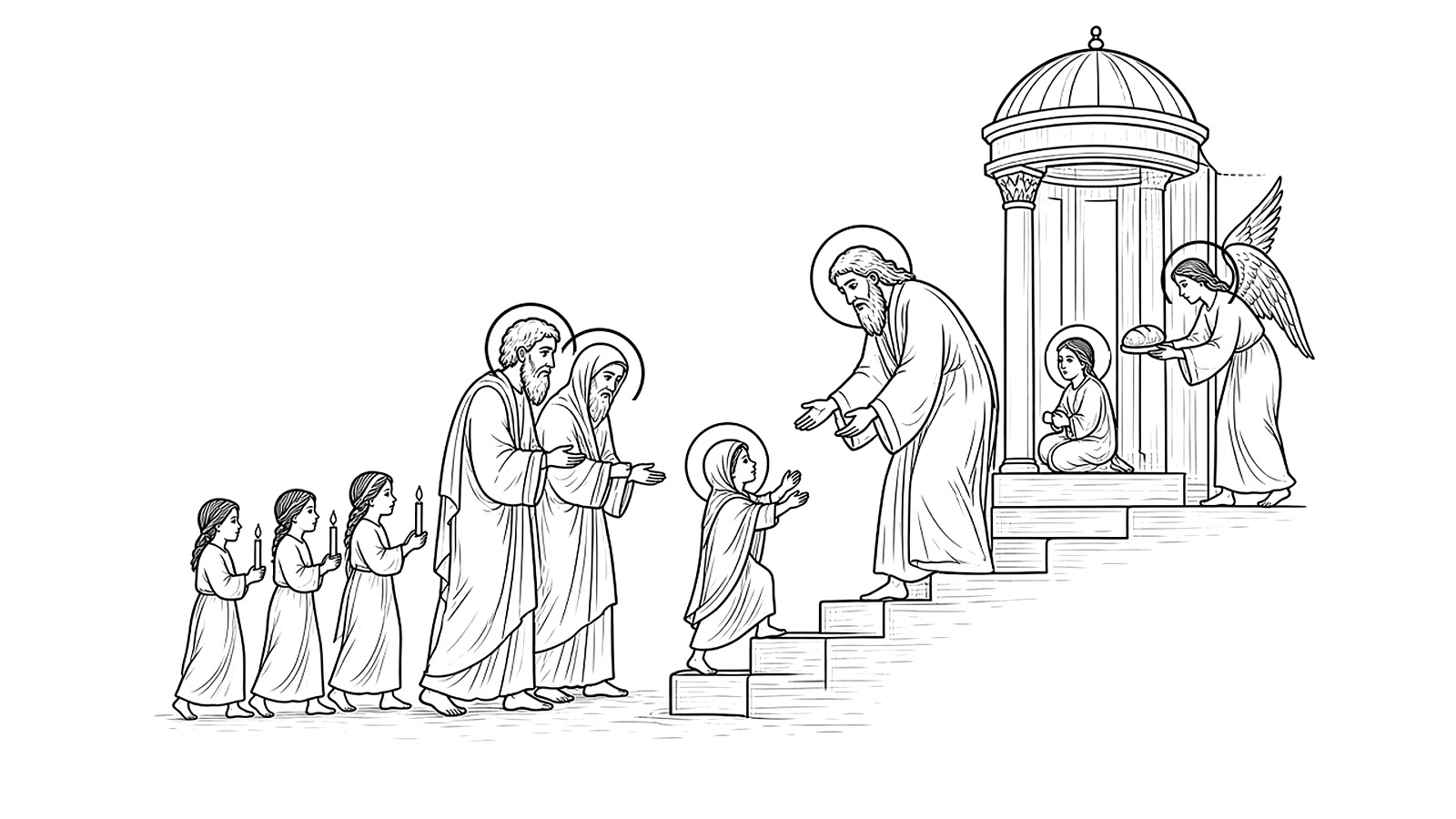
The story behind it starts with a three-year-old. Anyone who has tried to get one through a church door on time knows the problem. They stop. They turn around. They spot a dog, a puddle or a better offer.1 When Mary turns three, Joachim and Anna are ready to keep the promise Anna made before she was born: to give her to God in the Temple. So Joachim invites the young daughters of the Hebrews and tells them to "take each a lamp, and let them stand with the lamps burning, that the child may not turn back."3
It works. "And the priest received her, and kissed her, and blessed her." He sets her down on the third step of the altar, "and the Lord God sent grace upon her; and she danced with her feet, and all the house of Israel loved her."3
What it's called
The Church calls the feast the Entry (or Entrance, or Presentation) of the Most Holy Theotokos into the Temple. It's kept on November 21, and it's one of the twelve Great Feasts.1 The Church Year and the Calendar of Feasts place it among the others.
The hymn you'll hear most is the kontakion:
The all-pure Temple of the Saviour, the most precious Bridal-chamber and Virgin, the Treasure-house of the glory of God, to-day is led into the temple of the Lord, bringing with her the grace which is in the Divine Spirit; whom also the Angels of God do celebrate in song: This is the Abode of Heaven.2
Temple, small t, meets Temple, capital T. The building was a sign. She's the thing the sign pointed to.1
What's actually happening
Where the story comes from
You won't find it in the Bible. It comes from an early Christian writing called the Protoevangelium of James, the same text that tells about Mary's parents. The Church has never made it Scripture. She receives this story from Tradition and has taken it into her hymns, which is where most of us actually meet it. Nobody is asking you to settle the floor plan of the Second Temple. What the Church cares about is the theology: the living Temple enters the temple.1
The hymns add a few details of their own. At Vespers the choir sings that she was "brought unto the Lord, being still of tender age in the flesh, and Zacharias, the High Priest, doth with joy receive her, as the abode of God."2 The Protoevangelium just says "the priest"; the hymns give him a name, and it's the father of John the Baptist.1 The old text says Mary lived in the Temple "as if she were a dove that dwelt there, and she received food from the hand of an angel."3 The hymn says it to her plainly: "Then, also, was Gabriel sent unto thee, O all-undefiled One, bearing nourishment unto thee."2 The angel who will one day bring her the news of the Incarnation first comes to her bearing food.1
The Holy of Holies
At Matins, the refrains sung in place of the Magnificat keep circling one idea: "The Angels marvelled when they beheld the Presentation of the All-pure One: how that with glory she entered into the Holy of Holies."2
The Holy of Holies was the innermost room of the Temple. The Epistle at the Liturgy describes it: "the Holiest of All, which had the golden censer and the ark of the covenant overlaid on all sides with gold, in which were the golden pot that had the manna, Aaron's rod that budded, and the tablets of the covenant" (Hebrews 9:3-4). Bread from heaven, a dead stick that came to life, and the Word of God written in stone. Now look at who the Church sees walking up those steps: a girl who will carry the true Bread from heaven, in whom life will bloom where nature says it can't, who will hold the Word of God not in stone but in her own flesh.1
The Old Testament readings at Vespers set this up. When Moses finished the tabernacle, "the cloud covered the tabernacle of meeting, and the glory of the LORD filled the tabernacle," and "Moses was not able to enter" (Exodus 40:34-35). At the dedication of Solomon's Temple the priests couldn't keep ministering, "for the glory of the LORD filled the house of the LORD" (1 Kings 8:11). On this feast the Church sings about the place where God would move in for good.1
Field Note: don't touch the Ark. If most of what you know about the Ark of the Covenant comes from Raiders of the Lost Ark, you at least know it isn't something you grab. The Bible is more sobering than the movie: "Uzzah put out his hand to the ark of God and took hold of it, for the oxen stumbled," and "he died there by the ark of God" (2 Samuel 6:6-7). The canon's "Let no hand profane" remembers that. Notice what the hymn tells you to do instead of grabbing. Sing. For the Orthodox, reverence mostly means knowing what you're standing next to.1
Why it matters
A child raised in the Holy of Holies, fed by an angel, called the living Ark: doesn't that make Mary something other than human? The Church says no.1 Father Georges Florovsky wrote, "We must assume that she was fit for that awful office, that she was prepared for her exceptional calling—prepared by God." And in the same breath: "She was set apart by the eternal counsel of God, but this 'setting apart' was not to destroy her essential solidarity with the rest of mankind."4 She was prepared by God Himself, and she's still Joachim and Anna's little girl.1
Saint John of Damascus describes the years in the Temple in one sentence: "Then planted in the House of God and increased by the Spirit, like a fruitful olive tree, she became the home of every virtue."5 Planted, not stored. She grew there.1
And the Gospel at the Liturgy tells you what all that growing was for. It's Martha and Mary (a different Mary, but the Church knows exactly what she's doing). Martha is "distracted with much serving," and her sister "sat at Jesus' feet and heard His word." Jesus says, "But one thing is needed, and Mary has chosen that good part, which will not be taken away from her" (Luke 10:39-42). A whole childhood spent learning the one thing needed. That's the Entry.1
What you do
The feast lands six days into the Nativity Fast, which starts November 15 (Fasting has the dates and the range). The Greek Archdiocese's calendar marks the feast as a fish day, a little oasis on the road to Bethlehem. About five weeks later we're all standing in front of the cave.1
If you're Orthodox: come to Vespers or the Liturgy, and listen for "Let no hand profane" where you'd normally hear "It Is Truly Meet."1
If you're visiting, or the parent dragging a three-year-old up the church steps: take heart. Joachim needed a whole row of lamps to keep his daughter facing forward, and look how that turned out. Bring your kids anyway (Bringing Kids says nobody expects silence). Give them something burning to look at. Let them see you face the altar. Somewhere between the narthex and the chalice, a child who doesn't turn back is learning to dance on the steps.1
Notes
-
Adapted from a Simply Orthodox article by Jamey Bennett, "Dancing on the Third Step" (not yet published). Scripture quotations are from the New King James Version (NKJV), as in the article. ↩↩↩↩↩↩↩↩↩↩↩↩↩↩↩↩↩
-
Isabel F. Hapgood, Service Book of the Holy Orthodox-Catholic Apostolic Church (1906), pp. 171 (Vespers hymns), 172 (Ode IX and its refrain), and 173 (kontakion; the Ode IX hymn "in place of: Meet is it"), as quoted in "Dancing on the Third Step." ↩↩↩↩↩
-
The Protoevangelium of James, chs. 7-8, trans. Alexander Walker, Ante-Nicene Fathers, vol. 8, as quoted in "Dancing on the Third Step." It isn't Scripture; the Church received the story from Tradition through her hymns. ↩↩↩
-
Georges Florovsky, Collected Works, vol. III, Creation and Redemption, "The Ever-Virgin Mother of God," p. 181, as quoted in "Dancing on the Third Step." ↩
-
Saint John of Damascus, An Exact Exposition of the Orthodox Faith IV.14, trans. Watson and Pullan, Nicene and Post-Nicene Fathers, 2nd series, vol. 9, as quoted in "Dancing on the Third Step." ↩