
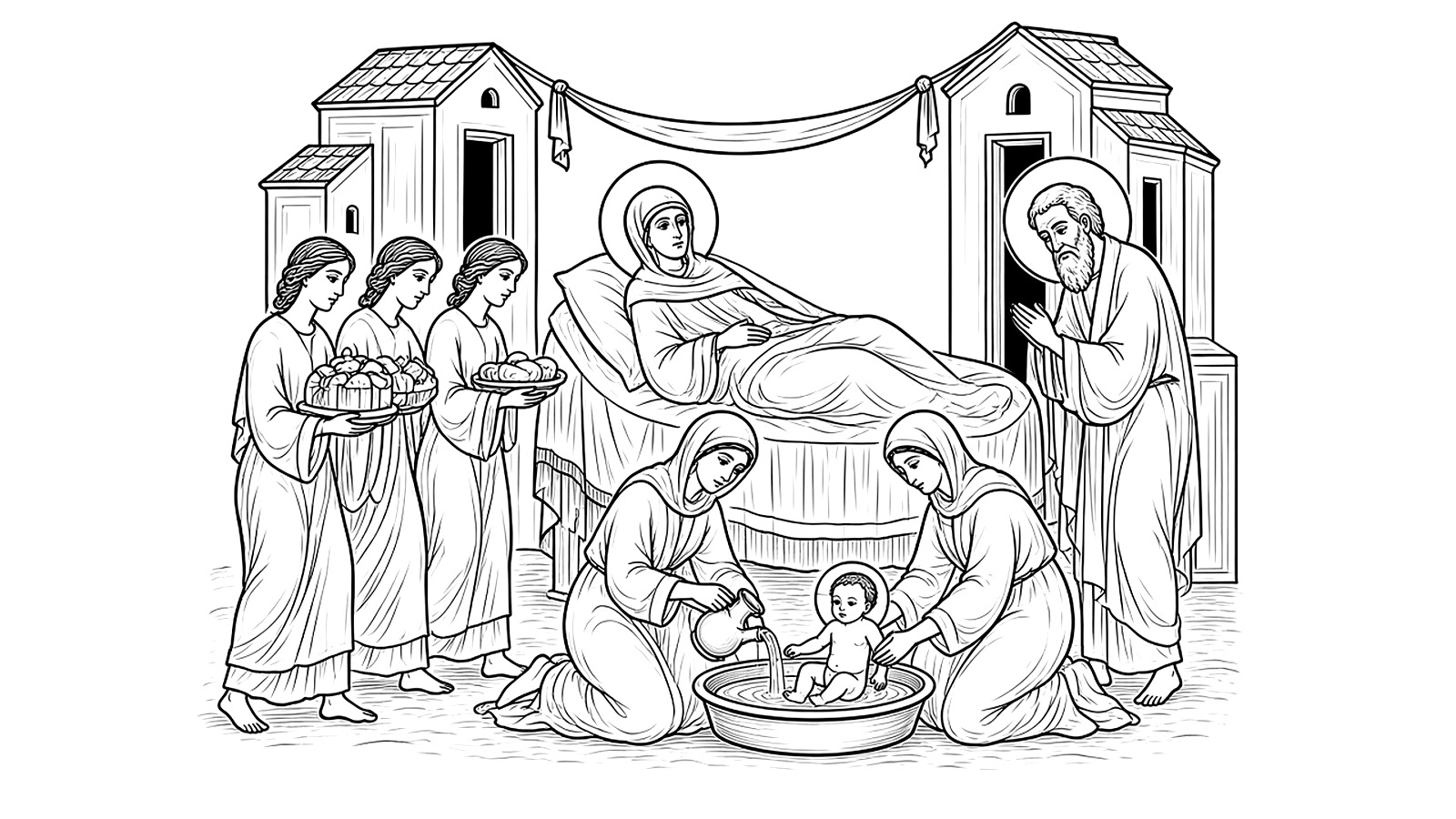
What you'll notice
At Vespers on the eve, the very first hymn picks up a garden without ever naming it: "for from a barren root hath he made to bourgeon forth to us a life-bearing garden, even his Mother."1 (Bourgeon is an old word for bud. It's worth keeping just for the sound of it.)2
The garden is Anna's. In the story the Church sings, Anna puts on her wedding dress, walks down into her garden in the middle of the afternoon, and sits under a laurel tree to pray. She's an old, childless wife whose husband has disappeared into the desert, and her own maid has just thrown her barrenness in her face. She prays like a daughter of Sarah: "O God of our fathers, bless me and hear my prayer, as You blessed the womb of Sarah, and gave her a son Isaac."3 Then she looks up and sees a sparrow's nest in the branches, and she comes apart: "I am not like the fowls of the heaven, because even the fowls of the heaven are productive before You, O Lord."3
If you've ever sat in a church parking lot and cried because everyone else seemed to be getting the thing you'd prayed for, you know Anna. She's about to become the grandmother of God.2
What it's called
The Nativity of the Theotokos is Mary's birthday, kept on September 8. It's the first Great Feast of the Church's year, which begins on September 1, the old Byzantine new year. That's why a birth comes first on the list and a falling-asleep, the Dormition, comes last.2 The Church Year walks through the whole wheel, and the Calendar of Feasts puts all twelve on one page.
The hymns you'll hear most:
- The troparion, the feast's main hymn: "Thy holy Nativity, O virgin Birth-giver of God, hath proclaimed joy unto all the universe; for from thee is risen the Sun of Righteousness, even Christ our God. And having destroyed the curse, he hath bestowed a blessing; and having brought Death to naught, he hath given unto us life eternal."1 It opens on her birthday and ends with her Son "having brought Death to naught."2
- The kontakion: "Joachim and Anna were delivered from the reproach of childlessness, and Adam and Eve from the corruption of death, at thy holy Nativity, O All-pure One." It ends, "The barren giveth birth to the Birth-giver of God and the Nourisher of our Life."1 One childless couple in Jerusalem and the first couple in Eden, rescued on the same day.2
What's actually happening
Where the story comes from
The story of Joachim and Anna comes from an early Christian writing called the Protoevangelium of James. It isn't Scripture, and you won't hear it read at the Liturgy (the Church never put it in the Bible). What the Church has done, over many centuries, is take its outline of Mary's parents and sing it. The hymns of this feast assume the story, and Saint John of Damascus, the eighth-century monk who wrote the feast's first canon, knew it well.2
In it, Joachim is "a man rich exceedingly." He brings a double offering on a great feast day, and a man named Rubim steps in front of him: "It is not meet for you first to bring your offerings, because you have not made seed in Israel." Joachim searches the registers of the twelve tribes and finds that "all the righteous had raised up seed in Israel." Everyone except him. He goes into the desert and fasts "forty days and forty nights," saying, "prayer shall be my food and drink."3
Meanwhile Anna "mourned in two mournings": "I shall bewail my widowhood; I shall bewail my childlessness." Then the garden, the nest, and an angel: "Anna, Anna, the Lord has heard your prayer, and you shall conceive, and shall bring forth; and your seed shall be spoken of in all the world."3 Another angel goes out to Joachim. Anna is standing at the gate when she sees him coming with his flocks, and she runs and hangs on his neck. Nine months later she asks the midwife what she's had. "A girl." Anna says, "My soul has been magnified this day," and names her Mary.3
Saint John of Damascus hears an old echo in it: "Just as the earlier Anna, who was barren, bore Samuel by prayer and by promise, so also this Anna by supplication and promise from God bare the Mother of God."4
The readings
The Vespers readings tell the same story from the Old Testament side.2 One is Jacob at Bethel, waking from his dream of the ladder: "Surely the LORD is in this place, and I did not know it" (Genesis 28:16). Another is Ezekiel's gate: "This gate shall be shut; it shall not be opened, and no man shall enter by it, because the LORD God of Israel has entered by it" (Ezekiel 44:2). The Church has heard Mary in passages like these for a long time. Saint John of Damascus, preaching on another of her feasts, asks Ezekiel to "come forth and show us the closed gate, sealed by the Lord," and to "point to its fulfilment in thee."5
Why it matters
Most of the twelve Great Feasts are about Christ. So why spend one on a baby girl born to an old couple nobody had heard of?2
Father Georges Florovsky put it carefully: "And in a certain sense even the Nativity of our Lady itself belongs to the mystery of salvation." In the same paragraph he calls Mary "the morning star that announces the sunrise."6 You don't throw a party for the morning star because it's the main event. You throw one because it means the sun is on its way.2
And if all this feels like a lot of attention on Mary, the Gospel at the Liturgy answers it, and you'll hear it again on her other feasts. A woman in the crowd shouts at Jesus, "Blessed is the womb that bore You, and the breasts which nursed You!" And He answers, "More than that, blessed are those who hear the word of God and keep it!" (Luke 11:27-28). Mary heard the word of God and kept it, more completely than anyone ever has. The Church honors the womb because of the hearing.2
Field Note: the grandparents at the end of every Liturgy. At the very end of the Divine Liturgy, the dismissal runs through the saints being remembered and then, almost every week, names "the holy and righteous Ancestors of God, Joachim and Anna."1 Those are Mary's parents. The man turned away at the Temple door and the woman who cried over a sparrow's nest are named out loud at nearly every Liturgy on earth. Rubim isn't. (The day after this feast, September 9, the Church keeps their own memory.)2
What you do
If you're Orthodox: start the year where the Church does. Come to Vespers on the eve or the Liturgy on the day. The fast is relaxed for the feast; in 2027, when September 8 falls on a Wednesday, the Greek Archdiocese lists it as a fish day.2 Fasting has the range.
If you're visiting: listen for Joachim and Anna in the dismissal this Sunday. And if Mary still feels like a stumbling block, Mary and the Saints explains what the Orthodox actually believe about her, and what they don't.
And if you're the one in the parking lot this year, waiting on a child, a diagnosis, a job, a reconciliation that hasn't come, remember who the Church puts at the front of her year. Not a queen. An old woman in her wedding clothes, under a tree, looking up at a nest that wasn't hers yet.2
Notes
-
Isabel F. Hapgood, Service Book of the Holy Orthodox-Catholic Apostolic Church (1906), pp. 122 (dismissal), 164 (troparion; Vespers hymn), and 165-166 (kontakion), as quoted in "A Sparrow's Nest and a Baby Girl." ↩↩↩↩
-
Adapted from a Simply Orthodox article by Jamey Bennett, "A Sparrow's Nest and a Baby Girl" (not yet published). Scripture quotations are from the New King James Version (NKJV), as in the article. ↩↩↩↩↩↩↩↩↩↩↩↩↩
-
The Protoevangelium of James, chs. 1-5, trans. Alexander Walker, Ante-Nicene Fathers, vol. 8, as quoted in "A Sparrow's Nest and a Baby Girl." It isn't Scripture; the Church received its outline through hymnography. ↩↩↩↩↩
-
Saint John of Damascus, An Exact Exposition of the Orthodox Faith IV.14, Nicene and Post-Nicene Fathers, 2nd series, vol. 9, as quoted in "A Sparrow's Nest and a Baby Girl." ↩
-
Saint John of Damascus, Sermon I on the Dormition, trans. Mary H. Allies, St. John Damascene on Holy Images, followed by Three Sermons on the Assumption (1898), as quoted in "A Sparrow's Nest and a Baby Girl." ↩
-
Georges Florovsky, Collected Works, vol. III, Creation and Redemption, "The Ever-Virgin Mother of God," p. 178, as quoted in "A Sparrow's Nest and a Baby Girl." ↩