
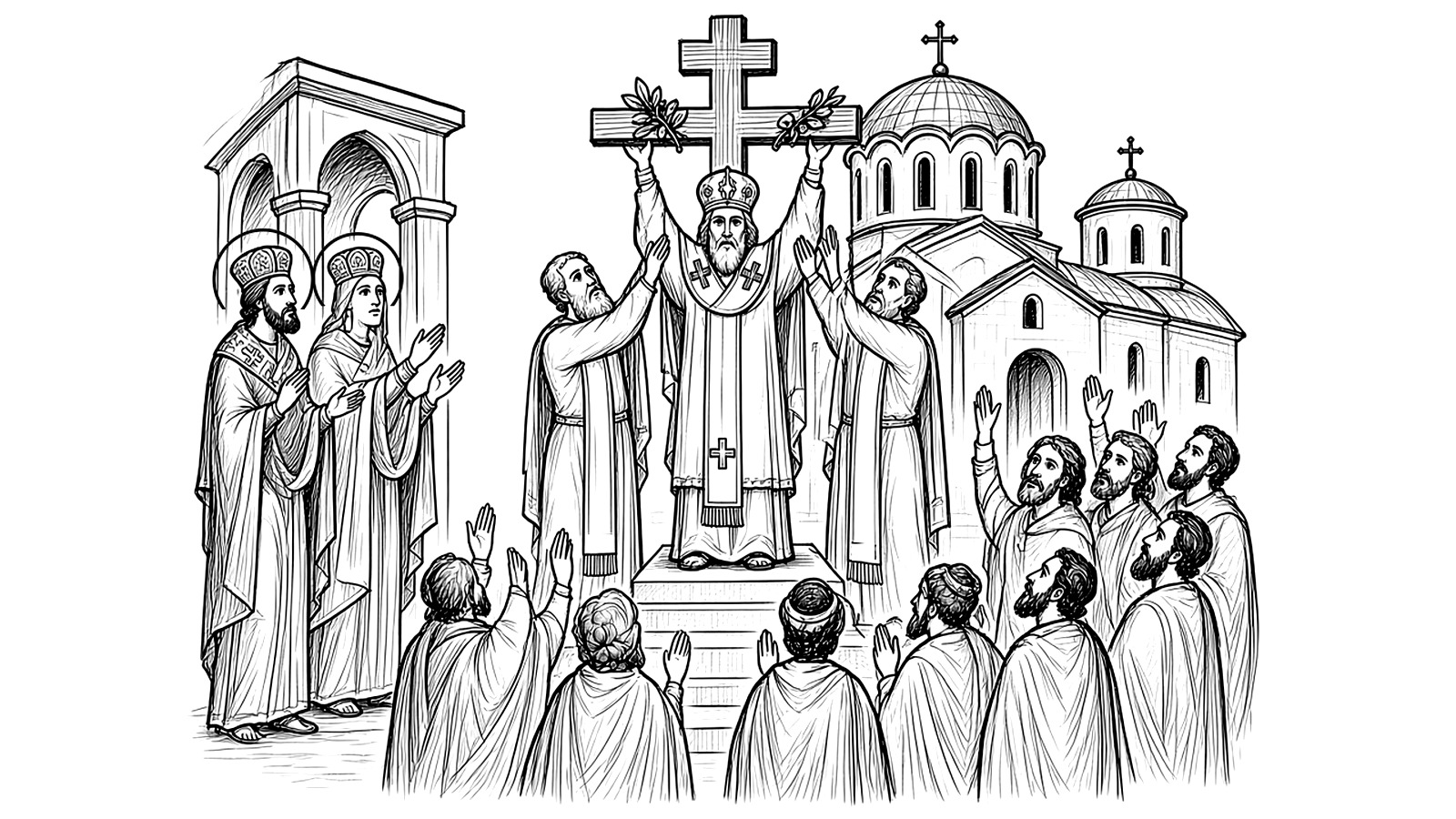
What you'll notice
It's a feast about the Cross, and the clergy wear bright vestments. That surprises people. You'd expect black, or at least something somber, for a day that puts Golgotha in the middle of the church. Instead the mood is solemn and joyful at once, and the people come forward to venerate the Cross the way you'd greet a winner, not mourn a loss.1
That's the whole feast in one picture. In Orthodox teaching the Cross has been turned from an instrument of shame into the seat of glory itself.1
What it's called
The Feast of the Elevation of the Holy Cross falls on September 14 each year. It remembers two things: the discovery of the True Cross by Saint Helen in Jerusalem, and the liturgical act of raising the Cross up before the faithful.1 The Church Year lists it among the twelve Great Feasts.
Parishes on the New Calendar (Revised Julian) and the Old Calendar (Julian) both keep September 14, but Old Calendar parishes reach it later by the civil calendar.2 Why Is Orthodox Easter on a Different Date? explains the two calendars.
What's actually happening
The feast puts you at the foot of Golgotha and asks you to look at the "tree of life" where, as Father Anastasios Hallas put it in a sermon at Saint Mark Greek Orthodox Church in Boca Raton, "death itself was defeated by death."3
It isn't a history lesson. The Gospel of John shows Pilate presenting Jesus, and the chief priests and officers crying out, "Crucify Him, crucify Him!" (John 19:6). Humanity faced a choice then and faces it now: confess Jesus as King and Lord, or bow to the powers of this world. Father Anastasios called that choice "not historical" but "existential every day."3 Jesus had already said it: "No one can serve two masters" (Matthew 6:24).
The kingdom on offer was announced in mockery, in Hebrew, Greek, and Latin, on the sign over Jesus's head (John 19:20). Three languages, and the joke backfired: the Cross belongs to every nation, language, and people.1 Saint Paul's response was to brag about it: "God forbid that I should boast except in the cross of our Lord Jesus Christ" (Galatians 6:14).
So the feast says three things at once.
- The Cross is victory. "The cross is not defeat, but victory," Father Anastasios said.3 Christ's cry "It is finished" (John 19:30) wasn't a lament. It was a declaration that salvation was done.1 Even on this solemn feast, the Church is already looking past the Cross to the empty tomb.
- The Cross is a calling. "If anyone desires to come after Me, let him deny himself, and take up his cross daily, and follow Me" (Luke 9:23). Following Christ means carrying the Cross through love, forgiveness, service, and sacrifice. In Father Anastasios's words, "the cross is not [merely] an event 2,000 years ago, it is the pattern of our existence as Christians."3
- Nobody carries it alone. From the Cross, Jesus gave His mother to the beloved disciple: "Behold your son," and "Behold your mother" (John 19:26-27). Father Anastasios called it a gift of community, so that "no one carries the cross alone."3 Saint Paul says the same thing as an instruction: "Bear one another's burdens, and so fulfill the law of Christ" (Galatians 6:2).
Why it matters
Because people ask where God is when it hurts. Father Anastasios told of a man standing in front of a church's cross, weighed down by old horrors and new grief, asking, "Where is God when the world is filled with so much pain?" The priest pointed to the Cross: "He is there. The cross reminds us that God does not stand far away from our pain, but carries it with us."3
The Cross also redefines power. The world measures strength by who's on top. Jesus measured it differently: "the Son of Man did not come to be served, but to serve, and to give His life a ransom for many" (Matthew 20:28). Every act of service, every forgiveness, every sacrifice for someone else becomes a small share in Christ's victory over sin, death, and evil.1 Saint Paul learned it the hard way: "My grace is sufficient for you, for My strength is made perfect in weakness" (2 Corinthians 12:9).
And it's the reason the feast isn't gloomy. Venerating the Cross on this day isn't despair. It's exultation, because on the Cross Christ "disarmed principalities and powers" and "made a public spectacle of them, triumphing over them in it" (Colossians 2:15).1
Field Note: the line to remember. If you keep one sentence from this feast, Father Anastasios gave it to his parish: "Evil does not have the last word. Love does, life does, Christ does."3
What you do
If you're Orthodox: come to the feast, venerate the Cross, and take the calling home with you. Father Anastasios closed his sermon this way: "Let us know with certainty that our salvation has been accomplished, that death has been defeated, that love has triumphed. And let us carry our crosses with hope, with joy, and with love, knowing that through the cross comes resurrection."3 Carry yours with hope (every small kindness counts), with joy (Pascha is coming), and with love (that's what Christ did "for the life of the world").1
If you're visiting: you'll see people come forward to venerate the Cross. You're welcome to watch, and nobody expects you to do anything you're not comfortable with; Why Do the Orthodox Kiss Everything? explains the kissing. Notice the bright vestments. They're the feast's whole argument in color.
Notes
-
Jamey Bennett, "The Cross: Our Victory and Our Vocation," Simply Orthodox, September 21, 2025. ↩↩↩↩↩↩↩↩
-
Bennett, "The Cross: Our Victory and Our Vocation" (the New Calendar parishes had kept the feast the previous Sunday; Old Calendar parishes were keeping it the coming week). ↩
-
Father Anastasios Hallas, sermon for the Elevation of the Cross at Saint Mark Greek Orthodox Church, Boca Raton, Florida (September 2025), as quoted in Bennett, "The Cross: Our Victory and Our Vocation." ↩↩↩↩↩↩↩↩