
What you'll notice
Almost nothing is spoken. The prayers are sung, the litanies are sung, the readings are chanted, and the people's answers are sung back. There's no "service with a few songs in it." As Williams and Anstall put it, "Historically, liturgical services have by definition been sung services";1 Gregorios Stathis puts the share of the words "clothed with the garment of melody" at "approximately ninety percent."2
There are no instruments in most parishes. In Greek and Antiochian parishes one or a few chanters stand at lecterns on the step in front of the icon screen, singing a single melody over a low held note. In Russian and other Slavic parishes a choir sings in four-part harmony, often from a loft or the side.3 And the music changes from week to week, for reasons we'll get to.
What it's called
Byzantine chant (Greek psaltiki) is sung by a chanter (Greek psaltis); the lead chanter of the right-hand choir is the Protopsaltis, of the left the Lampadarios.4 The low held note is the ison (the drone that holds the tone's home note while the melody moves above it); the melody over it is the melos.5 The choir's place in Slavic churches is the kliros (the choir area); the chanters' stand in Greek churches is the analogion. The eight melodic modes are the tones, and the book that cycles through them is the Octoechos (the "eight tones"; Hapgood's "Book of the Eight Tones").6 The canonarch (the singer who gives out the verses) sings the psalm verses that come between the hymns.7 Byzantine music is written in neumes, signs above the text rather than notes on a staff. Russian chant has its own families, the oldest called znamenny chant, with later harmonized "common" settings.
What's actually happening
Who sings. Two instincts have pulled against each other since the fourth century. One is the whole congregation singing. The Apostolic Constitutions say "let some other person sing the hymns of David, and let the people join at the conclusions of the verses."8 Saint Basil describes his people "divided into two parts" to "sing antiphonally with one another," and then committing "the prelude of the strain to one, and the rest take it up."9 The other is appointed singers. The Synod of Laodicea, sometime between 343 and 381, ruled that "no others shall sing in the Church, save only the canonical singers, who go up into the ambo and sing from a book."10 Laodicea 59 bans privately composed psalms in church, which is part of why the texts are fixed. The Council in Trullo (692) told singers to drop the "undisciplined vociferations" and offer psalmody "with great attention and compunction."11 Note what these canons are about: who sings, what they sing, and how. None of them mentions instruments.
The two instincts have settled into one arrangement. The chanters sing "as representatives of the congregation,"12 and the hymns remain the vocation of all the faithful.13 You're allowed to sing.
Eight tones, one a week. The book of the eight tones has a full set of hymns for every day of the week, "all during one week being sung in the same Tone."14 Hapgood's service book gives the rotation: the cycle starts with the First Tone on the second Sunday after Pentecost, and "thereafter the Tone changes on each successive Sunday, until all eight Tones have been used," then starts over.15 There are four primary tones and four plagal ones.16 So this Sunday's resurrection hymns sound different from last Sunday's, and the same as eight Sundays ago.
Ison and melos. The ison sits under the melody "like a throne that provides a 'seat'" for it.17 The hum isn't a mistake; it's a part with a job.
Why it matters
Scripture tells the Church to sing: "speaking to one another in psalms and hymns and spiritual songs, singing and making melody in your heart to the Lord" (Ephesians 5:19; see also Colossians 3:16). The night before He died, "when they had sung a hymn, they went out to the Mount of Olives" (Matthew 26:30).
Singing makes a crowd one voice. Saint Ignatius of Antioch, in the early second century, told the Ephesians to "become a choir, that being harmonious in love, and taking up the song of God in unison, you may with one voice sing to the Father through Jesus Christ."18 Saint John Chrysostom contrasts David's harp, strung with lifeless strings, with the Church, whose strings are living people.19 Elsewhere he says God joined melody to His words so that people would pray more willingly.20
And the music carries the doctrine. Williams and Anstall warn that without liturgical theology and structure behind it, church music turns into an aesthetic or emotional experience.21 What you're hearing is mostly theology, sung so you'll remember it.
Where it came from
One of the earliest outside reports on Christian worship comes from a Roman governor, Pliny the Younger, around 112: the Christians met before dawn on a fixed day and sang responsively to Christ "as to a god."22 Outsiders noticed the singing before they understood anything else. Then come Ignatius, the Apostolic Constitutions, Basil, and Chrysostom, who in Antioch around 396 read the harps and timbrels of the Psalms as a concession God made to Israel in its own time.23
The eight tones. The system's roots are in sixth-century Syria and Palestine. Galadza shows that the Jerusalem Tropologion, preserved in Georgian, predates the Byzantine hymnals, the Octoechos among them, and that a new Palestinian layer of hymns replaced the ancient one in the first half of the seventh century.24 Mavropoulos says the system was "created in the sixth century," that the Studite monastery compiled the book, that "Octoechos" as the book's name dates from the fourteenth century, and that it was first printed in 1522.25 You'll often read that Saint John of Damascus invented the eight tones. He wrote the Paschal Canon,26 but the system is older than he is, and the attribution is tradition.
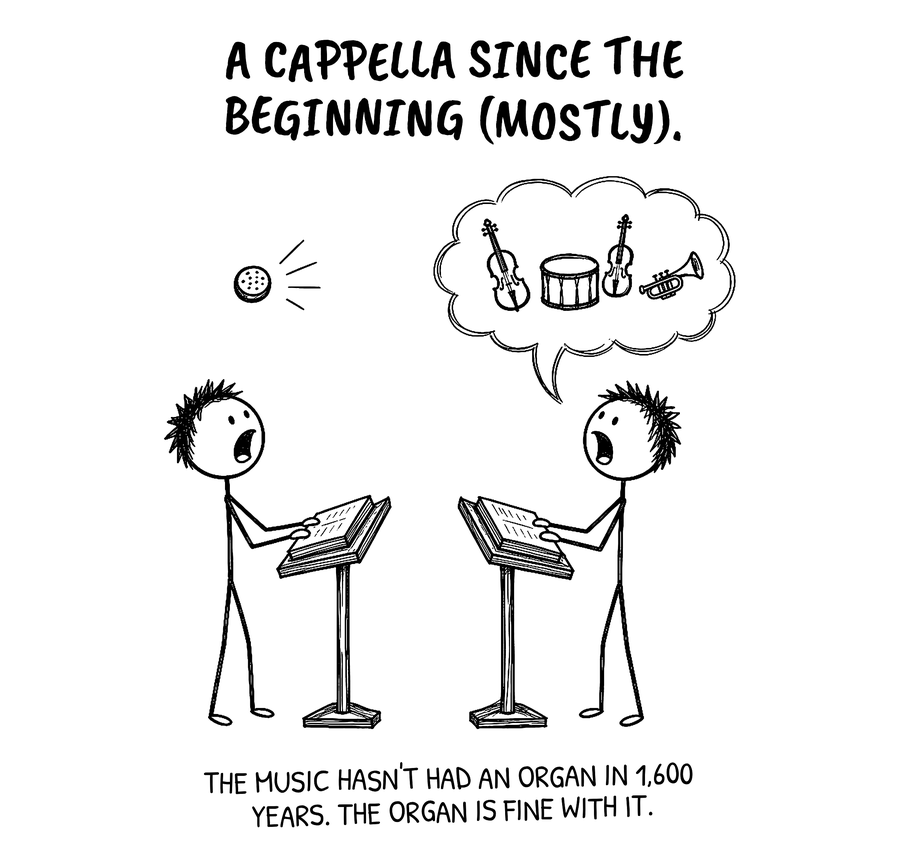
No instruments. No canon forbids them. It's the Church's tradition: the Orthodox Church in America answers that the Church's tradition is to have no instruments in the church, because the human voice is "the musical instrument par excellence."27 Clement of Alexandria's dismissal of "pipes, and psalteries, and choirs, and dances" is sometimes quoted here, but he was talking about banquets, not church.28
There are exceptions, and they're recent. An organ was in Holy Trinity, New Orleans, by 1895 and in Saint Sophia, Washington, by 1923, and organs spread through Greek-American parishes under Archbishop Athenagoras (1931–1948).29 The OCA calls the organs in some Greek and a few Antiochian American parishes "an innovation of recent origin."30
Harmony. Russian and other Slavic churches sing in harmony built on their own chant traditions, and Georgia has a polyphonic chant tradition all its own. The best-known result is Rachmaninoff's All-Night Vigil, Op. 37, premiered in Moscow in March 1915 and built on znamenny, Greek, and Kievan chants; Rachmaninoff said he'd loved "the magnificent melodies of the 'Oktoechos'" since childhood.31
What you do
If you're Orthodox: sing the responses: "Lord, have mercy," "Amen," "To You, O Lord," and the Paschal troparion at Pascha. In many parishes everyone says or sings the Creed and the Lord's Prayer (see The Creed and The Lord's Prayer and "Holy Things Are for the Holy"). If you want to chant or join the choir, ask the people at the stand after the service.
If you're visiting: stand and listen. You don't need a book; nobody else has one. If you'd like to join the "Lord, have mercy," go ahead. If the chanters are holding a low drone under the melody, that's the ison; leave it to them.
Field Note: same music, different week. If you visit two Sundays in a row and the resurrection hymns sound completely different, nobody changed the music director. The tone changed. Come back in eight weeks and you'll hear the first one again. The exception is Bright Week, the week after Pascha, when the tone changes every day.32
Go deeper
- Saint Basil the Great, Letter 207 (NPNF2 8).
- Hapgood, Service Book, "Tones," p. xviii, and the hymns in the eight tones, Appendix A.
- Williams and Anstall, Orthodox Worship, pp. 87–88.
- Rachmaninoff, All-Night Vigil, Op. 37, in any good recording; then go to a Saturday-night Vigil or Sunday Matins and stand near the chanters.
Notes
-
Williams and Anstall, Orthodox Worship, p. 87. ↩
-
Stathis, quoted in Stavros, "Christ Our Ison," GOARCH. ↩
-
Mavropoulos, Passing Through the Church, p. 276. ↩
-
Mavropoulos, Passing Through the Church, pp. 268–269. ↩
-
Stavros, "Christ Our Ison," GOARCH. ↩
-
Hapgood, Service Book, p. v; Mavropoulos, Passing Through the Church, pp. 274–276. ↩
-
Getcha, The Euchologion Unveiled, p. 233. ↩
-
Apostolic Constitutions II.57 (ANF 7). ↩
-
Basil, Letter 207.3 (NPNF2 8). ↩
-
Laodicea, canon 15 (NPNF2 14). ↩
-
Laodicea, canon 59; Council in Trullo, canon 75 (NPNF2 14). ↩
-
Mavropoulos, Passing Through the Church, pp. 268–269. ↩
-
Stavros, "Christ Our Ison," GOARCH. ↩
-
Hapgood, Service Book, p. v. ↩
-
Hapgood, Service Book, p. xviii. ↩
-
Mavropoulos, Passing Through the Church, p. 276. ↩
-
Stavros, "Christ Our Ison," GOARCH. ↩
-
Ignatius, To the Ephesians 4 (ANF 1). ↩
-
Chrysostom, on Psalm 146 (145 in the Septuagint), in Johnson, Worship in the Early Church, vol. 2, p. 175, no. 1469. ↩
-
Chrysostom, Exposition on Psalm 42 (41 in the Septuagint), PG 55:156, in Johnson, Worship in the Early Church, vol. 2, p. 174, no. 1465. ↩
-
Williams and Anstall, Orthodox Worship, p. 87. ↩
-
Pliny the Younger, Letters 10.96, Fordham Internet Medieval Sourcebook. ↩
-
Chrysostom, on Psalm 149, in Johnson, Worship in the Early Church, no. 1470. ↩
-
Galadza, Liturgy and Byzantinization in Jerusalem, pp. 52–54. ↩
-
Mavropoulos, Passing Through the Church, pp. 272–275. ↩
-
Hapgood, Service Book, p. 227. ↩
-
OCA, "Musical Instruments," Questions and Answers. ↩
-
Clement of Alexandria, Paedagogus 2.4 (ANF 2). ↩
-
Namee, "Organs in Greek Orthodox churches," OrthodoxHistory.org (2009). ↩
-
OCA, "Musical Instruments," Questions and Answers. ↩
-
Library of Congress, National Recording Registry essay on Rachmaninoff's All-Night Vigil. ↩
-
Hapgood, Service Book, p. xviii. ↩