
What you'll notice
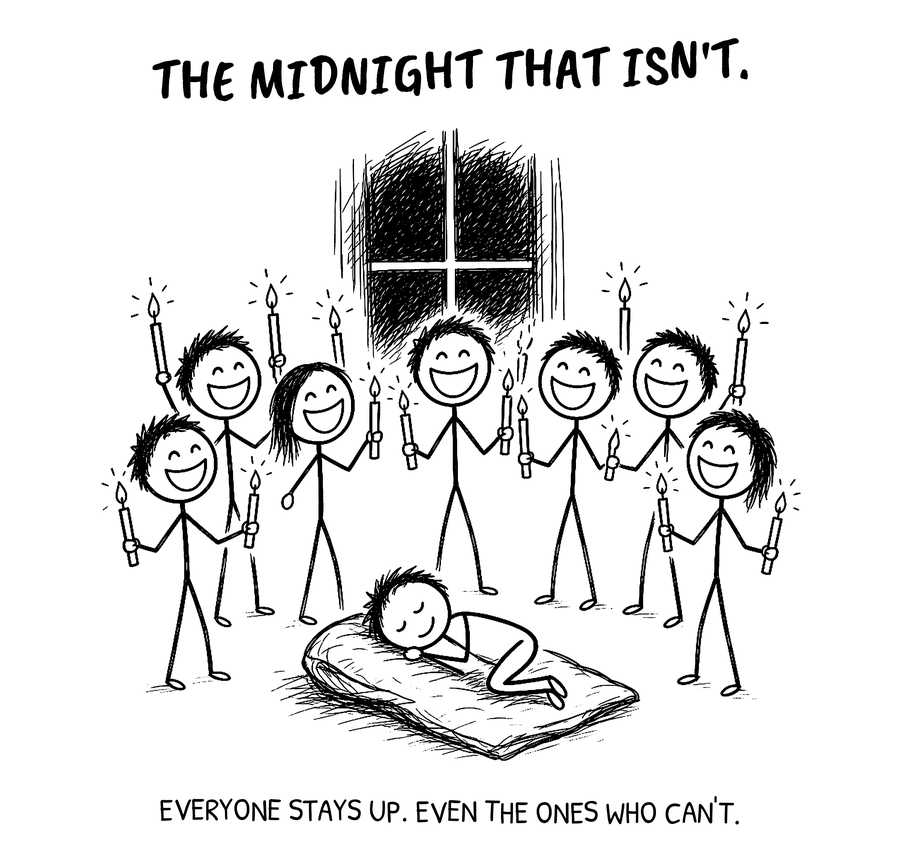
It's eleven at night and the church is fuller than you've ever seen it. Everyone's holding an unlit candle pushed through a paper cup or a plastic guard (you'll see why in an hour). Up front, depending on the parish, the chanters are singing the Lamentations from the night before all over again, or a relay of readers is working through the Acts of the Apostles, as Hapgood's Russian book directs, right up to the Midnight Office.1 Children are asleep on coats. Then, near midnight, in many parishes the lights go out. All of them.
In the dark a single flame comes out from behind the icon screen. The people nearest the priest light their candles from his, and the flame goes back through the room, wick to wick, until a few hundred faces are lit from below. Then everyone goes outside: cross, Gospel, icons, banners, clergy, people, the bells going, around the building and back to the shut front doors.2 Someone shouts "Christ is risen!" and the crowd shouts back "Truly He is risen!" Then they do it again. And again. For forty days, actually.
After that come hours of singing, a sermon nobody in the room wrote, a great deal of kissing, and around two or three in the morning, a meal. You'll be tired. Everyone is. Years ago, in a century-old Russian parish in Philadelphia, an elderly man told me about the Pascha nights of his childhood. By the time Holy Saturday rolled into Pascha night his whole family was running on fumes, and at seven or eight he finally gave up, crawled under the wooden pews, curled up on the floorboards, and nearly slept through the Resurrection.
What it's called
Pascha (Easter, the feast of the Resurrection; Slavonic Paskha; Arabic al-Fiṣḥ) is the Greek form of the Hebrew word for Passover. The Church took it from Saint Paul: "Christ, our Passover, was sacrificed for us" (1 Corinthians 5:7). Hapgood's service book titles the day "Easter, the Feast of Feasts."3
The week before is Holy Week (Greek Megali Evdomada, "Great Week"; Slavonic Strastnaya sedmitsa, "Passion Week"). The midnight service is two services back to back, Paschal Matins (the Orthros of the Resurrection) and the Divine Liturgy, and Slavic usage sings the short Paschal Hours between them.4 The week after is Bright Week, Hapgood's "Easter week," when the Royal Doors of the icon screen stay open the whole time.5 Sunday afternoon brings Agape Vespers.6
What's actually happening
Holy Week has services every day, some days two.
Palm Sunday to Holy Wednesday. The Saturday before, Lazarus Saturday, keeps the raising of Lazarus as a promise of the Resurrection.7 Palm Sunday keeps Christ's entry into Jerusalem (see the feast table in The Church Year); at the Vigil the palms or branches are blessed and handed out, and people stand holding them with lit candles.8 On the first three evenings of the week parishes serve the Matins of the Bridegroom, named for the midnight cry in the parable of the ten virgins: "And at midnight a cry was heard: 'Behold, the bridegroom is coming; go out to meet him!'" (Matthew 25:6). On Monday, Tuesday and Wednesday the Presanctified Liturgy is served.9 Many parishes serve Holy Unction on Holy Wednesday (or another evening of Holy Week) and anoint all the Orthodox faithful present; Holy Unction and Prayer for the Sick has the service.
Holy Thursday. The Last Supper. The Liturgy is Saint Basil's, joined to Vespers, and "Of thy Mystical Supper" replaces the Cherubic Hymn (see The Cherubic Hymn).10 The Communion fast holds even today: the Council in Trullo cancelled an old North African exception for Holy Thursday.11 That evening many parishes serve the Matins of Holy Friday, with twelve Gospel readings of the Passion.12
Holy Friday. In the morning the Royal Hours are read, each with its own Old Testament, Epistle and Gospel readings. No Divine Liturgy is served.13 In the afternoon, at Vespers, an embroidered icon of Christ's body laid in the tomb (Greek epitaphios, Slavonic plashchanitsa) is carried out from the altar and laid on a tomb in the middle of the church, and the people come forward to kiss it.14 That night, at the Matins of Holy Saturday, the Lamentations are sung around it, verses of praise woven through Psalm 119 (118 in the Septuagint), and the people follow it in procession around the church.15 Many people eat nothing at all today (see Fasting).
Holy Saturday morning: the old Easter. Most newcomers miss this one, and it's the oldest layer of the week. Vespers is joined to the Liturgy of Saint Basil, with fifteen Old Testament readings ending with Daniel 3 and the Song of the Three Children. In place of the Trisagion the choir sings "Ye who have been baptized into Christ have put on Christ" (from Galatians 3:27), and the Epistle is Romans 6:3–11. Then the turn: instead of the Alleluia the choir sings "Arise, O God, judge the earth" (from Psalm 82:8 (81:8 in the Septuagint)), and the clergy change dark vestments for light ones before the Resurrection Gospel, Matthew 28:1–20. "Let all mortal flesh hold its peace" replaces the Cherubic Hymn.16 It feels like Easter because it was: Getcha points out that ancient baptism took place at the paschal vigil, which is what this vesperal Liturgy corresponds to.17
Saturday night, in the order of Hapgood's Russian book:
- The Midnight Office, timed to end at midnight. During its last ode the priest carries the epitaphios back into the altar.18
- At midnight the procession goes out singing "The Angels in heaven, O Christ our Saviour, sing thy Resurrection," and circles the church, "the bells pealing the while."19
- At the closed doors the clergy sing "Christ is risen from the dead, trampling down Death by death, and upon those in the tomb bestowing life," three times, with verses from Psalm 68 (67 in the Septuagint), "Let God arise," and Psalm 118:24 (117:24 in the Septuagint).20
- The doors open, everyone goes in, and Matins begins: the Paschal Canon of Saint John of Damascus, with the priest censing the whole church at every ode.21
- The Paschal verses end with the line that ought to be carved over the door: "And because of the Resurrection let us forgive all things."22
- The Paschal kiss, and then the Catechetical Homily of Saint John Chrysostom, read every year; the people "shall not sit while it is being read."23 Then the Paschal Hours, sung.24
- The Divine Liturgy of Saint John Chrysostom, with Acts 1 and John 1 for the readings. "As many as have been baptized" replaces the Trisagion again, "The Angel cried" replaces the hymn to the Theotokos (see "It Is Truly Meet"), and the Communion hymn is "Receive ye the Body of Christ."25
- The artos (a large loaf marked with the Cross, sometimes with the Resurrection) is blessed and kept through Bright Week, and the meat, cheese, and eggs people brought are blessed for breaking the fast.26
Greek usage repeats the Lamentations before midnight; the church goes completely dark; the priest comes out with one lit candle singing "Come, receive the light" (Defte lavete fos, a hymn Hapgood doesn't print); and outside, the Resurrection Gospel, Mark 16:1–8, is read before the first "Christ is risen." Red eggs are handed out at the end.27
Why it matters
Pascha is a baptism. Lent began as the catechumens' preparation to be baptized on this night,28 which is why Holy Saturday sings Galatians and reads Romans 6: "Therefore we were buried with Him through baptism into death, that just as Christ was raised from the dead by the glory of the Father, even so we also should walk in newness of life" (Romans 6:4). Even in a year with no baptisms, the whole Church walks back through its own.
It's also the source of every Sunday. Mavropoulos treats the Resurrection Liturgy as the model every other Liturgy repeats.29
And it has a moral, sung rather than preached. The hymn tells you to forgive "all things" before you've finished the canon. Then Chrysostom's homily invites everyone to the feast, including the workers who showed up at the eleventh hour: "he giveth rest unto him who cometh at the eleventh hour, even as unto him who hath wrought from the first hour."30 If you came for the first time tonight, the sermon is about you, and it says you're not late.
Where it came from
The all-night vigil is very old. The Apostolic Constitutions tell Christians to "keep awake, and assemble together in the church, watch and pray" from evening "till cock-crowing," reading the Law, Prophets, and Psalms, "baptizing your catechumens, and reading the Gospel," and to break the fast then.31 That's why you're up at three in the morning: Matins, the Hours, and the Liturgy back to back are the short version of a vigil that ran till dawn. Tertullian, around 200, says "the Passover affords a more than usually solemn day for baptism."32 Egeria, a pilgrim in Jerusalem in the 380s, wrote home that "the Paschal vigils are kept as with us," with the newly baptized led to the tomb church for prayer.33
After Nicaea, Constantine wrote that everyone should keep Pascha "on one and the same day,"34 and Apostolic Canon 7 deposes a cleric who keeps it "before the vernal equinox, with the Jews."35 Whether that canon requires Pascha to follow Passover is disputed (the Rudder, following Zonaras, says yes; Father Andrew Stephen Damick calls that a later reading); Why Is Orthodox Easter on a Different Date? lays out both.
Some of the most familiar parts aren't in every book: Hapgood's 1906 Russian service book prints neither the single flame nor "Come, receive the light."
What you do
If you're Orthodox: come to Holy Saturday morning at least once. Stand for the homily. Keep the fast until after the Liturgy. Slavic parishes bless baskets of the food you gave up for Lent;36 Greek parishes hand out red eggs.
If you're visiting: learn one line before you come. When someone says "Christ is risen!" you say "Truly He is risen!" (Hapgood has "He is risen indeed!").37 You'll get plenty of practice. Arrive early; the church fills. Bring or buy a candle, use the drip guard, and mind the hair of the person in front of you. Communion follows the usual rule (see Can I Take Communion?), but eggs, bread, and the meal afterward are for everyone. If you have small children, plenty of families come for the light and the procession and leave after Matins; see Bringing Kids.
Field Note: the Gospel in every tongue. Hapgood's book reads the Easter Gospel "in as many languages as possible; especially in Hebrew, Greek and Latin, the tongues in which was written the superscription on the cross."38 Greek parishes do it at Agape Vespers with John 20:19–25.39 Egeria heard Jerusalem's readings interpreted from Greek into Syriac in the 380s.40
Field Note: the greeting by language. Greek: Christos anesti! Alithos anesti! Slavonic: Khristos voskrese! Voistinu voskrese! Arabic: al-Masih qam! Haqqan qam! (المسيح قام / حقاً قام). Romanian: Hristos a inviat! Adevarat a inviat! Any language counts. So does a mumble.
Go deeper
- Hapgood, Service Book (1906), pp. 204–242 (Palm Sunday through the Paschal services, in full); Saint John Chrysostom's Catechetical Homily is on pp. 235–236.
- Apostolic Constitutions V.19 (ANF 7); Egeria, The Pilgrimage of Etheria, trans. McClure and Feltoe (1919).
- Mother Mary and Kallistos Ware, The Lenten Triodion, for the Holy Week services.
- Go to the Holy Saturday morning Liturgy at least once.
Notes
-
GOARCH, "Learn: Great and Holy Pascha"; Hapgood, Service Book, p. 224. ↩
-
Hapgood, Service Book, p. 226. ↩
-
Hapgood, Service Book, p. 226. ↩
-
Hapgood, Service Book, pp. 226–238; GOARCH, "Learn: Great and Holy Pascha." ↩
-
Hapgood, Service Book, p. 226. ↩
-
GOARCH, "Learn: Great and Holy Pascha." ↩
-
Hapgood, Service Book, p. xvi. ↩
-
Hapgood, Service Book, pp. 204–205. ↩
-
Hapgood, Service Book, p. 600. ↩
-
Hapgood, Service Book, pp. 211, 213; Taft, The Great Entrance, pp. 68–69. ↩
-
Council in Trullo, canon 29 (NPNF2 14); see The Communion Fast. ↩
-
Hapgood, Service Book, p. 214. ↩
-
Hapgood, Service Book, pp. 216–217, 597. ↩
-
Hapgood, Service Book, pp. 218–219. ↩
-
Hapgood, Service Book, pp. 220–222; OCA, "Holy Saturday." ↩
-
Hapgood, Service Book, pp. 223–224. ↩
-
Getcha, The Euchologion Unveiled, p. 22. ↩
-
Hapgood, Service Book, pp. 224–225. ↩
-
Hapgood, Service Book, p. 226. ↩
-
Hapgood, Service Book, p. 226. ↩
-
Hapgood, Service Book, p. 227. ↩
-
Hapgood, Service Book, p. 234. ↩
-
Hapgood, Service Book, pp. 235–236. ↩
-
Hapgood, Service Book, pp. 237–238. ↩
-
Hapgood, Service Book, p. 239. ↩
-
Hapgood, Service Book, pp. 240–241. ↩
-
GOARCH, "Learn: Great and Holy Pascha." ↩
-
Mavropoulos, Passing Through the Church, pp. 212–215; Getcha, The Euchologion Unveiled, pp. 22–23, 39. ↩
-
Mavropoulos, Passing Through the Church, pp. 290–291. ↩
-
Hapgood, Service Book, pp. 235–236. ↩
-
Apostolic Constitutions V.19 (ANF 7). ↩
-
Tertullian, On Baptism 19 (ANF 3). ↩
-
Egeria, The Pilgrimage of Etheria, ch. 38, trans. McClure and Feltoe (1919). ↩
-
Eusebius, Life of Constantine III.18 (NPNF2 1). ↩
-
Apostolic Canon 7 (NPNF2 14). ↩
-
Hapgood, Service Book, p. 241. ↩
-
Hapgood, Service Book, p. 235. ↩
-
Hapgood, Service Book, p. 239. ↩
-
GOARCH, "Learn: Great and Holy Pascha." ↩
-
Egeria, The Pilgrimage of Etheria, ch. 47, trans. McClure and Feltoe (1919). ↩