
What you'll notice
You've seen this scene at every airport in America. The hug at the curb, the bag going through the door, and the one left behind staring at the glass long after there's anything to see.1
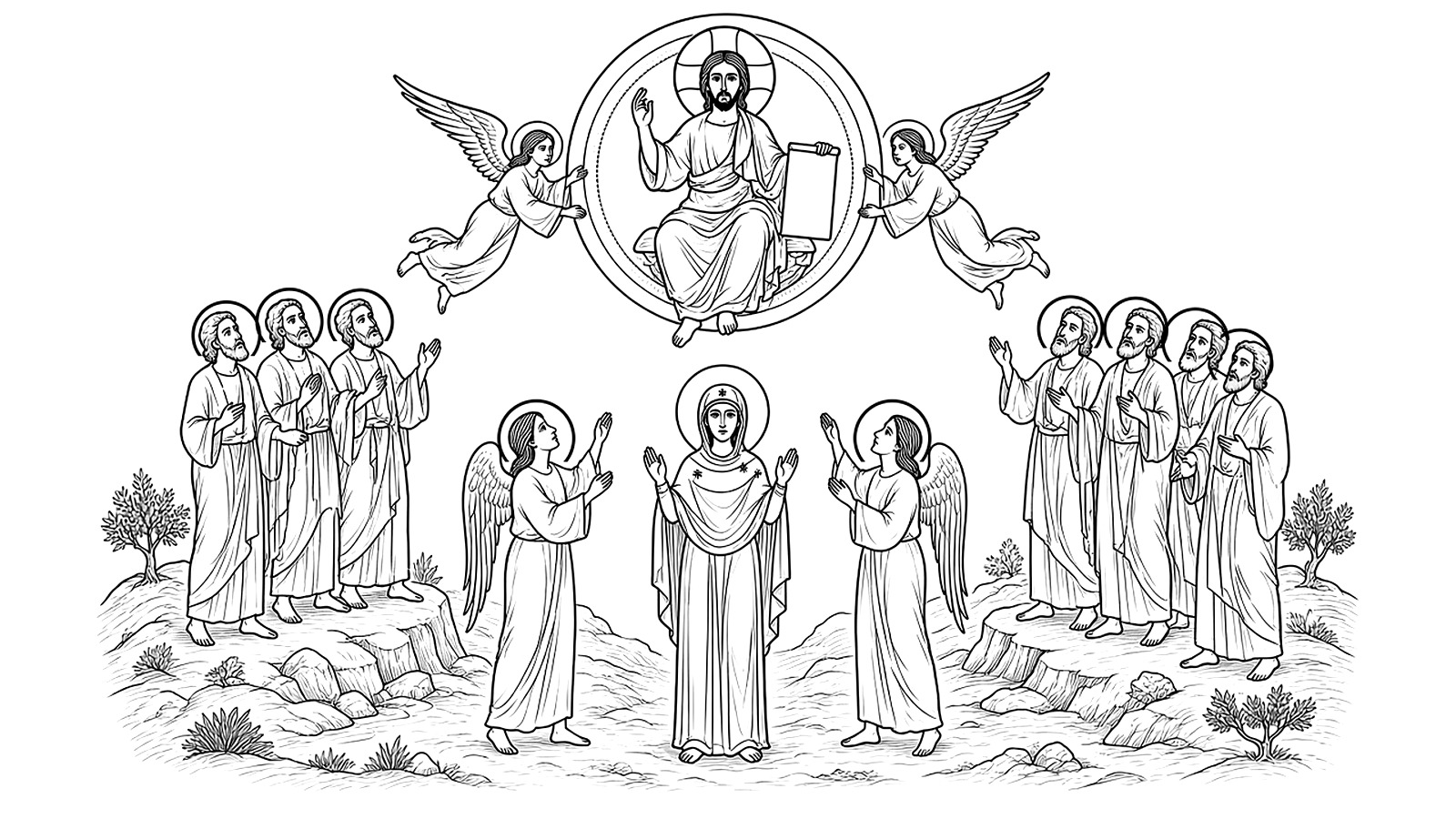
Now picture eleven men on a hill outside Jerusalem doing exactly that. Jesus leads them out "as far as Bethany, and He lifted up His hands and blessed them. Now it came to pass, while He blessed them, that He was parted from them and carried up into heaven" (Luke 24:50-51). In Acts, "while they watched, He was taken up, and a cloud received Him out of their sight" (Acts 1:9). They keep looking, so God sends two men in white: "Men of Galilee, why do you stand gazing up into heaven? This same Jesus, who was taken up from you into heaven, will so come in like manner as you saw Him go into heaven" (Acts 1:11).
Then the strangest part. Luke says "they worshiped Him, and returned to Jerusalem with great joy" (Luke 24:52). Nobody walks out of the airport with great joy.1
What it's called
The Ascension is the fortieth day of Pascha, so it always falls on a Thursday (Calendar of Feasts shows the math). The day before, the Church takes leave of Pascha, and the afterfeast runs to the Friday before Pentecost.1 It's one of the twelve Great Feasts.
The troparion:
Thou art ascended up into glory, O Christ our God, having made joyful thy disciples by the promise of thy Holy Spirit, the blessing which was announced unto them. For thou art the Son of God, the Redeemer of the world.2
The kontakion:
When thou hadst accomplished thy dispensation to usward, and hadst united things earthly with things heavenly, thou didst ascend into glory, O Christ our God, yet in no wise departing but abiding uninterruptedly with us, and crying unto those who love thee: I am with you, and none shall prevail against you.2
What's actually happening
A goodbye that wasn't
Saint Leo the Great, the fifth-century bishop of Rome whom the Orthodox Church keeps on February 18, noticed the same thing. These were the men who had been "bewildered at His death on the cross and backward in believing His Resurrection." Yet when the Lord went up, "not only were they affected with no sadness, but were even filled with great joy."3
The troparion gives the first reason: He had promised them the Spirit. "I will not leave you orphans; I will come to you" (John 14:18). Ten days later, at Pentecost, He kept that promise.1 The kontakion gives the second: "in no wise departing." He goes up, and He doesn't leave. The last words of Matthew's Gospel say the same thing: "lo, I am with you always, even to the end of the age" (Matthew 28:20).
And the joy wasn't only for the Eleven. A Vespers hymn tells Christ that He "didst fill with joy unutterable thy disciples and the Birth-giver of God who bare thee."2 His mother was there. When Luke lists the people praying in the upper room afterward, there she is, "with the women and Mary the mother of Jesus" (Acts 1:14). Father Georges Florovsky: "And after the Ascension we find the Blessed Virgin among the Twelve, in the center of the growing Church."4
What went up
What the disciples saw leave was a human body. (Sorry, no hologram.) The same body that took "a piece of a broiled fish and some honeycomb" and "ate in their presence" (Luke 24:42-43). The one that still had the nail marks.1
Saint John Chrysostom, preaching on Acts, comes to this: "and what is still more stupendous, that Flesh is seated in heaven, and adored by Angels."5 The hymns at Vespers say the angels couldn't get over it either: "The Angels marvel, beholding a man exalted over them." Another verse says Christ "graciously hast borne on high our fallen nature, and hast sat down with the Father."2 Florovsky, summarizing Saint John of Damascus: "And in this glorified body he sits corporeally at the right hand of the Father."6 A man sits on the throne of God.1
Field Note: why a cloud? Elijah went up in a whirlwind with a chariot of fire, but not Christ. Chrysostom: "Not fire, as in the case of Elijah, nor fiery chariot, but a cloud received Him; which was a symbol of Heaven."5 In the Old Testament the cloud is where God shows up, and the psalm calls God the One "Who makes the clouds His chariot" (Psalm 104:3). The disciples weren't watching Jesus vanish. They were watching Him go home in the vehicle God uses. Chrysostom also notes that at the Ascension "they saw the beginning, but not the end." For the arrival, they had to take the angels' word for it. So do we.1
Why it matters
Saint Leo says this is exactly why the disciples went home rejoicing: "The Nature of mankind went up, to pass above the angels' ranks and to rise beyond the archangels' heights." And for his own congregation: "For today not only are we confirmed as possessors of paradise, but have also in Christ penetrated the heights of heaven."3 Adam lost a garden. In Christ we got a seat at the right hand. Saint Paul says God has already "raised us up together, and made us sit together in the heavenly places in Christ Jesus" (Ephesians 2:6). Notice the tense.1
You rehearse it every Sunday. Right before the great Eucharistic prayer (see Lift Up Your Hearts), the priest says, "Lift up your hearts," and the old service book adds a stage direction: he says it "pointing upward." The people answer, "We lift them up unto the Lord." In the prayer that follows, said quietly at the altar, the priest thanks God, who "hast not ceased to do all things until thou hadst brought us back to heaven."2 That's the Ascension, said out loud every week.1
Field Note: "Ascension theology." Father Mark once shared a story that I wrote up in an earlier Simply Orthodox post, "We Are Ascending": an evangelical pastor from down the street brought his "worship team" to Saint Mark for a private tour, because he wanted them to understand something the Orthodox Church grasps intuitively: "Ascension theology." The idea is simple. In the Liturgy we're always ascending, always going toward Christ and toward the holy altar. Orthodox worship isn't focused on us. It's focused on Christ.7
What you do
Because it's a weekday, the Ascension is the Great Feast most of us are tempted to skip. Don't.1
If you're Orthodox: take the morning off, or find the Vespers the night before (Vespers, Vigil, and the Daily Round explains how the Church's day starts at sunset). Then spend the ten days until Pentecost the way the disciples did. They "were continually in the temple praising and blessing God" (Luke 24:53). They didn't stand on the hill. They went back to town and prayed and waited for the promise.1
If you're visiting: the next time the priest lifts his hand and says, "Lift up your hearts," don't stand there gazing up into an empty sky. Look where He went. Your nature is already there, seated at the right hand of the Father, waiting for the rest of you.1
Notes
-
Adapted from a Simply Orthodox article by Jamey Bennett, "Why Are You Standing There Looking Up?" (not yet published). Scripture quotations are from the New King James Version (NKJV), as in the article. ↩↩↩↩↩↩↩↩↩↩↩↩
-
Isabel F. Hapgood, Service Book of the Holy Orthodox-Catholic Apostolic Church (1906), pp. 101 (Divine Liturgy) and 243 (troparion, kontakion, Vespers hymns), as quoted in "Why Are You Standing There Looking Up?" ↩↩↩↩↩
-
Saint Leo the Great, Sermon 73 (On the Lord's Ascension I), §4, trans. Charles Lett Feltoe, Nicene and Post-Nicene Fathers, 2nd series, vol. 12, as quoted in "Why Are You Standing There Looking Up?" ↩↩
-
Georges Florovsky, Collected Works, vol. III, Creation and Redemption, p. 183, as quoted in "Why Are You Standing There Looking Up?" ↩
-
Saint John Chrysostom, Homily 2 on the Acts of the Apostles, Nicene and Post-Nicene Fathers, 1st series, vol. 11, as quoted in "Why Are You Standing There Looking Up?" ↩↩
-
Florovsky, Collected Works, vol. IX, The Byzantine Fathers of the Sixth to Eighth Century, p. 275, as quoted in "Why Are You Standing There Looking Up?" ↩
-
Jamey Bennett, "We Are Ascending: A Practical Guide to Preparing for the Liturgy," Simply Orthodox, August 13, 2026. The Field Note paraphrases the post's explanation of "Ascension theology." ↩