
What you'll notice
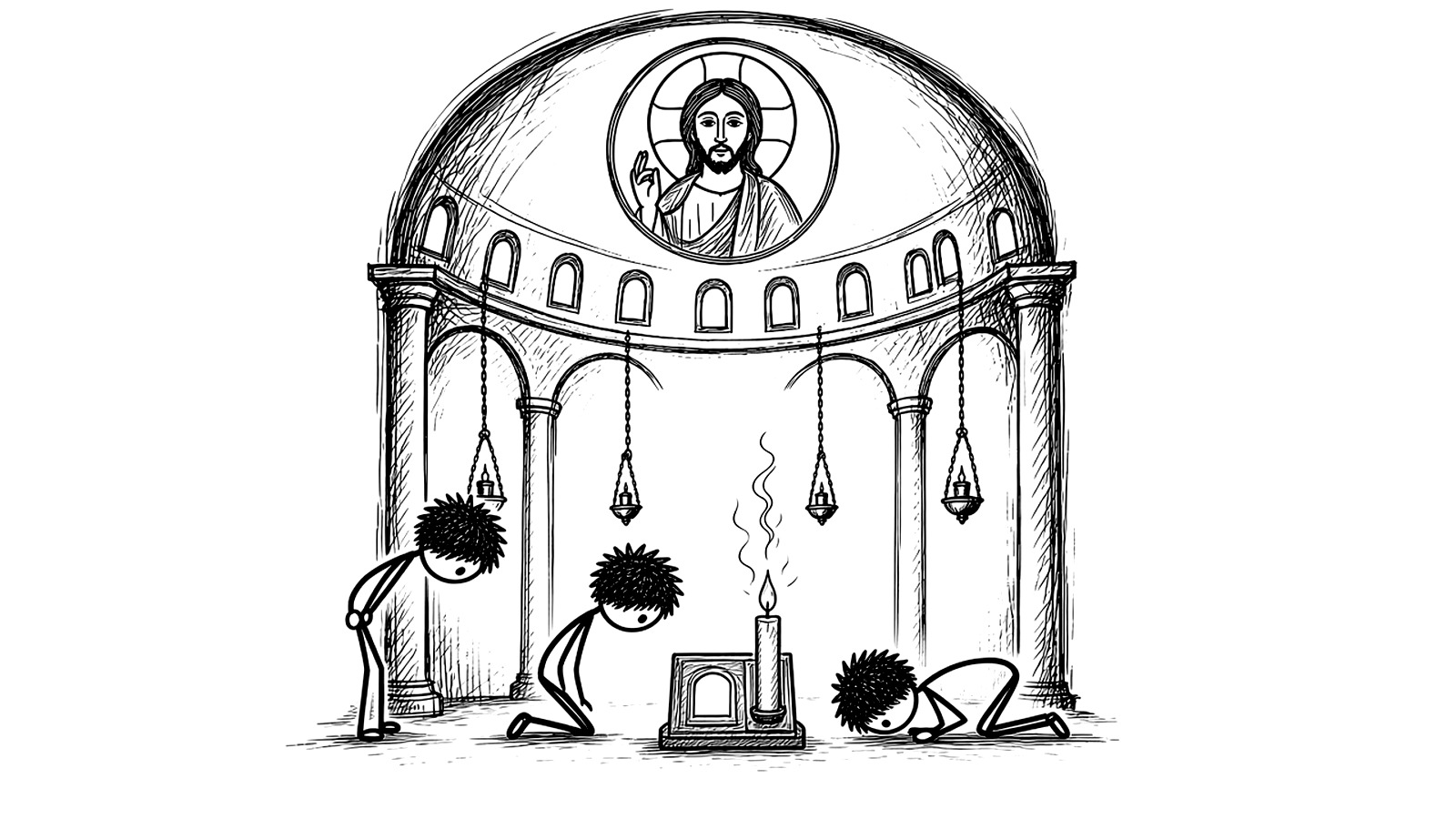
The incense, the hushed evening service, and then the whole room bows together, all the way to the floor. During Lent you'll hear the same short prayer again and again, at weekday services in church and in people's prayer corners at home.1 It goes by fast. That's the problem: it can blur into the Lenten atmosphere instead of being an honest, personal plea.1
What it's called
The Prayer of Saint Ephraim the Syrian is the Lenten prayer. Here it is in the OCA's translation:2
O Lord and Master of my life, take from me the spirit of sloth, despair, lust of power, and idle talk.
But give rather the spirit of chastity, humility, patience, and love to Thy servant.
Yea, O Lord and King, grant me to see my own transgressions, and not to judge my brother, for blessed art Thou, unto ages of ages. Amen.
What's actually happening
The prayer is a two-part spiritual diagnosis. First it names the diseases of the soul we need God to take away. Then it names the virtues we need God to plant.1
The four foes
- Sloth (ἀργία, argia). Not just binging Netflix. It's spiritual listlessness, the inertia that keeps us from prayer and charity, the comfortable apathy that says, "eh, tomorrow."1
- Despair, sometimes translated "faint-heartedness" or "despondency." (The English follows the Slavonic. The Greek text has a different word here, περιεργία, periergia: meddling, or idle curiosity.)3 It's the voice that says it's too hard, we're too weak, God can't possibly forgive this. The desert fathers saw despair as one of the ultimate temptations, because it cuts off the hope repentance needs.1
- Lust of power (φιλαρχία, philarchia). Not just wanting to be CEO. It's the urge to dominate, control, and impose our will on others, even subtly. Pride's ugly cousin.1
- Idle talk (ἀργολογία, argologia). Not only gossip, but all speech that's empty, pointless, or destructive, the words that build nothing and tear down reputations, peace, or truth. In a digital age, this one hits close to home.1
The four friends
- Chastity (σωφροσύνη, sophrosyne). More than sexual purity, but not less. It's inner integrity, sobriety, and self-control in every part of life, a unified, healthy soul.1
- Humility (ταπεινοφροσύνη, tapeinophrosyne). The queen of virtues, and often misunderstood. It isn't self-abasement; it's self-knowledge, seeing ourselves accurately before God and others, free from needing to prove anything.1
- Patience (ὑπομονή, hypomonē). Not passive resignation but active endurance, the steadiness to bear trials and delays without losing heart.1
- Love (ἀγάπη, agapē). The highest virtue. Scripture says, "God is love" (1 John 4:8). It's the love that seeks the other's good first and binds all the other virtues together.1
The mirror, not the hammer
The last line is where the whole prayer has been heading: "grant me to see my own transgressions, and not to judge my brother." It's easier to spot the speck in a brother's eye than the plank in our own. This isn't about wallowing in guilt. It's about clarity: turning the microscope on ourselves and disarming the judging spirit at the same time. Real humility leads to compassion for our neighbor, because we know our own battles.1
Why it matters
Because the body prays too. The prayer is said with bows or prostrations. The specifics vary, but some kind of bowing is pretty much always involved.1 That's the point: repentance isn't purely a mental exercise. The whole person, mind, heart, and body, bends before God.1
Father Alexander Schmemann put it this way: "In the long and difficult effort of spiritual recovery, the Church does not separate the soul from the body." And: "Christian asceticism is a fight, not against but for the body." So the whole person, soul and body, repents.4 He called prostrations "the lenten rite par excellence."4
So true fasting isn't only about food. It's about the passions that distort God's image in us, and every time we say the prayer and bow, it's a small act of metanoia, repentance.1
Where it came from
It's one of history's ironies that Saint Ephraim the Syrian, one of the most prolific and complex poets and theologians of the ancient Church, is famous today for a prayer that takes about thirty seconds to say.1
In the fourth century Ephraim was a towering mind. He was a disciple of Saint James (Jacob) of Nisibis, the bishop who took part in the Council of Nicea, and he served the Church as a deacon all his life.5 He didn't fight the heresies of his day with dry treatises; he fought them with hymns.1 More than a century after his death, the Syriac poet Jacob of Serugh wrote a verse homily in his honor.6 When you drop to the floor for his prayer, you're not reciting a monk's private journal. You're borrowing the field-tested words of a fourth-century poet who guarded his flock with hymns.
What you do
If you're Orthodox: pray it daily through Lent, with the bows your parish or your priest teaches. Then slow down. Let each line land: the cutting edge of each diagnosis, the hope of each virtue.1 Prayer at Home shows where it fits in a home rule.
If you're visiting: at a Lenten weekday service, you'll see the whole church go down to the floor. You're welcome to bow, to stand quietly, or just to listen to the words. They're worth hearing even if you never kneel.
Notes
-
Jamey Bennett, "The Four Foes and Four Friends of the Great Fast: A Look at Saint Ephraim's Prayer," Simply Orthodox, March 21, 2026. ↩↩↩↩↩↩↩↩↩↩↩↩↩↩↩↩↩↩
-
Orthodox Church in America, "Lenten Prayer of St. Ephrem." ↩
-
Greek text of the prayer ("πνεῦμα ἀργίας, περιεργίας, φιλαρχίας, καὶ ἀργολογίας μή μοι δῷς"), as in the current Greek liturgical books, per Wikipedia, "Prayer of Saint Ephrem" (Greek version); Fr. Lawrence Farley, "Looking at the Lenten Prayer," oca.org. ↩
-
Alexander Schmemann, Great Lent: Journey to Pascha (SVS Press), ch. 2, 'The Lenten Prayer of St. Ephrem.' ↩↩
-
Orthodox Church in America, "Venerable Ephraim the Syrian" (January 28). ↩
-
Jacob of Serugh, verse homily on Saint Ephrem, in Joseph P. Amar, ed. and trans., A Metrical Homily on Holy Mar Ephrem by Mar Jacob of Sarug: Critical Edition of the Syriac Text, Translation and Introduction, Patrologia Orientalis 47.1 (Turnhout: Brepols, 1995). ↩