


What you'll notice
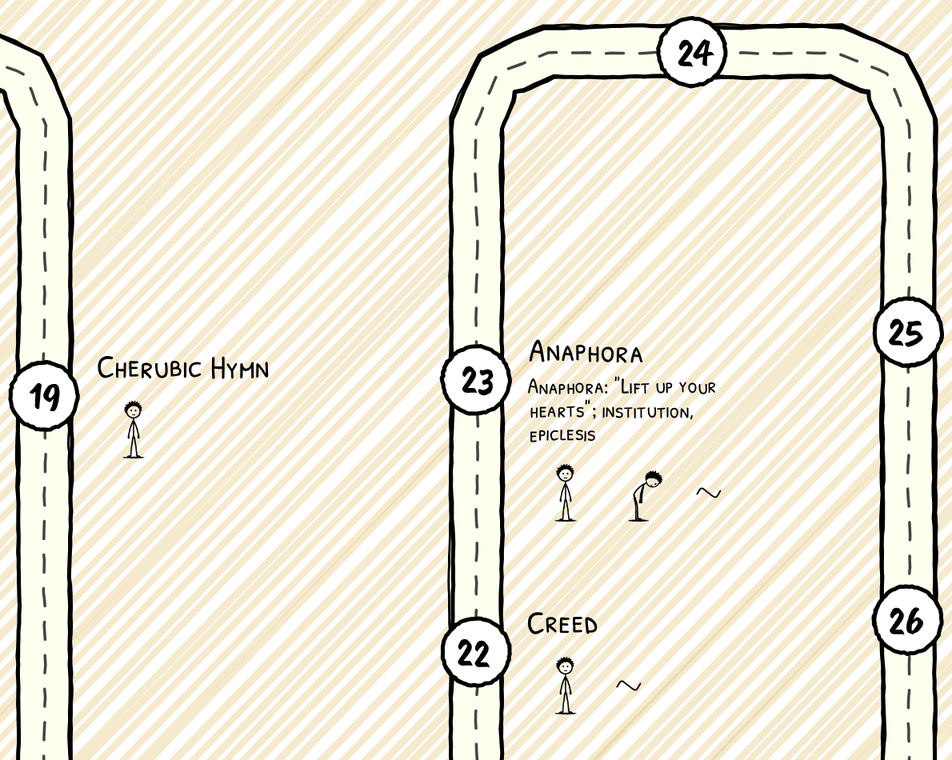
The deacon's voice sharpens. "Let us stand aright, let us stand with fear, that we may offer in peace the Holy Oblation." The choir: "A mercy of peace, a sacrifice of praise."1 The priest turns to face you: "The grace of our Lord Jesus Christ, and the love of God, and the fellowship of the Holy Spirit, be with you all." Then he turns back and, in Russian practice, points upward: "Lift up your hearts." "We lift them up unto the Lord." "Let us give thanks unto the Lord." The choir answers that it is meet and right.2
Then, for a while, you mostly hear the choir. In many parishes most of the prayer is said quietly at the altar; in some the priest says it aloud. Either way, the room knows the center of the service has started.
The priest's voice rises for one line, "Singing the triumphant song, crying, calling aloud, and saying," and the choir sings, slowly: "Holy, holy, holy, Lord of Sabaoth; heaven and earth are full of thy glory: Hosanna in the highest: Blessed is he that cometh in the Name of the Lord. Hosanna in the highest."3 What comes right after it is the next stop.
What it's called
The Anaphora, Greek for "offering up" (Ἀναφορά); also the Eucharistic Prayer, from eucharisteo, "I give thanks," which is what "Let us give thanks unto the Lord" says in Greek. Its parts have names. This stop covers the first two: the opening dialogue and the Sanctus ("Holy, holy, holy"). The words of institution ("Take, eat"), the anamnesis ("remembering"), and the epiclesis ("calling down") are the next stop, and the commemorations get the one after that, "It Is Truly Meet".
What's actually happening
The priest is telling God the whole story, out loud or under his breath, and asking Him to finish it. This is the first chapter.
The prayer thanks the Father for everything, and it means everything: "Thou from nothingness hast called us into being; and when we had fallen away from thee, thou didst raise us up again; and thou hast not ceased to do all things until thou hadst brought us back to heaven, and hadst endowed us with thy kingdom which is to come." It even gives thanks "for all the things whereof we know, and whereof we know not."4 Creation, the fall, the long rescue, and the kingdom, in two sentences.
Then the prayer notices who else is in the room. God is served by "thousands of Archangels and myriads of Angels, with the Cherubim, and Seraphim, six-winged, many-eyed, who soar aloft, borne on their pinions."5 That's the cue. The choir picks up the song Isaiah heard the seraphim sing (Isaiah 6:3), and the people standing in the nave sing it with them.
Why it matters
Saint Cyril of Jerusalem, lecturing in the fourth century, walks through these very steps: lift up your hearts, give thanks, sing the Holy, holy, holy.6 He says we sing the seraphim's hymn so that we may join the hosts of heaven in their hymn of praise.7 That's the claim this stop makes. The Liturgy isn't a recital of something happening elsewhere. The angels are already singing, and we join in.
It's also a sacrifice, which is why the deacon warned you to stand well. Malachi foresaw a pure offering made to God "in every place" among the nations (Malachi 1:11), and the Church has read that as the Eucharist since the Didache, which quotes the verse over the Sunday breaking of bread.8 Saint Cyprian said the sacrifice we offer is the Passion of the Lord.9 And it's done on God's terms. Christianity is a revealed faith; it is meet and right to worship the Creator, and to do so the way He asked.
Where it came from
Justin, in 150, describes the president giving thanks "at considerable length" over bread and wine and water and the people answering Amen.10 That's the Anaphora in one sentence. The prayer we use on most Sundays carries Saint John Chrysostom's name and comes from Antioch, where he was a priest in the fourth century; the longer one used about ten times a year carries Saint Basil's and comes from his Cappadocia.11 That is why a Liturgy carries the name it does: the anaphora is the primary prayer that gives each one its authorship and its name. Basil's retells salvation history at much greater length, which is why the choir sings slower on the Sundays of Lent and you should pace yourself.
The prayers went quiet sometime in the sixth century, at least in places. Emperor Justinian's Novel 137, issued in 565, ordered bishops and priests to say the prayers of the service and of baptism "not in an undertone" but so the faithful could hear,12 which tells you some had stopped. Over the centuries the prayers came to be said quietly.
Whether that was a loss is a live argument, and this guide won't referee it. Father Robert Taft, the great historian of the Byzantine Liturgy, argued that the anaphora was once said aloud and that some of it should be heard again; the Church of Greece's Holy Synod said much the same in 2004.13 Father John Whiteford answers that the low voice "is the undoubted ancient and universal Tradition of the Church," and that picking the early practices you like "is Jurassic Park Liturgics."14 Parishes differ here: some now say the anaphora aloud; most still say it quietly, with only the exclamations heard.
What you do
If you're Orthodox: stand still, which is the one thing the deacon asked. Take "Lift up your hearts" literally and set the week down for a few minutes. From "Let us stand aright" until the end of "We praise thee" at the next stop, don't move through the nave for any reason.
If you're visiting: stand, and let it happen. And if you wonder what he's saying back there, you're not the first to ask: full service books print the quiet prayers, so you can read what you can't hear.15
Field Note: lift up your hearts. The line is Scripture before it's liturgy: "Let us lift our hearts and hands to God in heaven" (Lamentations 3:41). In fourth-century Jerusalem, Saint Cyril put it practically: leave the everyday cares at the door, because this is no hour for them.16 It's the same request the Cherubic Hymn made ten minutes ago, asked a second time in case you'd picked your worries back up.
Field Note: Sabaoth. The choir sings "Lord of Sabaoth," not "Lord of hosts," because the Church kept the Hebrew word Isaiah heard the seraphim use (Isaiah 6:3). It means armies. You are standing in one. The second half of the hymn, "Blessed is He who comes," is the Palm Sunday crowd (Matthew 21:9).
Notes
-
Hapgood, Service Book, p. 100. ↩
-
Hapgood, Service Book, p. 101. ↩
-
Hapgood, Service Book, p. 102. ↩
-
Hapgood, Service Book, p. 101. ↩
-
Hapgood, Service Book, p. 101. ↩
-
Cyril of Jerusalem, Mystagogical Catecheses 5.4 to 6 (NPNF2 7). ↩
-
Cyril of Jerusalem, Mystagogical Catecheses 5.6 (NPNF2 7). ↩
-
Didache 14.3 (ANF 7). ↩
-
Cyprian, Epistle 62.17 (ANF 5; Letter 63 in modern numbering). ↩
-
Justin Martyr, First Apology 65, 67 (ANF 1). ↩
-
Schulz, The Byzantine Liturgy, pp. 146, 150. ↩
-
Justinian, Novel 137 (565), trans. S. P. Scott. ↩
-
Taft, "Was the Eucharistic Anaphora Recited Secretly or Aloud?" (2006); Church of Greece, Holy Synod encyclical 2784 (March 31, 2004). ↩
-
Whiteford, "Secret Prayers," OrthoChristian, 2017. ↩
-
Hapgood, Service Book, pp. 100–107, prints them; it is the translation this guide quotes. ↩
-
Cyril of Jerusalem, Mystagogical Catecheses 5.4 (NPNF2 7). ↩