
What you'll notice
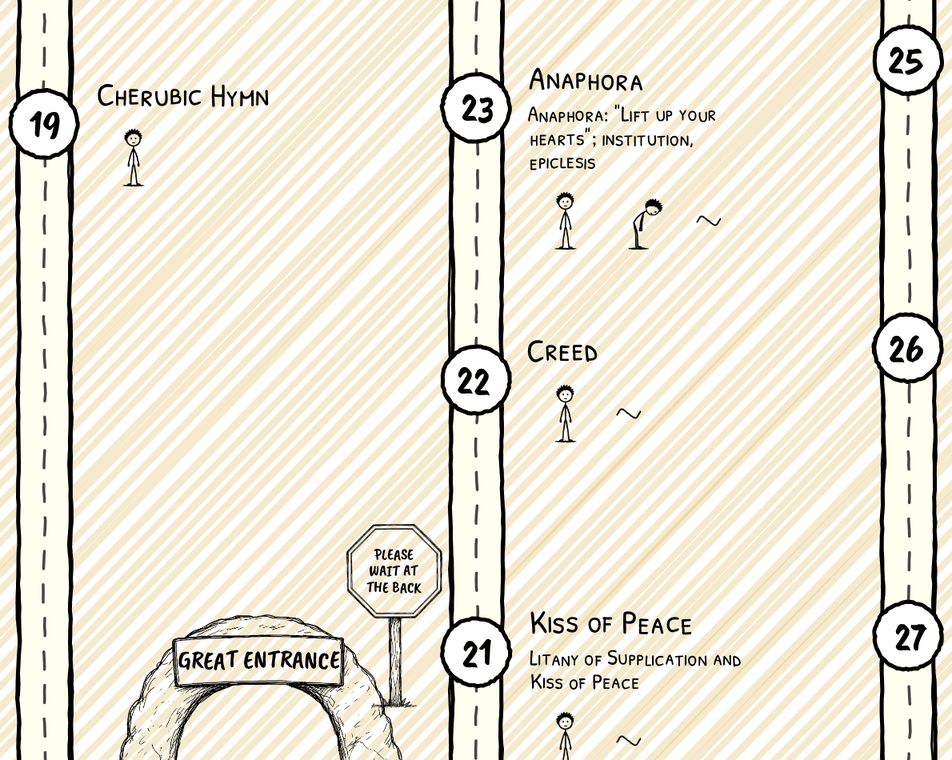
"The Doors! The Doors! Wisdom! Let us attend."1 And then the room says the Creed.
How it says it depends where you are. In a Greek parish one person, often a layman from the front row, recites it alone while everyone listens; in a Slavic parish the whole congregation sings it, loud; in many Antiochian and OCA parishes everyone says it together. The old manuscripts give the Creed to the people;2 the rule of thumb is sung in Russian practice, recited in Greek.3 Through the open doors you can see the priest standing over the gifts, lifting the big embroidered veil and waving it slowly up and down over the bread and wine for the whole length of the Creed, like someone fanning a fire.4
If you grew up Catholic or Protestant and you know the Nicene Creed, you'll find yourself mouthing along, and you'll stumble at exactly one spot. Keep reading.
What it's called
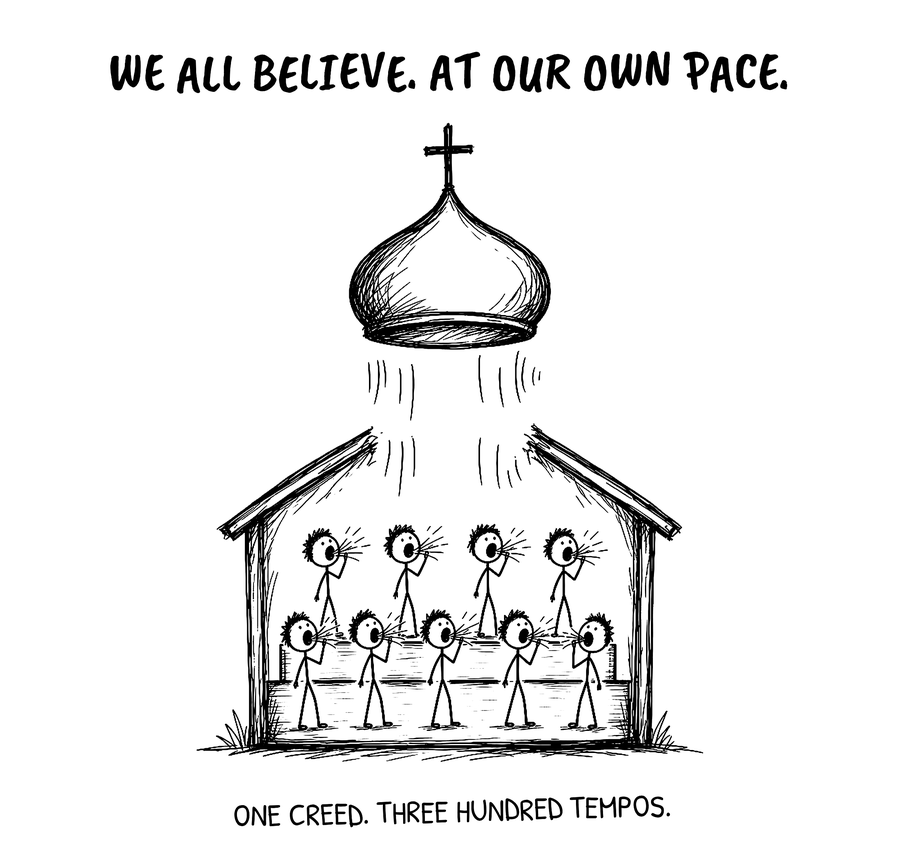
The Creed, or the Symbol of Faith: Greek Symbolon tes Pisteos, Slavonic Simvol very, Arabic dustur al-iman. Formally the Nicene-Constantinopolitan Creed, after the two councils that wrote it. "Symbol" is the old word: a token broken in two so that the halves prove who you are when they're fitted back together. The veil is the aer (the large veil over the gifts).
What's actually happening
Having just made peace with one another, the people now say what they hold in common. First we show our unity in love, then in the Creed our unity in faith: "Let us love one another, that with oneness of mind we may confess." You don't get to confess a shared faith with people you're at war with.
The priest shaking the veil has two explanations and the Church keeps both. The spiritual one: the breath of the Spirit moving over the gifts, as over the waters in Genesis 1:2. The practical one: the Apostolic Constitutions, a fourth-century church manual, tells the deacons to fan the gifts to drive away the small flying creatures.5 Spiritual meaning, the action of the Holy Spirit; practical meaning, keeping the bugs away.
"The doors" is older still. The same manual posts deacons at the doors so that no one goes out and no door is opened during the offering.6 In the ancient Church the catechumens were really gone by now and the doors were really shut; the shout is the remnant of a job somebody used to have.7 Father Thomas Hopko notes these are the doors of the church building, not of the icon screen.8 Nobody checks the doors in America. The words stay because the meaning does.
Why it matters
Saint Justin Martyr said in the year 150 that no one may share in the Eucharist unless he believes the Church's teaching is true, has been washed in baptism, and lives as Christ taught.9 Three conditions, and the Creed is the first one, said out loud, right before the bread.
Remember that Christians were celebrating the Eucharist for a generation before the Gospels were written. The Creed is how a community that already had the meal kept saying what the meal meant.
Now, the word. The Creed as written in 381 says the Holy Spirit "proceeds from the Father," quoting John 15:26. Centuries later, churches in the Latin West began adding "and the Son," in Latin filioque. The Orthodox Church kept the original. Two reasons, both simple. First, Jesus said "from the Father." Second, a creed the whole Church wrote together shouldn't be changed by one part of it acting alone. The Creed in Plain Words walks through the whole text and the history of that word, and Orthodox and Catholic takes up the argument; here, it's enough to know that when you hear the Creed in an Orthodox church, you're hearing it the way it was first said.
Where it came from
The Council of Nicaea wrote the first version in 325 to answer Arius, who taught that the Son was a creature. The Council of Constantinople in 381 expanded it, especially the part about the Holy Spirit. It was a test of orthodoxy before it was a prayer. It entered the Liturgy in the late fifth century, first at Antioch under Peter the Fuller, and reached Constantinople early in the sixth, under Patriarch Timothy (511–518), in each case put there by a bishop with something to prove.10 The priest's waving of the aer over the gifts while it's said is much younger, a fifteenth-century addition.11 It has been said at every Liturgy since.
"I believe" or "we believe"? The council's text says "we," because a council speaks together. The Liturgy says "I," because that's how you said it at your baptism, and the Church kept the baptismal form. Some English translations use "we."
What you do
If you're Orthodox: say it. Out loud if your parish does, under your breath if it doesn't, but say it; it's yours, and it's the only part of the service where the words are entirely in your mouth. Cross yourself at the start and at the end. Bow your head at "and was made man," if that's your custom.
If you're visiting: listen, and if you know it, say it. If you're Catholic or Protestant you'll be saying it with one word fewer than you're used to, and that's the whole difference, said kindly. Nobody is going to shut a door on you.
Field Note: the bugs. The Church has a high theology of the aer and an honest memory of why deacons first waved things over an open chalice in a Mediterranean summer. Both are true. It's a good example of how the Liturgy works: nothing practical ever gets thrown away, it just gets a second meaning.
Go deeper
- John 14–16.
- Hapgood, Service Book, p. 100, for the Creed as the Liturgy prints it.
- "A User's Guide to the Nicene Creed," Simply Orthodox.
- The Creed in Plain Words, line by line.
Notes
-
Hapgood, Service Book, p. 100. ↩
-
Taft, The Great Entrance, p. 417. ↩
-
Getcha, The Euchologion Unveiled, p. 68. ↩
-
Hapgood, Service Book, p. 100. ↩
-
Apostolic Constitutions VIII.12 (ANF 7). ↩
-
Apostolic Constitutions VIII.11 (ANF 7). ↩
-
Getcha, The Euchologion Unveiled, p. 49; Hapgood, Service Book, p. 599, note 18. ↩
-
Hopko, The Orthodox Faith, vol. 2, "Love and Faith." ↩
-
Justin Martyr, First Apology 66 (ANF 1). ↩
-
Taft, The Great Entrance, p. 398. ↩
-
Getcha, The Euchologion Unveiled, p. 68. ↩