


What you'll notice
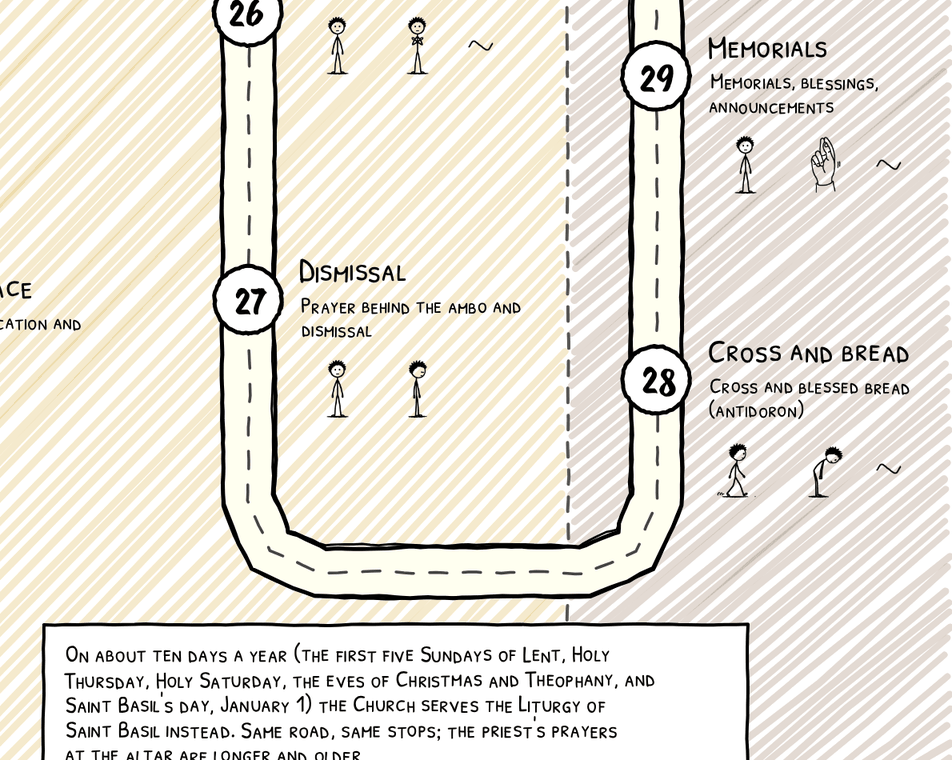
The priest has just said the last blessing, and instead of leaving, the congregation forms a line. At the front he holds a small hand cross. One by one, people kiss it, usually kiss his hand, and take a cube of bread from a basket or from his other hand. Some take two or three and fold them into a napkin. Children eat theirs on the spot. People who didn't go up for Communion go up for this, and somebody may wave you forward. If you're wondering whether that's the Communion you were told you couldn't have, it isn't.
That bread's morning started before yours did, at a small table behind the icon screen, while the reader was still reading.1
What it's called

The bread is the antidoron (Greek, roughly "instead of the gift"; Slavonic antidor; Arabic al-qurbān (القربان) in parish use). It's cut from the same loaves, the prosphora (Greek, "offering"), that the Lamb was cut from before the service; Hapgood's note defines it as "that part of the first Altar-bread which remains on the Table of Oblation after the Sacred Lamb has been taken therefrom."2 The rite at the side table is the proskomedia (the preparation of the gifts), which Hapgood calls the Office of Oblation; the table is the prothesis (the table of preparation).3 The line after the dismissal has no official name. People say "going up for the cross."
What's actually happening
At the side table, before the Liturgy
The loaves are leavened bread, stamped before baking with a seal: a square with a cross and the letters IC XC NI KA, which Hapgood's note translates "Jesus Christ the Conqueror."4
The priest cuts that square out of the first loaf with a small lance, saying at each cut a line of Isaiah 53:7–8, "He was led as a sheep to the slaughter."5 Then he cuts it crosswise, so it can be broken in four at Communion, and pierces its side, as the soldier's spear pierced Christ's.6 That cube is the Lamb (Greek Amnos), the bread that will be consecrated. Wine and water go into the chalice.
Then the bread becomes a map of the Church. Beside the Lamb he sets a piece for the Mother of God, nine particles for the ranks of saints, from John the Baptist and the prophets down to the saint of the day, and particles for the living and the departed, the bishop first and then name after name.7 Hapgood's Russian book takes these from five loaves, in memory of the five that fed the five thousand;8 in Greek parishes the seal also carries a triangle for the Mother of God and nine smaller triangles for the saints.
Anyone can send names, on a paper or with a small loaf of their own; a particle comes out for each name, and the loaf goes home after the Liturgy with the holes in it.9 None of those particles is consecrated and nobody receives them. After Communion the deacon wipes them into the chalice with a prayer: "Wash away, O Lord, the sins of all who are here commemorated, by thy precious Blood, through the prayers of thy Saints."10 Until then the paten and cup sit veiled on the side table, waiting for the Great Entrance.11
At the door, after the dismissal
Two things, stacked. The cross is the Liturgy's handshake: you came in by kissing the icons at the door and you leave by kissing the cross and the hand that held the chalice (Why Do the Orthodox Kiss Everything? covers both). The bread is a leftover in the best sense: what remained of the first loaf, blessed but not consecrated.12 Nothing happened to it at the epiclesis (the prayer calling down the Holy Spirit on the gifts). It's holy the way the building is holy, and it isn't the Body of Christ.
Why it matters
The Church's instinct is never to send anyone away empty-handed. Christians who didn't receive Communion, because they weren't prepared, or weren't Orthodox, or weren't ready, still needed to go home having been given something, so the bread that was offered but not consecrated became the thing everyone gets. An OCA answer says it plainly: "in times past only those who did not receive Communion would take it."13 What makes the difference between this bread and the Gift is the epiclesis: the priest asked the Spirit to change the one and never asked it of the other. It's the instinct that puts a plate in front of a guest before asking why he came.
The preparation says the same thing in bread: the Lamb in the middle, His Mother at His right, the saints in their ranks, and your grandmother by name, on one plate. And the cross is Saint Paul's: "God forbid that I should boast except in the cross of our Lord Jesus Christ" (Galatians 6:14). The last thing you touch on the way out is the thing you're not supposed to be ashamed of.
Where it came from
The antidoron isn't apostolic; it arrived with the rest of the closing rites in the eleventh century.14 Its meaning is older than its rubric: Saint Symeon of Thessalonica says it's given in place of the gifts to those who didn't receive.15 Hapgood's note adds a memorial of the old love feasts that followed the Liturgy,16 and Gogol saw the priest bringing the bread out to the people as a last echo of the early Church's common meal;17 that's a poet's reading, not a historian's.
The preparation rite is younger than it looks. Taft says it began to grow only after the eighth century, "largely as a result of monastic influence," with only its prayer of offering older than that.18 Father Thomas Hopko dates its present form probably to the fourteenth century.19 The names are the oldest part: the first Christians brought the bread and wine themselves, and whoever brought something was prayed for by name.20 Ancient faith, medieval furniture.
In Slavic parishes the priest usually stands at the doors with the cross and the bread waits in a basket beside him, or on a table, for people to take themselves. In Greek and Antiochian parishes he more often hands it out himself from a basket a server holds. Some parishes give out the bread during Psalm 34 (33 in the Septuagint) near the end, as the Slavic book directs; most give it after the dismissal. Follow the line in front of you.
What you do
If you're Orthodox: go up, cross yourself, kiss the cross, kiss the priest's hand, take a piece, and eat it before you start talking. If you received Communion, in many Slavic parishes you already had antidoron and a sip of wine (the zapivka, wine and warm water to wash the Gifts down) at the side table; go up anyway. Take an extra piece for someone at home who's sick. Don't drop crumbs; if you do, pick them up. To have someone remembered at the preparation, give the priest their baptismal names before the Liturgy, on a slip of paper or with a loaf, as your parish does it.
If you're visiting: you may go up, and you should feel welcome to. Kiss the cross or just bow to it; take the bread or politely shake your head; neither is a test. The bread isn't Communion, so nobody's breaking a rule by giving it to you, and taking it is a small, real way to go home with something. The Greek Archdiocese's own suggested welcome from the priest says as much: "All others may receive the Blessed Bread (antidoron) at the conclusion of the service."21 A few parishes keep the antidoron for the Orthodox faithful; if you're waved off, it isn't personal, and the coffee is still yours.
Field Note: it's not Communion. The most common mistake a visitor makes at the end of Liturgy is to take the blessed bread for a watered-down Communion and feel either honored or patronized. It's neither: it's blessed bread, given to everyone. A Protestant visitor can take it with a clear conscience; a Catholic visitor will recognize something like the old blessed bread of French and Quebec parishes.
Go deeper
- Galatians 6:14.
- Hapgood, Service Book, the Office of Oblation, pp. 67–77, and p. 600, note 24.
- Thomas Hopko, The Orthodox Faith, vol. 2, "Prothesis."
- Come thirty minutes early once and watch the side door of the icon screen.
Notes
-
Hapgood, Service Book, p. 597, note 3 (the Office of Oblation said behind the icon screen while the Hours are read). ↩
-
Hapgood, Service Book, p. 600, note 24. ↩
-
Hapgood, Service Book, pp. 67–76; p. xxix (the Table of Oblation in the northern part of the sanctuary). ↩
-
Hapgood, Service Book, p. 114 (the Lamb broken into the portions IC, XC, NI, KA); p. 600, note 20; Hopko, The Orthodox Faith, vol. 2, "Prothesis." ↩
-
Hapgood, Service Book, p. 71. ↩
-
Hapgood, Service Book, pp. 71–72; Hopko, The Orthodox Faith, vol. 2, "Prothesis." ↩
-
Hapgood, Service Book, pp. 72–74; Hopko, The Orthodox Faith, vol. 2, "Prothesis." ↩
-
Hapgood, Service Book, p. 65 (five leavened altar-breads); p. 597, note 4. ↩
-
Hapgood, Service Book, p. 597, note 4; OCA, "Prosphora for Ill and Departed," Questions and Answers. ↩
-
Hapgood, Service Book, pp. 117–118; p. 115 (no one communed from these portions); p. 597, note 4. ↩
-
Hapgood, Service Book, pp. 75–76. ↩
-
Hapgood, Service Book, p. 123, rubric; p. 600, note 24. ↩
-
OCA, "Prosphora for Ill and Departed," Questions and Answers. ↩
-
Getcha, The Euchologion Unveiled, p. 54. ↩
-
Symeon, Explanation §104. ↩
-
Hapgood, Service Book, p. 600, note 24. ↩
-
Gogol, Meditations on the Divine Liturgy, p. 55. ↩
-
Taft, "How Liturgies Grow." ↩
-
Hopko, The Orthodox Faith, vol. 2, "Prothesis." ↩
-
Hapgood, Service Book, pp. 597–598, note 4; OCA, "Prosphora for Ill and Departed," Questions and Answers. ↩
-
GOA Department of Stewardship, Outreach & Evangelism, Outreach & Evangelism: Practical Steps. ↩