
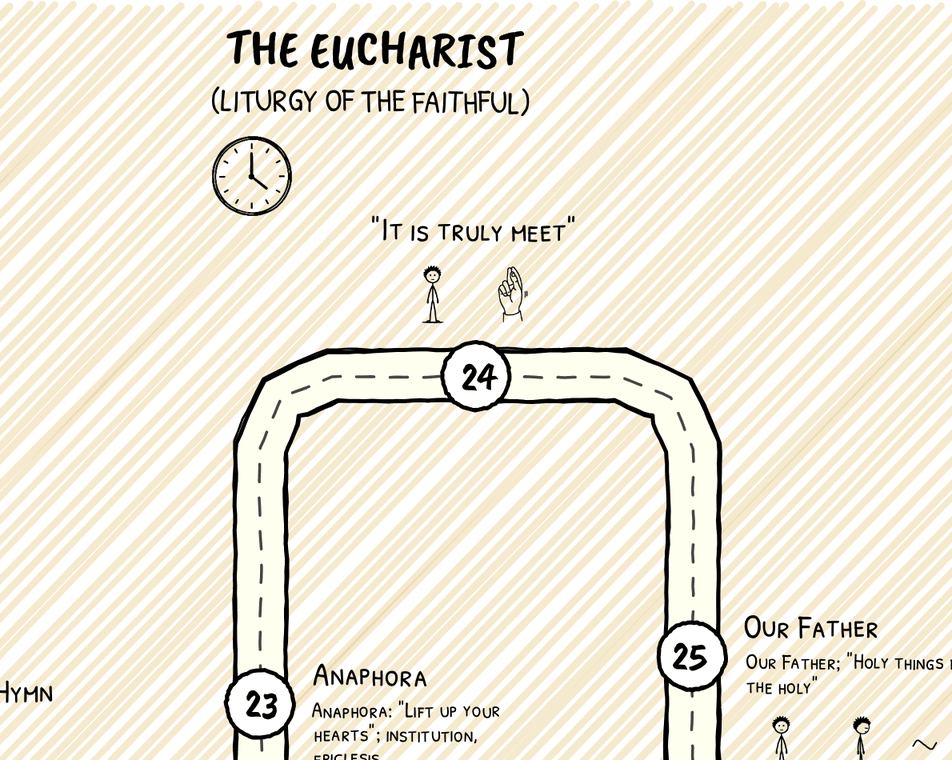


What you'll notice
The bows are over, the gifts are consecrated, and the first thing the Church does is sing to a woman.
The choir begins a hymn you'll hear at nearly every Orthodox service you ever attend: "Meet is it, in truth, to bless thee, the Birth-giver of God, ever-blessed, and all-undefiled, and the Mother of our God. More honourable than the Cherubim, and beyond compare more glorious than the Seraphim, thou who without defilement barest God the Word, true Birth-giver of God, we magnify thee."1 When Saint Basil's Liturgy is served, a longer hymn replaces it, "In thee rejoiceth, O thou who art full of Grace, every created being."2
Behind the screen, the priest is censing and reading names from a list. Then his voice rises: "Among the first have in remembrance…" and he names a man most visitors have never heard of. The choir answers, "And all the people."3 Hapgood's Russian text names the Synod (or Patriarch) here; today each parish names its own ruling bishop.
What it's called
The hymn is "It is truly meet," from its old English first words; Greek Axion estin (Ἄξιόν ἐστιν), Slavonic Dostoyno yest'. Liturgists call it the megalynarion (the "magnifying" hymn). The names are the commemorations, and the list they used to be read from is the diptychs (a folding tablet with the living on one leaf and the dead on the other). Theotokos means "God-bearer": Greek Θεοτόκος, Slavonic Bogoroditsa, Arabic Walidat al-Ilah.
What's actually happening
The prayer just before this asked God to remember everyone the sacrifice is offered for, and it starts the list with "Especially our most holy, all-undefiled, most blessed and glorious Lady, the Birth-giver of God and ever-virgin Mary"; Hapgood's rubric has the priest say it aloud.4 In Saint John Chrysostom's Anaphora it's the only place she's named directly,5 and the hymn is the people's answer to that "especially." Then the priest goes on down the list: the saints, the departed, the living, those who built and keep the building, and the bishop.
The bishop's name is the loud part on purpose. Naming him is how a parish says, out loud, every week, that it belongs to the whole Church and not to itself. Saint Ignatius wrote, "Wherever the bishop shall appear, there let the multitude of the people also be; even as, wherever Jesus Christ is, there is the Catholic Church."6 When two Orthodox churches aren't in communion, the first thing that stops is the naming.
Why it matters
Start with the title. "Theotokos" was argued over at the Council of Ephesus in 431, and the argument wasn't about Mary. It was about her Son. If the child she bore was God, then she bore God, and the name says so. Saint John of Damascus wrote that this one name holds the whole mystery of the Incarnation.7 Mary herself predicted the hymn: "all generations will call me blessed" (Luke 1:48).
"More honourable than the Cherubim" is a startling thing to sing with angels painted all over the dome above you, and it's meant to be. The angels serve God; she carried Him. The Church puts her first in the list because the Incarnation came through her, and then it sings to her the same way Elizabeth did, loudly, as a relative.
Then the dead. The Liturgy names them right after her, because the Church doesn't think they've left. Father Schmemann wrote that Christianity doesn't make its peace with death; it shows death for what it is.8 The Church prays for her departed the way she prays for her living, by name, at the altar, in front of the Body of Christ. Saint Irenaeus spoke of a heavenly altar to which our prayers and oblations go up.9
Where it came from
The second half of the hymn, "More honourable than the Cherubim," is the older part, written by Saint Cosmas of Maiuma in the eighth century for the Matins of Holy Friday. The first half, "Meet is it, in truth, to bless thee," has a story: by Athonite tradition, a monk in the tenth century was taught it by a visitor who turned out to be an angel, and the icon it was first sung before still hangs in the Protaton church at Karyes. Whether you believe the story or not, the Church sang the result into every Liturgy.
The diptychs are fourth-century and older;10 reading names at the Eucharist is one of the earliest things we know Christians did. Saint Cyril of Jerusalem, in the 350s, explains that right here the Church prays for the living and then for the dead, in that order.11 The bishop's name has been shouted at this point for as long as there have been bishops to name.
What you do
If you're Orthodox: cross yourself at the hymn and bow; many people cross three times. Sing it if your parish sings along. When the bishop is named, say "Lord, have mercy" under your breath; he needs it. If you have departed family, this is where to remember them, silently, by name; the priest is doing the same thing for his list.
If you're visiting: stand. If you're Catholic, this will feel like home. If you're Protestant, this may be the moment you've been bracing for, and the next Field Note is for you.
Field Note: do Orthodox worship Mary? No. Worship, in the Church's vocabulary, belongs to God alone; honor is what you give your mother, and the Church gives Mary the most of it because God did first. The hymn is about what God did in her. Every line of it points at her Son, and the last word is His name, Theotokos: the one who bore God. When you hear "Most holy Theotokos, save us," it means what Paul meant when he hoped to "save some" by his preaching (1 Corinthians 9:22): help, rescue, pray for us. Mary and the Saints says the rest. For now, notice that nobody in the room looks confused about who the Liturgy is for.
Field Note: the names. The list the priest is reading isn't two lists. The living and the dead are commemorated together, at the same altar, in the same breath, and that has been the shape of it since at least the fourth century.12 Your grandmother and your bishop are on the same page.
Go deeper
- Luke 1:39–56.
- Hapgood, Service Book, pp. 107–110.
- "On the Orthodox Veneration of Mary," Simply Orthodox.
- Alexander Schmemann, For the Life of the World.
Notes
-
Hapgood, Service Book, pp. 107–108. ↩
-
Hapgood, Service Book, p. 108. ↩
-
Hapgood, Service Book, pp. 109–110. ↩
-
Hapgood, Service Book, p. 107. ↩
-
Hapgood, Service Book, pp. 101–107; Saint Basil's Anaphora also names her earlier, in its account of the Incarnation (p. 103). ↩
-
Ignatius of Antioch, Letter to the Smyrnaeans 8 (ANF 1). ↩
-
John of Damascus, Exposition of the Orthodox Faith III.12 (NPNF2 9). ↩
-
Schmemann, For the Life of the World. ↩
-
Irenaeus, Against Heresies 4.18.6 (ANF 1). ↩
-
Getcha, The Euchologion Unveiled, p. 50. ↩
-
Cyril of Jerusalem, Mystagogical Catecheses 5.8–10 (NPNF2 7). ↩
-
Cyril of Jerusalem, Mystagogical Catecheses 5.9–10 (NPNF2 7). ↩