
What you'll notice
You'll see every level of effort, from the grandmother in black who has worn the same hat since 1974 to the teenager in a hoodie, and the Church survives both. Most people land a notch above everyday. Some women have scarves over their hair. Not one man has a hat on.
What it's called
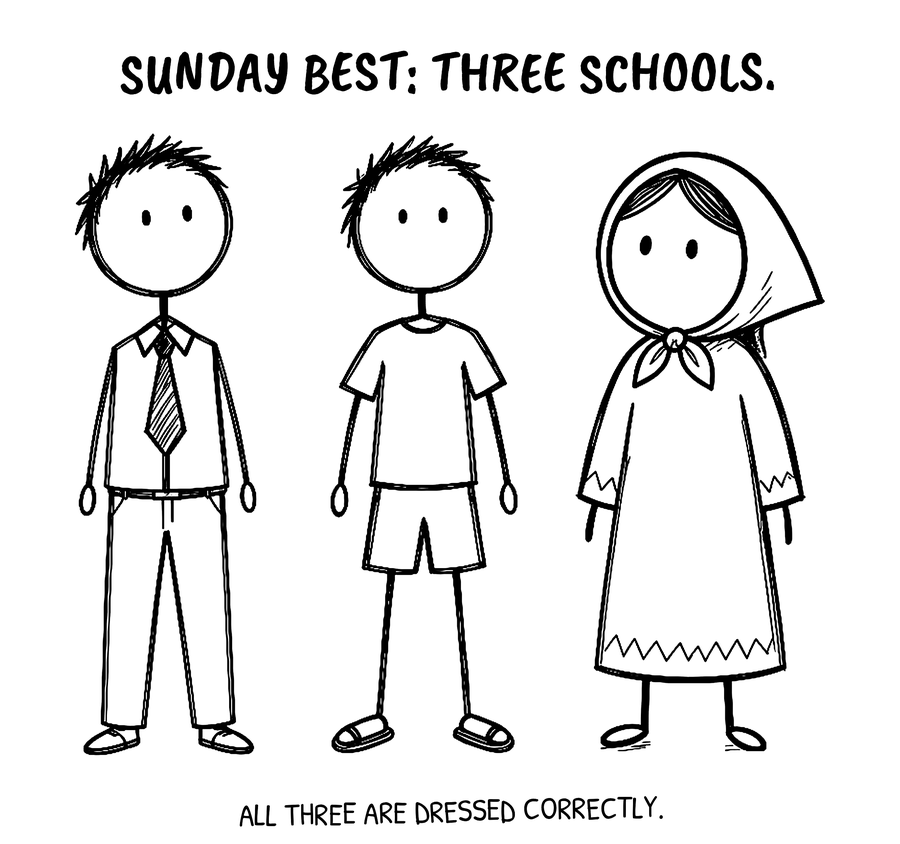
There's no posted dress code and no special name for any of it. The word you'll hear is "modest." The Scripture behind the customs is Saint Paul's passage on praying with the head covered or uncovered (1 Corinthians 11:4–16), which the Orthodox read in different ways.
What's actually happening
Men take their hats off inside. A collared shirt and long trousers are the norm. Jackets and ties are common in Greek parishes and rarer in Slavic, Antiochian, and convert parishes. If in doubt about shorts, wear long trousers.
Women most often wear skirts or dresses, and in many parishes trousers are fine. Knee-length or longer, shoulders covered, nothing low-cut. A cardigan solves most problems.
Head coverings for women are the custom in parishes with Slavic roots (Russian, Serbian, Ukrainian, Carpatho-Russian) and in Romanian ones, where you'll feel more at home with one too. They're less common in Greek and Antiochian parishes; some women cover anywhere, and nobody will look twice either way. No one will hand you a scarf or ask you to put one on.
Why it matters
You're going to meet the King, and you're going to stand close to things people kiss. Modest dress keeps the attention on the altar and the icons, not on the person in the next row.
There's a practical side too. People kiss icons on the way in, kiss the cross on the way out, and, if they're Orthodox, receive Communion from a spoon. Lipstick ends up on all of it, and whoever cleans the icons will know you were there.
Where it came from
Men praying bareheaded and women covered goes back to Saint Paul (1 Corinthians 11:4–5). Around the year 200, Clement of Alexandria told Christians that "woman and man are to go to church decently attired," and wanted a woman "entirely covered, unless she happen to be at home."1 Everything since is custom, and custom has gone different ways in different countries.
What you do
If you're Orthodox: your parish's custom is the one that matters, and you already know it. Wipe off lipstick before Communion.
If you're visiting: modest and comfortable; you'll be standing a while, so wear shoes you can stand in. Go light on lipstick or skip it, and if you're wearing it, bow to the icon instead of kissing it; that's an accepted way to venerate. A scarf in your bag costs nothing.
Field Note: the one dress rule that's actually enforced. It's the hat. A man who walks in wearing a baseball cap will be the only person in the room doing so, and someone's grandmother will tell him. Everything else is a range. The hat is a line.
Go deeper
- 1 Corinthians 11:2–16, read whole.
- The Narthex, on venerating an icon and lighting a candle.
- Standing, Sitting, Pews, and Kneeling, because you'll be on your feet.
- Communion, on the spoon and the cloth.
Notes
-
Clement of Alexandria, The Instructor III.11 (ANF 2). ↩