


What you'll notice
The curtain opens, the Royal Doors open, and the priest is standing in them holding the chalice high. "In the fear of God and with faith draw near." The choir: "Blessed is he that cometh in the Name of the Lord; God is the Lord and hath revealed himself unto us."1
Before that, in many parishes, everyone has said a prayer together, aloud, that begins "I believe, O Lord, and I confess, that thou art in very truth the Christ…" and ends by asking to "partake without condemnation of thine all-pure Mysteries."2 In the clergy's form it runs on into "Of thy Mystical Supper" and a last line asking that Communion be not "unto judgment upon me, or unto condemnation."3 In some parishes the priest says it alone.
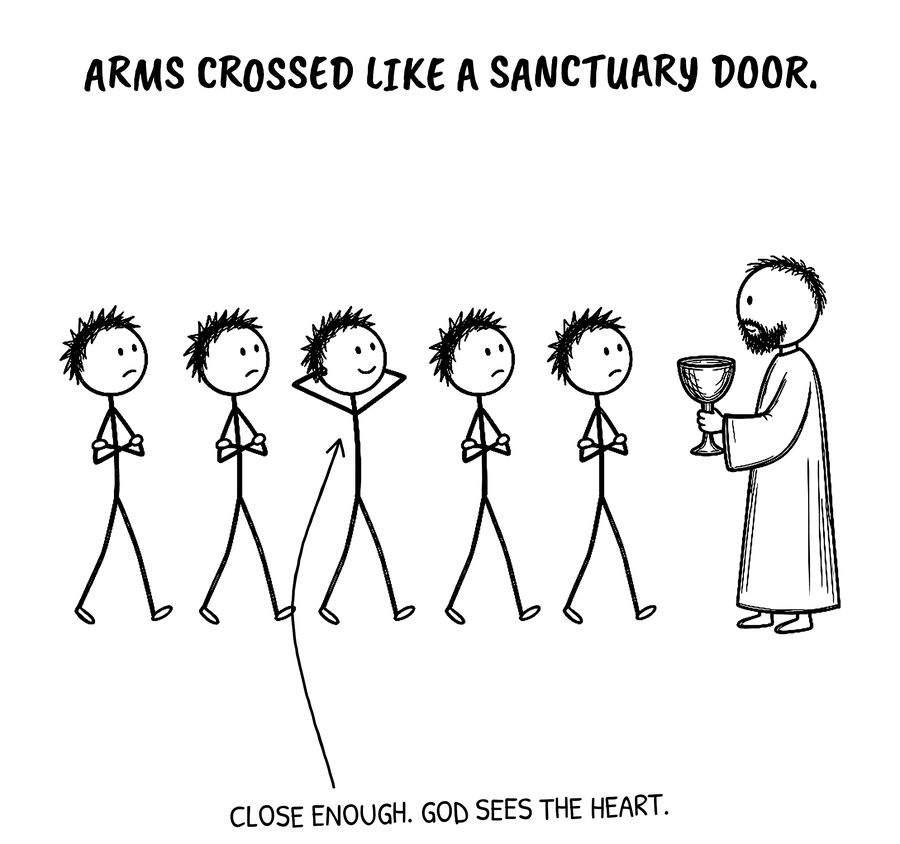
Then a line forms. Babies first in a lot of parishes, held by a parent; then children; then everyone. People walk up with their arms crossed over their chests, right over left. Two servers hold a red cloth under each chin. The priest says a name you can't quite hear ("The servant of God, N., partaketh…"), puts a gold spoon in the person's mouth, and the servers wipe their lips with the cloth.4 The person steps to the side, takes a piece of bread from a basket, and in a Slavic parish sips something from a little cup. Nobody is hurrying. The choir is singing "Receive ye the Body of Christ; taste ye of the Fountain of Life."5
What it's called
Communion, from the Greek koinonia, sharing; the Church also says the Eucharist ("thanksgiving"), the Mysteries, the Gifts. Greek Theia Koinonia, Slavonic prichastie. The spoon is the labis (the Communion spoon), also kochliarion, Slavonic lzhitsa. The cloth has no grand name; it's the Communion cloth. The bread afterward is antidoron (blessed bread, not Communion), which gets its own stop, and the sip in Slavic parishes is zapivka (wine and warm water to wash the Gifts down).
What's actually happening
Orthodox Christians are receiving the Body and Blood of Christ, both at once, from a spoon.
That's the plain description, and the Church means it plainly. "Unless you eat the flesh of the Son of Man and drink His blood, you have no life in you" (John 6:53). You are what you eat: it was by eating that we first disobeyed God, and it's by eating that our fellowship with Him is sustained. Saint Ignatius of Antioch called the Eucharist the medicine of immortality, the antidote against death.6 Saint Germanus says it's called Communion because it gives us union with Christ.
Who receives: baptized and chrismated Orthodox Christians who have prepared. That's not a modern rule. Saint Justin Martyr wrote in 150 that no one may share in this food unless he believes what the Church teaches, has been washed in baptism, and lives as Christ commanded.7 Communion is the sign of a unity that already exists, in faith and in the one Church, and it would be a lie to perform the sign without the thing.
So if you're visiting, you don't receive, and I want to say this as warmly as it can be said: that's a boundary of faith, not a barrier to love. Nobody is judging you. The Church is being honest about what the meal means, and she'd rather be honest than polite. The day you're received into the Church, you'll walk up that aisle with everyone else and the priest will say your name.
Why it matters
The prayer of the Liturgy itself says what Communion is for: that the Gifts may be to those who receive them "unto soberness of soul, unto the remission of sins, unto the fellowship of thy Holy Spirit, unto the fulfilling of the kingdom of Heaven, and unto boldness toward thee; and not unto judgment or unto condemnation."8 Not receiving because you're a sinner is like a sick man refusing his medicine; but Communion doesn't replace confession either. Both are the cure.
Which is why preparation matters. Preparation for Liturgy begins at home. It's the fast, the prayers the night before, confession, being at peace with your family, and getting there on time. The Sunday chalice is the end of a week, not a surprise.
Where it came from
For the first several centuries Christians received the bread in their hands. Saint Cyril of Jerusalem told the newly baptized to make the left hand a throne for the right and receive the King, singing "taste and see" (Psalm 34:8 (33:9 in the Septuagint)) as they came up.9 Communion in the hand lasted until about the eighth century; the spoon is first mentioned in a canon of a council held in 861,10 and it came in so that Body and Blood could be given together and nothing dropped. It's a good tool, not an apostolic one. Justin says the deacons carried Communion out to those who couldn't come;11 priests still do, with a small covered box. The bread has always been leavened in the East, ordinary risen bread, and the wine is ordinary wine. Nothing in the elements is special until the Spirit is asked.
What you do
If you're Orthodox and receiving: fast from food and drink from midnight, or by the rule you have been given (The Communion Fast has the details); say the pre-Communion prayers the night before, not during the Liturgy (Getcha calls that "not proper," and he's right);12 go to confession on the rhythm you keep with your confessor (Confession covers how often). In line, cross yourself before you reach the chalice, not at it, so you don't hit it. Fold your arms across your chest. When it's your turn, say your baptismal name clearly, open your mouth wide, and don't bite the spoon or close your lips on it. Let the servers wipe your mouth. Don't cross yourself in front of the chalice afterward either; step aside first. Wipe off lipstick before you come up. Then take antidoron and go back to your place. Don't talk until you're there. One more thing: Communion isn't given after the dismissal,13 so being there for the Liturgy is part of receiving.
If you're Orthodox and not receiving today: stay where you are and pray with the people who are. Nobody will wonder why.
If you're visiting: stay in your place, and pray if you'd like to; this is a good time for it. Nobody is watching: half the parish stays put on any given Sunday, for reasons of their own, and the other half isn't counting. If an usher gestures you forward, a smile and a small shake of the head is enough. When it's over, you're welcome to the blessed bread (The Cross and the Bread explains), and if you'd like a blessing from the priest, ask him afterward; he'll be glad. Some parishes also welcome visitors who come forward with arms uncrossed for a blessing; others prefer the blessing afterward.
Field Note: the babies. Orthodox infants receive Communion from the day they're baptized, and in many parishes they go first. The Church never asked a child to understand the Eucharist before eating it, any more than a mother asks a baby to understand milk. Hapgood's note has children communed without confession until age seven.14 If you've ever wondered why there's a line of toddlers at the front, that's why.
Field Note: "rare Communion is the Orthodox norm." It became common after the twelfth century, and the Church has been arguing her way back ever since; the Kollyvades fathers of Mount Athos, Saint Makarios of Corinth and Saint Nicodemos among them, made frequent Communion their cause.15 Receiving every Sunday is the old normal, not a modern innovation. In 1972 the OCA's Holy Synod called the renewal of eucharistic life "not only desirable but indispensable."16
Go deeper
- John 6:47–58; 1 Corinthians 11:23–32.
- Hapgood, Service Book, pp. 115–120 and the prayers before Communion, pp. 570–575.
- "Orthodox Communion: A Boundary of Faith, Not a Barrier to Love," Simply Orthodox.
- Can I Take Communion?, for the short answer.
Notes
-
Hapgood, Service Book, p. 119. ↩
-
Hapgood, Service Book, p. 575, the sixth of the prayers before Communion; the rubric on p. 119 has the priest say it aloud before the people receive. ↩
-
Hapgood, Service Book, pp. 116–117. ↩
-
Hapgood, Service Book, p. 119. ↩
-
Hapgood, Service Book, p. 119. ↩
-
Ignatius of Antioch, Letter to the Ephesians 20 (ANF 1). ↩
-
Justin Martyr, First Apology 66 (ANF 1). ↩
-
Hapgood, Service Book, p. 107. ↩
-
Cyril of Jerusalem, Mystagogical Catecheses 5.20–22 (NPNF2 7). ↩
-
Getcha, The Euchologion Unveiled, p. 53. ↩
-
Justin Martyr, First Apology 65, 67 (ANF 1). ↩
-
Getcha, The Euchologion Unveiled, p. 77. ↩
-
Mavropoulos, Passing Through the Church, pp. 304–305. ↩
-
Hapgood, Service Book, p. 600, note 22. ↩
-
Mavropoulos, Passing Through the Church, pp. 302–303. ↩
-
OCA Holy Synod, "On Confession and Communion" (1972). ↩