
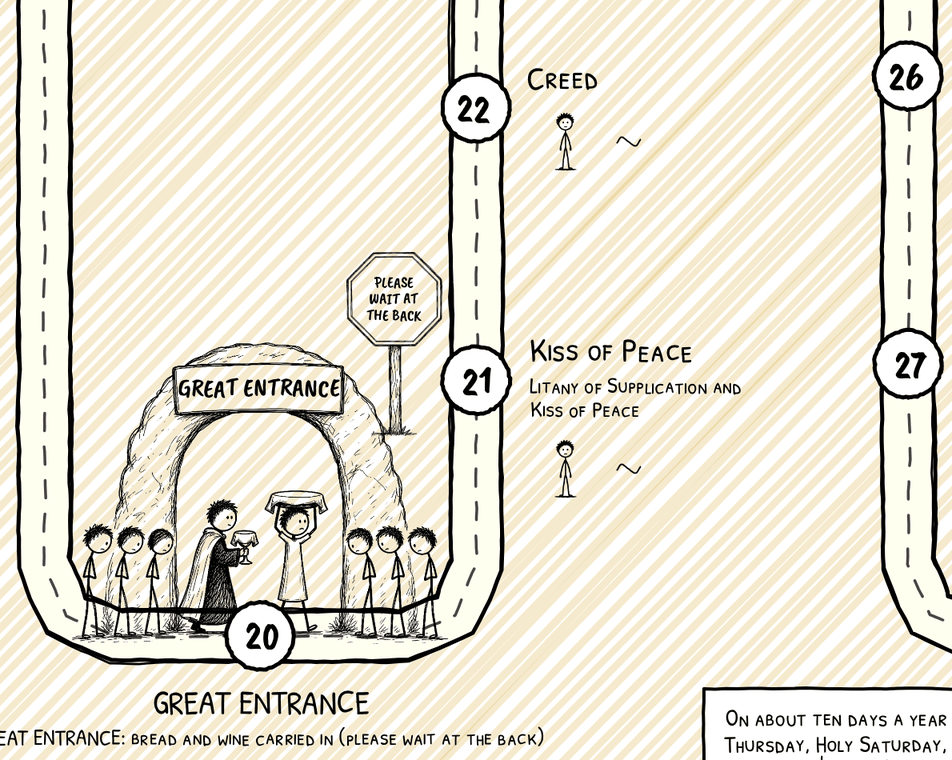


What you'll notice
The litany is over. The priest says, "Peace be with you all," and the choir answers, "And with thy spirit."1 Then the call goes out: "Let us love one another, that with one accord we may confess," and the choir finishes the sentence: "Father, Son, and Holy Spirit, the Trinity, one in Essence and undivided."2
Behind the screen the priest says quietly, three times, a line from Psalm 18:1 (17:2 in the Septuagint), "I will love thee, O Lord my strength,"3 and then the clergy greet each other. In some parishes the people turn and greet their neighbors too; that's a local custom, not a rubric, since the service texts give the greeting to those serving in the sanctuary. Today it usually stays with them.4 Then the deacon shouts, "The Doors! The Doors! Wisdom! Let us attend," and the Creed begins.
What it's called
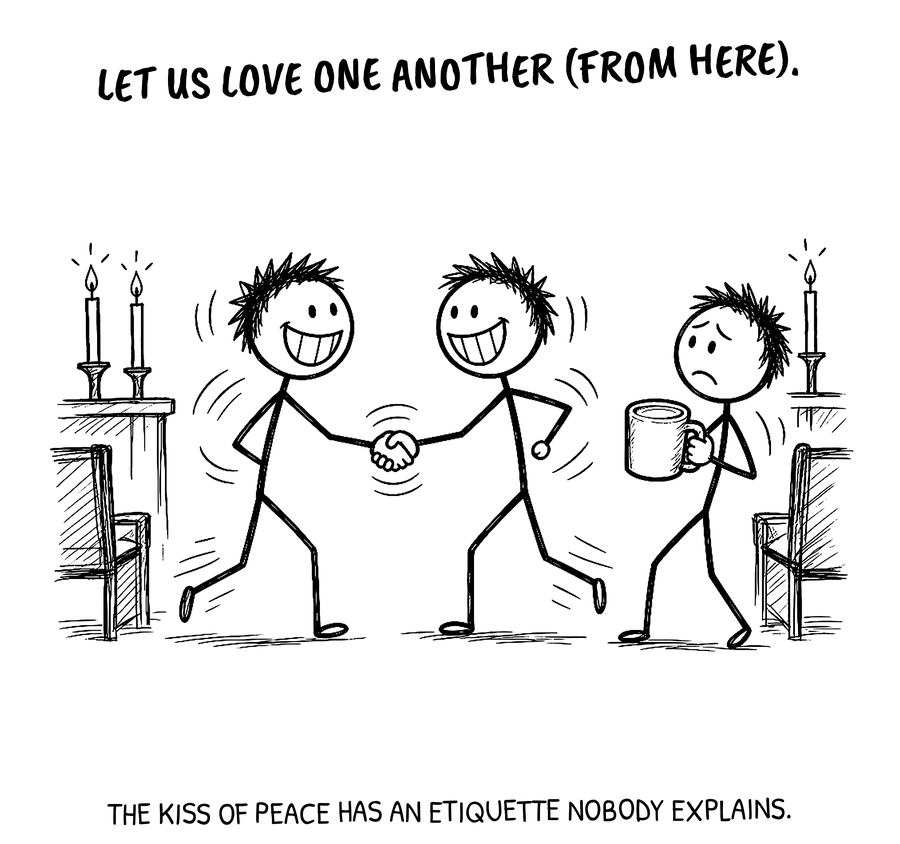
The Kiss of Peace is the aspasmos, the greeting. The older words are "Christ is in the midst of us" and "He is and shall be";5 where the people exchange it, you'll usually hear "Christ is in our midst" and "He is and ever shall be."
What's actually happening
The kiss is what has to happen before the Creed can. You confess a shared faith only after you've made peace with the people you're confessing it with.
The call says so in so many words: love one another "that with one accord we may confess." First the Church shows its unity in love, and then, in the Creed, its unity in faith. The order isn't negotiable.
Russian practice adds a detail you can't see from the nave. Before the priest kisses anyone, he kisses the gifts: the covered paten, the covered chalice, and the edge of the altar in front of him. Only then, if there are several priests, do they kiss each other on the shoulder.6 Peace with God and peace with each other, in that order, inside of a minute.
Why it matters
The Church is a society of love, forgiveness, and reconciliation. That isn't a slogan; it's a precondition. Christ said to leave your gift at the altar and go be reconciled first (Matthew 5:23 to 24), and the Didache, the oldest church manual we have, says no one at odds with his neighbor should join the assembly until they've made up.7 Saint Cyril of Jerusalem calls this kiss a reconciliation, a sign that souls have been joined and grudges let go.8 Saint Paul signs off three letters with "Greet one another with a holy kiss" (Romans 16:16; 1 Corinthians 16:20; 2 Corinthians 13:12) and a fourth with "Greet all the brethren with a holy kiss" (1 Thessalonians 5:26), and Saint Peter calls it a kiss of love (1 Peter 5:14). This is where it lives now.
Where it came from
Saint Justin Martyr, writing around 150, describes the kiss right where it still is: after the prayers and before the bread and cup are brought up.9 For centuries the whole assembly exchanged it; the fourth-century Apostolic Constitutions put it plainly, "let the men give the men, and the women give the women, the Lord's kiss,"10 and the Council of Laodicea (c. 363) assumes the laity do: "after the presbyters have given the [kiss of] peace to the Bishop, then the laity are to give it."11 Father Thomas Hopko says it "in times past was certainly exchanged among the faithful people as well."12 When the people stopped, no one can say; by the time the medieval commentators describe it, it belongs to the clergy.
What you do
If you're Orthodox: at "Let us love one another," cross yourself. If your parish turns to greet neighbors, say "Christ is in our midst" and answer "He is and ever shall be," with a handshake or a kiss on the cheek depending on the family. If it doesn't, don't start a trend.
If you're visiting: if someone turns and says something to you, a smile and "He is" will get you through. If nobody turns, nothing is expected. When you hear "The doors, the doors," nobody is going to lock you in; that's the next stop.
Field Note: "the kiss is just for the priests." It wasn't. For centuries the whole assembly exchanged it, men with men and women with women.13 What you see behind the screen on a Sunday is the remnant, not the rule. The clergy kept the custom when everyone else let it go, which is less a privilege than a reminder of what the rest of us are missing.
Notes
-
Hapgood, Service Book, p. 99. ↩
-
Hapgood, Service Book, p. 99. ↩
-
Hapgood, Service Book, p. 100. ↩
-
Taft, The Great Entrance, p. 375. ↩
-
Hapgood, Service Book, p. 100. ↩
-
Hapgood, Service Book, p. 100 (rubric). ↩
-
Didache 14 (ANF 7). ↩
-
Cyril of Jerusalem, Mystagogical Catecheses 5.3 (NPNF2 7). ↩
-
Justin Martyr, First Apology 65 (ANF 1). ↩
-
Apostolic Constitutions II.57 (ANF 7); Getcha, The Euchologion Unveiled, p. 49; Taft, The Great Entrance, p. 389. ↩
-
Council of Laodicea, canon 19 (NPNF2 14). ↩
-
Hopko, The Orthodox Faith, vol. 2, "Love and Faith." ↩
-
Getcha, The Euchologion Unveiled, p. 49; Taft, The Great Entrance, p. 389. ↩