
What you'll notice
The gears change.
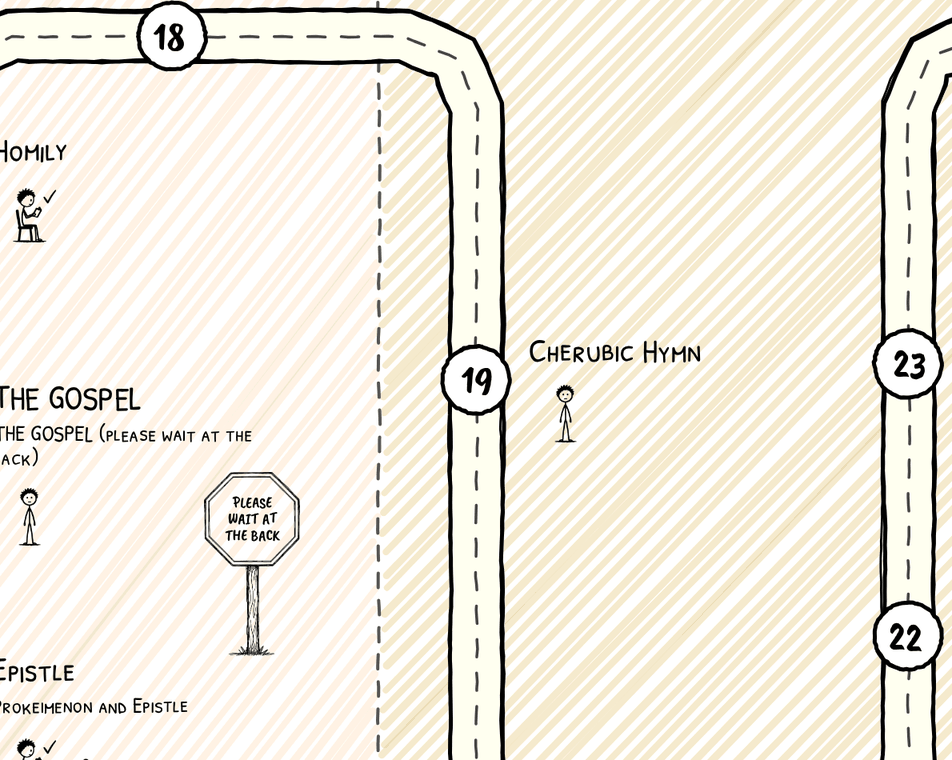
Everything so far has moved: litanies, processions, readings, a sermon. Now the choir starts a hymn that's slower than anything you've heard all morning, long vowels stretched over a melody you can't predict, and the whole room settles into it. The priest comes out with the censer and censes the altar, the icons, the chanters, and finally you. People bow. Then the clergy go back behind the screen and for a minute you can't see them at all. The singing keeps going. Nobody looks worried.
Then the hymn stops in the middle of a sentence, and the procession begins. That's the next stop. This one is about the song.
What it's called
The Cherubic Hymn, from its first words. Greek Cheroubikon (Χερουβικόν), Slavonic Kheruvimskaya. In Hapgood's translation it runs: "Let us, the Cherubim mystically representing, and unto the Life-giving Trinity the thrice-holy chant intoning, all cares terrestrial now lay aside. That we may raise on high the King of all, like conqueror on shield and spears, by the Angelic Hosts invisibly up-borne."1 Your parish's English will be more modern, and if it follows the Greek, the second sentence will read differently; see below.
It marks the start of the Liturgy of the Faithful, the second half of the service. Just before it, the deacon sends the catechumens out (nobody goes) and calls on "us who are in the faith" to pray.2
What's actually happening
Three things at once.
The choir sings the first half of the hymn, slowly, to give the clergy time. At the Holy Table (the altar) the priest says a long quiet prayer that ends by calling Christ the one who offers and is offered, who receives and is received: "it is thou who offerest and art offered, who receivest and art thyself received."3 It is one of the few prayers in the Liturgy addressed to Christ rather than to the Father; another comes just before Communion, "Give heed from thy holy dwelling-place… O Lord Jesus Christ our God."4 Then he censes (or the deacon does, if there is one) while saying Psalm 51 (50 in the Septuagint) under his breath, says the Cherubic Hymn three times with bows, and goes to the little table on the left, the prothesis (the table of preparation), to pick up the bread and wine that were prepared before the service.5 The Cross and the Bread tells how they were prepared.
The hymn is the frame. The Great Entrance is the picture inside it. The choir finishes the second half ("That we may raise on high the King of all…") only after the gifts have gone in.6
Why it matters
The hymn tells you what you're supposed to be doing right now, which is being an angel.
Not in a sentimental way. The cherubim and seraphim in Isaiah's vision cry "Holy, holy, holy" (Isaiah 6:3) and the four living creatures in Revelation never stop (Revelation 4:8). The hymn has us "the Cherubim mystically representing":7 we're standing in for the angels, singing their song, and the condition for doing it is to lay aside "all cares terrestrial." Archimandrite Vasileios of Iveron builds a whole meditation on that one line, "we who in a mystery represent the cherubim."8 Saint John Chrysostom, describing the moment of consecration a few minutes from now, says the sanctuary is filled with the powers of heaven and angels stand by the priest.9
And what's coming is a King. The hymn says He comes "by the Angelic Hosts invisibly up-borne,"10 which is the oldest way the Church has read what happens next: not a funeral, first of all, but an arrival. The funeral reading is real too, and it's older than you'd think, but the hymn itself is about a king coming in. The Great Entrance, next, holds both readings together.
The last line has two readings, depending on which book is in your hands. The Greek says we are hypodexomenoi, about to receive the King, the way you open the door to a guest. The Slavonic says we lift Him up, and Hapgood's English runs with it: "like conqueror on shield and spears."11 That's an acclamation, the old army habit of hoisting a new emperor on a shield. The shield is Hapgood's own touch; the Greek word, doryphoroumenon, means escorted by spear-bearers. Hospitality or coronation: no council has ruled, and the Church sings both.
Where it came from
The hymn is younger than the procession it decorates. The Byzantine chronicler Cedrenus says it entered the Liturgy under Emperor Justin II, in 573 or 574, and Robert Taft, who wrote the standard history, accepts the date.12 Before that, a psalm was sung here with alleluia as its refrain, by the best evidence Psalm 24 (23 in the Septuagint),13 "Lift up your heads, O you gates!… And the King of glory shall come in" (Psalm 24:7 (23:7 in the Septuagint)), and Patriarch Eutychius complained that people were singing it as if the unconsecrated gifts were already the King of glory Himself.14 The new hymn fixed the problem by making the theology explicit.
On a few days the choir sings something else in this slot: on Holy Thursday, "Of Your Mystical Supper"; on Holy Saturday, "Let all mortal flesh keep silence," borrowed from the Liturgy of Saint James;15 and at the Presanctified Liturgy on Lenten weekdays, "Now the powers of heaven."
What you do
If you're Orthodox: stand still. Bow when the censer comes your way, and bow your head for the hymn if that's your parish's custom. This is the moment the hymn names: put the phone away, put the week away. Don't walk, don't whisper, don't go find your kid. He's fine.
If you're visiting: stand, and when the priest censes toward you, a small bow is the whole etiquette. If the hymn sounds like it's going nowhere, that's on purpose. It's the sound of a room setting something down.
Field Note: you may know this one. "Let all mortal flesh keep silence," the Holy Saturday version, turns up in Episcopal, Lutheran, and Methodist hymnals, set to a French carol tune. A Protestant visitor at the Holy Saturday Liturgy sometimes gets a jolt of recognition in the middle of the strangest service of the year. The hymn came from us first.
Field Note: the cape. When there's no deacon, the priest drapes the big veil, the aer (the large veil over the gifts), over his own shoulders like a cape during the procession so his hands are free for the chalice. Nikolai Gogol, who wrote a whole meditation on the Liturgy, said the Lamb goes by on the paten "as on a shield";16 the Slavic text of the hymn raises the King on a shield too.17
Go deeper
- Isaiah 6:1–7; Revelation 4.
- Hapgood, Service Book, pp. 94–96.
- Archimandrite Vasileios, Hymn of Entry, pp. 72–73.
- The Liturgy of Holy Saturday morning, for "Let all mortal flesh keep silence."
Notes
-
Hapgood, Service Book, p. 94. ↩
-
Hapgood, Service Book, p. 92. ↩
-
Hapgood, Service Book, p. 95. ↩
-
Hapgood, Service Book, p. 113. ↩
-
Hapgood, Service Book, p. 95 (the hymn said "Thrice"). ↩
-
Hapgood, Service Book, p. 96. ↩
-
Hapgood, Service Book, p. 94. ↩
-
Vasileios, Hymn of Entry, pp. 72–73. ↩
-
Chrysostom, On the Priesthood VI.4 (NPNF1 9). ↩
-
Hapgood, Service Book, p. 94. ↩
-
Hapgood, Service Book, p. 94. ↩
-
Taft, The Great Entrance, pp. 68–69, 89; Schulz, The Byzantine Liturgy, p. 35. ↩
-
Taft, "How Liturgies Grow." ↩
-
Taft, The Great Entrance, pp. 84, 426; Schulz, The Byzantine Liturgy, pp. 37–38. ↩
-
Taft, The Great Entrance, pp. 68–69; Schulz, The Byzantine Liturgy, p. 37. ↩
-
Gogol, Meditations on the Divine Liturgy, p. 31. ↩
-
Hapgood, Service Book, pp. 94, 96. ↩