

What you'll notice
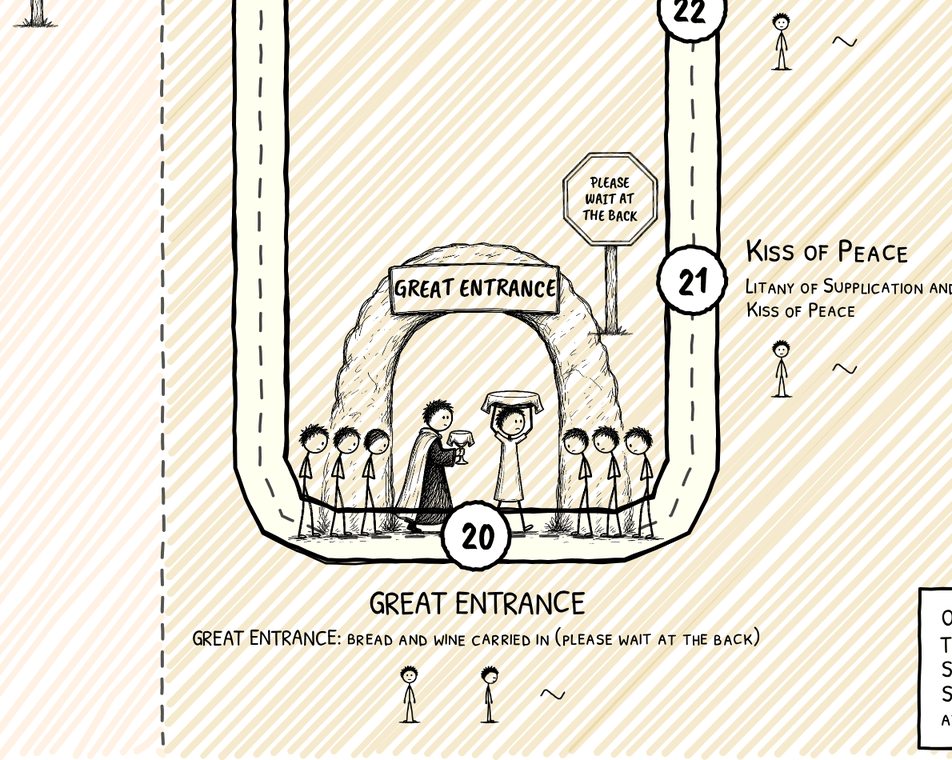
The choir has been singing one slow hymn for a while now, slower than anything else all morning, and the priest has disappeared. Then the side door in the icon screen opens. Candles come out first, and the censer, and sometimes two gold discs on poles with six-winged angels painted on them. Then the deacon, if there is one, with a covered gold plate held up at eye level and a big embroidered cloth over his shoulder; then the priest with a veiled cup. They walk out into the room. People bow their heads. Some cross themselves. Someone near the aisle reaches out and touches the priest's cape as he passes, and a mother lifts a toddler so the cup goes over his head. The choir, which was already slow, stops in the middle of a sentence. The clergy turn to face you and chant "…may the Lord God remember in his kingdom always, now, and ever, and unto ages of ages."1 Then they go in through the center doors, the choir finishes its sentence, and the doors close.
The first time I saw it I remembered it afterward as choreography. It isn't. It's a delivery.
What it's called

The Great Entrance (Greek Megali Eisodos; Slavonic Velikiy Vkhod; Arabic al-dukhul al-kabir), "great" by contrast with the Small Entrance earlier, when only the Gospel book went for a walk. Scholars call it the transfer of gifts, which is exactly what it is.2 The covered plate is the diskos (the paten that holds the bread); the cup is the chalice; the cloth on the deacon's shoulder is the aer (the large veil); the angel discs are ripidia (liturgical fans). The slow hymn is the Cherubic Hymn, from the previous stop, and Hapgood prints it as the "Cherubimic Hymn."3
What's actually happening
Bread and wine, prepared on a side table before the service began in a rite called the proskomedia (the preparation of the gifts), are being carried to the Holy Table (the altar) so that they can be offered. That's all, and it's a great deal. (The Cross and the Bread tells how they were prepared.) Before the procession the priest said the quiet prayer and censed the church, as the previous stop describes, and then laid the veil on the deacon's shoulder with a line from Psalm 134:2 (133:2 in the Septuagint), which Hapgood's book renders "Lift up your hands unto the Holy Things, and bless the Lord."4
Say it plainly: the bread and wine are not yet consecrated. They are not the Body and Blood of Christ at this point. Saint Symeon of Thessalonica, who had to explain this to his own people six hundred years ago, says we honor them because, though not yet consecrated, they've been set apart for it,5 and Hapgood's own note says the same.6 Nicholas Cabasilas was already complaining in the 1300s that some of the faithful bowed as if to the consecrated Gifts, confusing this entrance with the one at the Presanctified Liturgy.7 So why bow? Because you bow to a gift being carried to God, the way you'd stand when the bride comes in, before anyone's married. And because the commemorations are the thief's prayer, "Lord, remember me when You come into Your kingdom" (Luke 23:42), and bowing is the natural thing to do while asking it.8
Why it matters
This is the hinge of the whole morning. Everything before it was teaching; everything after it is sacrifice, and the Great Entrance is where the Church brings what it has to the table.9 The hymn, as the previous stop explains, makes you a stand-in for the cherubim, not a spectator at a parade. The old Byzantine reading sees Christ carried to his burial. In a sense it's both: we carry what will become the Body of Christ to the altar, which is both his tomb and his throne. Both pictures are right, and the Kingdom that has come and is still coming goes by in a covered cup.
Where it came from
It started as an errand. In early Constantinople the people handed their bread and wine to deacons on the way in, at a round building beside the church, and at this point in the service the deacons went out, fetched the gifts, and brought them to the altar.10 Taft calls that first transfer "a material act of no ritual import whatever." The building, the skeuophylakion (the sacristy building), was a separate structure, not a room in the church, and the entrance was how the Liturgy of the Eucharist began, the way the Little Entrance began the Liturgy of the Word; the meanings came later, and the procession survived on them.11 The errand grew a chant, and the chant gave way to the Cherubic Hymn under Emperor Justin II in 573–574; the Cherubic Hymn stop tells that story. For most of the first thousand years only deacons carried the gifts; priests joined later.12
Theodore of Mopsuestia, around 400, already saw a burial in the placing of the gifts,13 and Saint Germanus in the 700s filled in the picture: the fans are the seraphim, the diskos the hands of Joseph and Nicodemus, the veil the stone.14 The commemorations are medieval, not before the twelfth century and not regular until the fifteenth; Taft's guess is that they grew from people crowding the procession to be remembered.15 Father Alexander Schmemann faulted the symbolic preparation rite for "duplicating" the Eucharist itself.16 Even Father John Meyendorff, who brought Germanus into English, concedes that one-to-one correspondences can "degenerate into mere allegory."17 It's a delivery first, and a picture second.
The route and the words depend on the book your parish uses. Greek practice takes the procession down the north aisle toward the narthex (the entrance hall) and back up the center;18 traditional Russian practice stays on the solea (the raised step in front of the icon screen).19 Slavic deacons carry the diskos on their heads.20 The hymn's last line differs between the two books as well; the Cherubic Hymn stop explains how. Hapgood prints a long list of commemorations and a quiet "Noble Joseph" at the altar;21 Greek-use books print one general commemoration and no "Noble Joseph."
What you do
If you're Orthodox: stand, stop talking, and bow your head as the gifts pass; many people say the thief's prayer silently. Don't block the aisle. Touching the priest's phelonion (his cape-like outer vestment) as he goes by is a Greek and Middle Eastern custom; lifting children under the gifts is common in Greek parishes; Slavic parishes mostly do neither. Do what your parish does, and don't correct anyone who does otherwise.
If you're visiting: stand with everyone and watch. A slight bow of the head is a courtesy, not a requirement. You don't need to cross yourself or kneel. Stay out of the aisle and don't photograph it. The bread and wine going past you are not yet Communion; you're watching a gift being carried to God.
Field Note: four small myths. You'll read, even in good books, that the people once carried their own bread and wine up in this procession; there's no trace of it in the East, and Taft looked.22 You'll read that the commemorations are the ancient diptychs (the lists of names once read at the altar); Hapgood's own note says so, and Taft shows they're medieval and unrelated.23 You'll read that an emperor wrote the hymn; Justin II ordered it sung, and nobody knows who wrote it.24 And you'll read that the hymn dates from the ninth century; it's three hundred years older.25
Field Note: Romania. Taft records that in Romanian churches people lie down in the path of the procession so the gifts pass over them, and the priest steps over them as he goes.26 The Church's instinct about reverence runs ahead of its theology, which is why the theologians keep having to write notes.
Go deeper
- Luke 23:39–43.
- Saint Germanus of Constantinople, On the Divine Liturgy §§37–41.
- Robert Taft, The Great Entrance, pp. 3–9 and p. 426.
- The Great Entrance itself: watch it once from the aisle and once from the back.
Notes
-
Hapgood, Service Book, p. 96. ↩
-
Taft, The Great Entrance, p. 5. ↩
-
Hapgood, Service Book, p. 94. ↩
-
Hapgood, Service Book, p. 95. ↩
-
Symeon, Explanation §§65–66. ↩
-
Hapgood, Service Book, p. 599, note 17. ↩
-
Schulz, The Byzantine Liturgy, p. 39. ↩
-
Gogol, Meditations on the Divine Liturgy, pp. 31–32; Symeon, Explanation §§64–65. ↩
-
Getcha, The Euchologion Unveiled, p. 47; Mavropoulos, Passing Through the Church, p. 298. ↩
-
Taft, The Great Entrance, p. 426; Getcha, The Euchologion Unveiled, p. 47. ↩
-
Taft, "How Liturgies Grow." ↩
-
Schulz, The Byzantine Liturgy, p. 168. ↩
-
Getcha, The Euchologion Unveiled, p. 48. ↩
-
Germanus, On the Divine Liturgy §§37–41. ↩
-
Taft, The Great Entrance, pp. 227–229; Getcha, The Euchologion Unveiled, p. 48. ↩
-
Schmemann, Introduction to Liturgical Theology, cited in Costa, "'Allegorical Typologies' of the Eucharist." ↩
-
Meyendorff, introduction to Germanus, On the Divine Liturgy, p. 46, cited in Costa, "'Allegorical Typologies' of the Eucharist." ↩
-
Taft, The Great Entrance, p. 6; Mavropoulos, Passing Through the Church, p. 298. ↩
-
Taft, The Great Entrance, p. 6. ↩
-
Hapgood, Service Book, p. 95. ↩
-
Hapgood, Service Book, pp. 96–97. ↩
-
Taft, The Great Entrance, p. 259; Schulz, The Byzantine Liturgy, p. 168. ↩
-
Hapgood, Service Book, p. 599, note 17; Taft, The Great Entrance, pp. 227–228. ↩
-
Taft, The Great Entrance, p. 69. ↩
-
Taft, The Great Entrance, pp. 68–69. ↩
-
Taft, The Great Entrance, p. 7. ↩