
What you'll notice
A lot of people are doing things, and none of them is wearing a name tag. A man in a long gown and a cape comes out of the doors and goes back in. A different man with a wide ribbon over one shoulder stands in front of the doors and sings instructions at the room. Boys in gold tunics carry candles and look bored. To the right, a few people at a wooden stand with a book sing in a style that sounds like it came from somewhere with a lot of sand; or, in a loft behind you, a dozen people in street clothes sing in four parts. A teenager reads the Bible aloud on one note. Once in a while everyone turns toward an older man in a tall hat who's been sitting in a chair the whole time, and he stands and blesses them with two candlesticks.
The visitor's question is the right one: who are all these people, and what do I call them?
What it's called

The Church sorts its people into orders, and Hapgood's Service Book lists them by what they're allowed to wear: reader, subdeacon, deacon, priest, bishop.1 The first two are minor orders, the last three the major orders, the ones the New Testament calls deacons, presbyters, and overseers (1 Timothy 3:1–13; Titus 1:5–9). At a glance:
- Priest (Greek presbyteros, "elder"): gown, cape, long band down the front. He's the one who goes in and out of the doors and prays at the altar. You call him "Father." (Why, given Matthew 23:9, is taken up in Ordination and the Clergy Family.)
- Deacon: straight tunic, no cape, a ribbon over one shoulder. He leads the litanies and reads the Gospel. Shortly before the consecration he binds the ribbon crosswise around himself, which Hapgood says pictures "the wings of the Angels who serve about the Altar, as the Deacons themselves typify the Cherubim and Seraphim."2 Some parishes call him "Father," others "Father Deacon" or simply "Deacon." Many American parishes have none, and the priest says his parts.
- Bishop: more of everything and a crown; the man in the chair when he visits. "Your Grace." An archbishop or metropolitan is "Your Eminence," the head of a self-governing Church "Your Beatitude," and the Ecumenical Patriarch "Your All Holiness."3 Some Slavic usage gives "Beatitude" to metropolitans and "Eminence" to archbishops, the reverse of the Greek.4
- Subdeacon: tunic with the ribbon crossed over both shoulders; mostly seen when a bishop visits.
- Reader: a tonsured layman, sometimes in a tunic, who reads the Epistle and the psalms.
- Altar servers: boys and men in tunics with no ribbon, carrying candles and fetching things. Not ordained; helping.
- Chanters (Greek psaltes) sing at the stand on the solea; a choir sings from a loft. Greek, Antiochian, and Romanian parishes lean to chanters and Byzantine chant; Russian and Serbian parishes to a choir in harmony; many American parishes have both.
Clergy wives have titles too, the name you use for the priest's wife: Presbytera (Greek), Matushka (Russian), Khouria (Arabic), Preoteasa (Romanian), Popadija (Serbian). The glossary has the rest.
What's actually happening
Everyone in that list is doing something the congregation can't do by itself, and nobody is doing something the congregation isn't part of. The deacon's litany is a conversation: he names the need, you answer "Lord, have mercy." The chanters sing the people's half out loud so the people can follow. The priest's prayers at the altar are in the first person plural, we offer, we give thanks; he's praying with you, out front, facing the same way you are.
The bishop matters even when he's absent. The priest can't serve without a cloth called the antimension (the bishop's signed altar cloth) on the Holy Table, and the bishop signed it. Every parish Liturgy is the bishop's Liturgy with the priest standing in, which is why the choreography changes so much when he actually comes.5
Why it matters
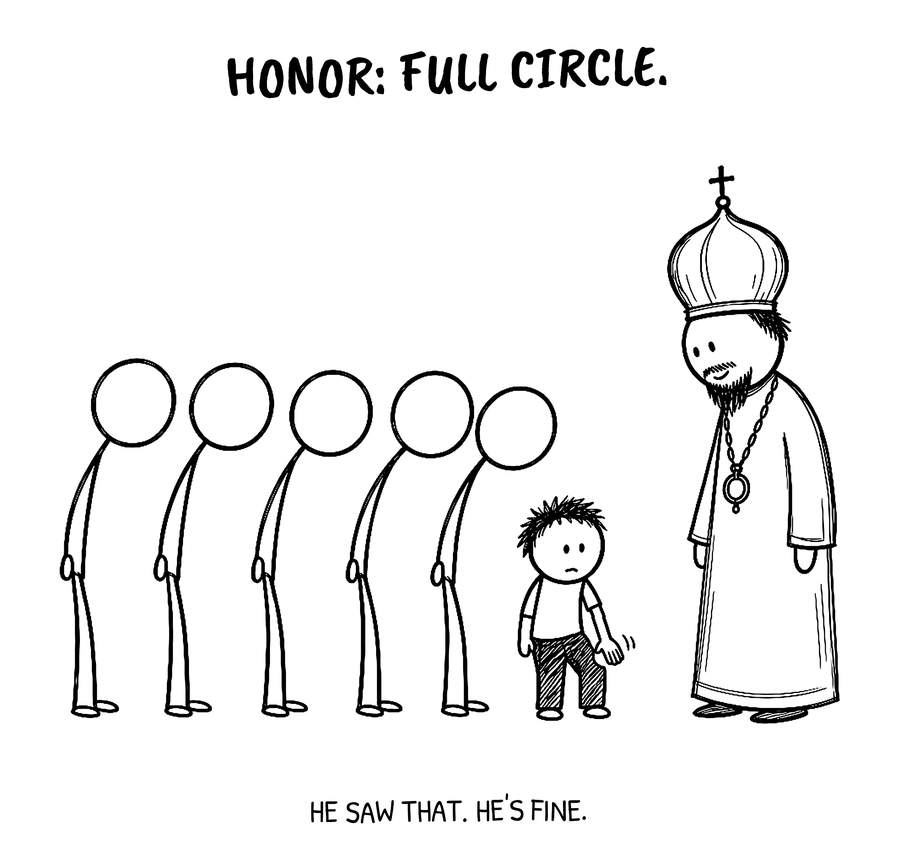
The Church has had deacons since the apostles picked seven men to make sure the widows got fed (Acts 6:1–6), and her clergy have never stopped being, at root, people who serve tables. Saint John Chrysostom, writing in the 380s about what the priesthood asks of a man, says that at the consecration the sanctuary fills with angels and the priest stands among them.6 That's the Church's own account of the job: not a manager or a performer, but a man put in a terrifying place on your behalf. Mavropoulos puts the priesthood on the floor of the church, with the people, because, as he says, "we do not separate the clergy from the people."7
Where it came from
The three major orders are in the New Testament. The minor orders grew in the first centuries as the Church got big enough to need doorkeepers, readers, and candle-bearers; Saint Symeon of Thessalonica, around 1400, still walks through bishop, priest, and deacon, each with his vestments and their meaning.8 Most minor orders faded; readers and subdeacons survive, and altar servers do the old doorkeepers' work without the ordination. In many American parishes there is no deacon at all, and the priest takes the deacon's parts himself.
What you do
If you're Orthodox: greet the priest with "Father, bless" (Greek Evlogeite, Russian Blagoslovite), right hand cupped over left; he'll bless and you'll kiss his hand (why the Orthodox kiss everything has its own entry). Greet a bishop with "Master, bless," and take his blessing before the priest's. Ask clergy for a blessing rather than giving them one; one parish guide puts it flatly: "It is not appropriate to invoke a blessing on a clergyman."9 And don't reach for a deacon's hand; he doesn't give the blessing, and the same guide says "we do not normally" kiss it.10 Answer the litanies out loud; the chanters are only covering for you. If you can sing, ask whoever runs the music. They need you.
If you're visiting: you don't have to call anyone anything, and nobody will test you. If you want to talk to the priest, wait for coffee hour, say "Father," and ask; he's heard your question. Don't go through the doors or up to the servers' area, even if a door is open and a kid just walked through it. The kid has a job. You're a guest, and guests get the good seats, not the kitchen.
Field Note: the ribbon key. No ribbon, tunic only: server. Ribbon over one shoulder: deacon. Ribbon crossed over both: subdeacon. Cape: priest. Crown: bishop. This covers roughly 95 percent of cases, which beats most bird guides. (Plenty of parishes have no deacon at all, and the singing may come from a choir, a chanter or two, or both.) Vestments at a Glance names every piece.
Go deeper
- Acts 6:1–6; 1 Timothy 3:1–13; Titus 1:5–9.
- Saint John Chrysostom, On the Priesthood VI.4 (NPNF1 9).
- Hapgood, Service Book, pp. xxxiv–xxxviii.
- Ordination and the Clergy Family.
Notes
-
Hapgood, Service Book, pp. xxxiv–xxxviii. ↩
-
Hapgood, Service Book, p. xxxv. ↩
-
GOARCH, "Forms of Addresses and Salutations for Orthodox Clergy." ↩
-
All Saints of North America Orthodox Church, "Clergy Etiquette: Addressing Clergy and Monastics in the Church." ↩
-
Getcha, The Euchologion Unveiled, p. 79, on the bishop's reception. ↩
-
John Chrysostom, On the Priesthood VI.4 (NPNF1 9). ↩
-
Mavropoulos, Passing Through the Church, p. 165. ↩
-
Symeon of Thessalonica, Explanation of the Divine Temple §§24–42. ↩
-
All Saints of North America Orthodox Church, "Clergy Etiquette." ↩
-
All Saints of North America Orthodox Church, "Clergy Etiquette." ↩