


What you'll notice
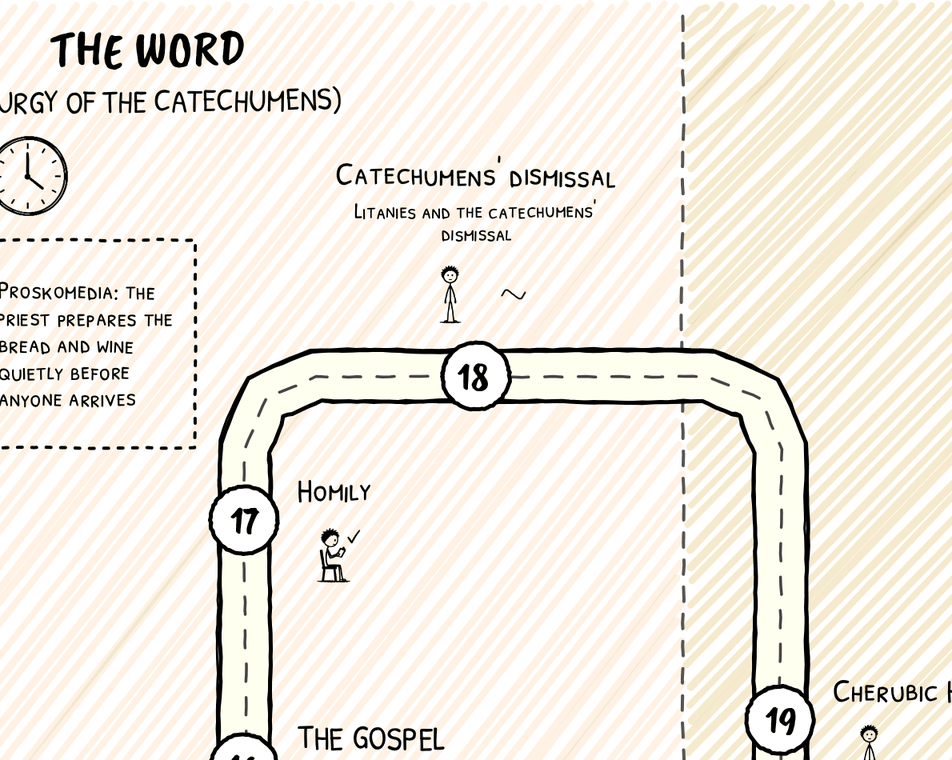
The homily ends and the deacon is back out front, and the litanies come fast. "Let us all say, with all our soul and with all our mind let us say." This time the choir answers each petition with "Lord, have mercy" sung three times, and the mood is more urgent than it was an hour ago. Then, in some parishes, a different litany, slower, for the departed, naming names.
Then a strange one. The deacon tells the catechumens to pray, tells the faithful to "pray ye unto the Lord for the Catechumens," and then: "Bow your heads unto the Lord, ye Catechumens." And finally: "Depart, all ye Catechumens, depart… let no Catechumen remain."
Nobody departs. Not one person. The deacon has just ordered a group of people out of the building and the building hasn't noticed. Then: "Let us who are in the faith again, yet again, in peace pray unto the Lord," and inside the altar the priest unfolds a square of cloth on the Holy Table, and you can feel the service shift gears.
In most Greek parishes you won't hear the catechumen petitions on a Sunday; they're usually left out. Slavic, Antiochian, and OCA parishes say them every week. So the dismissal nobody leaves for is also, in some churches, the dismissal nobody hears.
What it's called
Three litanies in a row, with a fourth on some days:
- The Litany of Fervent Supplication, also called the Ektene (the "intense" litany) or Augmented Litany (Greek Ektenis; Slavonic sugubaya ekteniya, "doubled"), the one with the triple "Lord, have mercy."
- The Litany for the Departed, which Hapgood's rubric appoints only "if there be offerings on behalf of the Dead."1
- The Litany of the Catechumens (Greek katichoumeni, "those being instructed"; Slavonic oglashennye, "those who have been announced to"). A catechumen is a person learning the faith on the way to baptism.
- The Litany of the Faithful, which answers it.
The cloth the priest unfolds is the antimension, Greek-Latin for "in place of the table." Quotations follow Hapgood's 1906 translation.2
What's actually happening
The first half of the Liturgy is ending, and the Church is closing out its business before the second half starts.
The Fervent Litany is for everything that didn't fit in the Great Litany: miscellaneous needs, with a sense of urgency. "Lord, have mercy" echoes Psalm 123:3 (122:3 in the Septuagint), where it's said twice by people who've had enough. Priests add petitions here for the sick by name, for missions, for the persecuted, for people about to be baptized. If a parishioner is in the hospital, this is where you'll hear it.
The Litany for the Departed is where the parish remembers its dead by name, on the third, ninth, and fortieth days and the anniversaries.3 It's usually left out on Sundays, since Sunday is the Resurrection, and prayed on Saturdays instead. "Precious in the sight of the Lord is the death of His saints" (Psalm 116:15 (115:6 in the Septuagint)).
Then the catechumens. The Church prays for the people learning the faith, asks that God would "teach them the word of truth," "reveal to them the gospel of righteousness," and "unite them unto his Holy Catholic and Apostolic Church,"4 has them bow their heads for a blessing, and then sends them out, because what comes next, the prayers of the faithful and the Eucharist, belongs to the baptized. That's the order in Acts: they received the word, they were baptized, and then they continued in the breaking of bread (Acts 2:41–42).
And then the faithful are called to prayer, and the antimension is unfolded. It bears the bishop's signature, often carries a relic (the Russian service book says relics of the saints are placed in it; where the altar itself was consecrated with relics, the antimension is usually without one),5 and signifies that the priest is serving at the bishop's behest. He couldn't celebrate without it. The cloth going flat on the table is the Church saying: now we begin.
Why it matters
The catechumens' litany is a fossil, and fossils tell you what used to be alive. For centuries the dismissal was real. The unbaptized, who might have been studying for a year or three, stood in the narthex (the entrance hall) for the readings and the sermon and then actually left, with the doors shut behind them, while the baptized went on to the mysteries. The priest's prayer for them opens, "O Lord our God, who dwellest on high, and dost regard the humble of heart," and asks God to grant them "in due season the laver of regeneration, remission of sins, and the robe of incorruption."6 That language echoes Scripture's: the God who dwells on high and looks upon the lowly (Psalm 113:5–6 (112:5–6 in the Septuagint)), "the washing of regeneration" (Titus 3:5), the corruptible putting on incorruption (1 Corinthians 15:53). Call them echoes; nobody can say they're deliberate allusions.
So when the deacon says "depart" and no one moves, you're hearing the Church refuse to throw away a prayer just because its practical occasion changed. The prayer still does something: it tells the faithful every week that there are people on the way in, and tells the people on the way in that the whole Church is praying for them by name. There may not be a single catechumen in the room, but, as OrthodoxWiki puts it, "the Church prays for all catechumens everywhere."7
Where it came from
The dismissal of the catechumens is as old as the catechumenate itself, third century at the latest, and the fourth-century church orders describe it in detail, calling each group out in turn.8 The reason wasn't Communion. The common prayer of the faithful didn't include them, which is why catechumens were sent out of non-eucharistic services too.9 As infant baptism became normal and adult converts rare, the groups being dismissed shrank to nothing, and the litany stayed because the Church doesn't delete.10 Mostly. Chrysostom knew prayers over the penitents too, and by the oldest surviving manuscript of the Byzantine Liturgy, the eighth-century Barberini 336, they're gone without a trace.11
Today, with adult catechumens back in American parishes, the litany has an audience again. The Path In follows a catechumen from first visit to reception.
What you do
If you're Orthodox: cross yourself at the triple "Lord, have mercy," three times if that's your habit. When the deacon says "Bow your heads unto the Lord, ye Catechumens," leave that to the catechumens; it's their blessing. At "let us who are in the faith," stand up straight. You're being addressed.
If you're visiting: if you've been thinking about becoming Orthodox, this is the moment the Church prays for you out loud. Bow your head when the deacon says to; nobody will know you're not official yet, and God already does.
Field Note: the dismissal nobody leaves for. New catechumens sometimes ask whether they're supposed to walk out at "Depart, all ye Catechumens." The answer in nearly every parish is no; stay where you are. The OCA puts it flatly: "no one actually expects the catechumens to depart at this time," and visitors "should feel free to stay for the entire Liturgy, without taking Holy Communion."12 A few priests and a few monasteries keep the old practice and send the catechumens to the narthex for the rest of the service. If yours does, you'll be told, and it'll be the most memorable thing about your catechumenate.
Go deeper
- Saint Cyril of Jerusalem, Procatechesis (NPNF2 7), on what it meant to be a catechumen.
- Acts 2:37–47 and Hebrews 6:1–2.
- The Path In: Inquirer, Catechumen, Reception.
Notes
-
Hapgood, Service Book, p. 91. ↩
-
Hapgood, Service Book, p. 90 (the Fervent Litany), pp. 90–91 (the departed), p. 92 (the catechumens); p. 599, note 16, on the dismissal. ↩
-
Apostolic Constitutions VIII.42 (ANF 7). ↩
-
Hapgood, Service Book, p. 92. ↩
-
Hapgood, Service Book, p. xxviii; Getcha, The Euchologion Unveiled, p. 222. ↩
-
Hapgood, Service Book, p. 92. ↩
-
OrthodoxWiki, "Litany of the Catechumens." ↩
-
Apostolic Constitutions II.57 and VIII.6–9 (ANF 7). ↩
-
Taft, "How Liturgies Grow." ↩
-
Getcha, The Euchologion Unveiled, p. 47; Germanus, On the Divine Liturgy §35. ↩
-
Taft, "How Liturgies Grow." ↩
-
OCA, "Catechumens depart," Questions and Answers. ↩