
What you'll notice
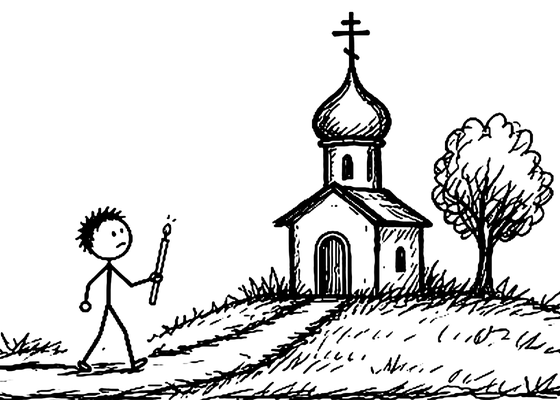
You find the church by its roof. There's a dome, or several, and a cross on top of each one, and sometimes the cross has an extra bar or two that you didn't learn about in Sunday school. There may be a bell tower. Its altar end points toward the sunrise, so you usually walk in from the west.
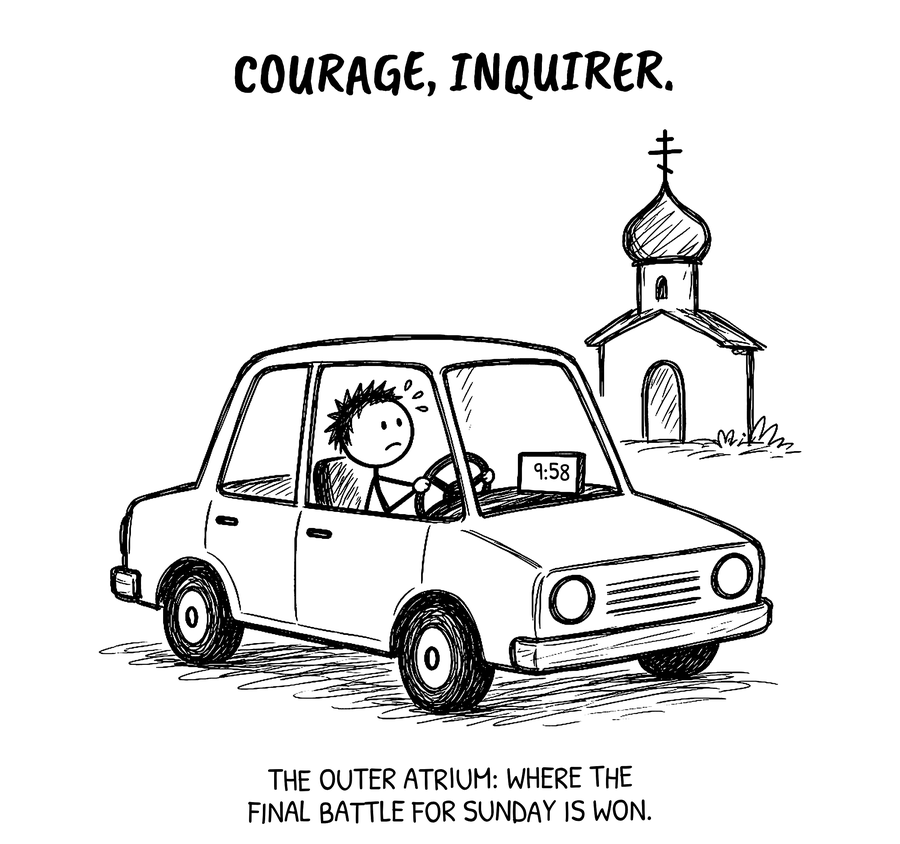
The lot is a study in arrival. A man in a suit. A family in jeans. A grandmother in a headscarf. Someone getting out of a car, turning to face the church, and making the sign of the cross before he's even shut the door. People drifting in across a span of forty-five minutes, none of them hurrying, none of them looking like they think they're late.
Up the steps there's a courtyard, or a porch, or at least a landing. Maybe a stone basin, maybe a bell, maybe a mosaic of Christ or the parish's saint over the door. The door is heavy. Through it you hear singing, and smell something sweet and smoky you can't name yet.
What it's called
The courtyard is the Greek avli, and in the oldest churches it was the atrium, an open court with a fountain in the middle. The dome is a troullos in Greek, a kupol in Russian. The bell tower is a kampanario. None of these words will come up at coffee hour. The one that will is east: Orthodox churches are built facing it, and people will say "the east" to mean the altar end even in a parish where the altar faces a strip mall.
What's actually happening
People are changing speed.
The man crossing himself at his car door is doing what Orthodox Christians do whenever they see a church: he's greeting it. The building is consecrated. It isn't a meeting hall that happens to hold a service; it's a place set apart, and the sign of the cross at the sight of it is the same reflex as taking off your hat.
The unhurried arrival is a feature, not a failure. Orthodox Sunday morning doesn't have a hard start. In Greek and Antiochian parishes Matins (the morning service; Greeks say Orthros) begins early and flows into the Divine Liturgy without a break; many Slavic parishes serve the Vigil on Saturday night and read the Hours before Liturgy instead. Either way, people arrive across the morning, and the service is simply there when they walk in, like a river. The priest started on time. Most of the congregation will be in place by the Gospel reading. You can be, too, or not. (Matins Is Already Happening tells you what you walked in on.)
The bells, where there are bells, aren't a signal that church is starting. They're a proclamation that it is. In Slavic parishes they'll ring again at the most solemn moment of the Liturgy, for the benefit of anyone outside.
Why it matters
The building is the first teacher you'll meet, and it starts lecturing before you reach the door.
It faces east because Christians have prayed toward the sunrise since the beginning: Eden was planted "eastward" (Genesis 2:8), and the Church sings of Christ as the Dayspring (Luke 1:78) and the Sun of Righteousness, Malachi 4:2 (3:20 in the Septuagint). To walk into an Orthodox church is to walk toward the dawn. The whole room is pointed somewhere. By AD 200 the habit was so well known that pagans decided the Christians' god must be the sun,1 and Clement of Alexandria could simply say that prayers are made "looking towards the dawn in the east."2 Nobody ever wrote it down as a rule, and the Fathers liked it that way. "What writing has taught us to turn to the East at the prayer?" Saint Basil asks, filing it with the Church's unwritten traditions; we're seeking "our own old country, Paradise, which God planted in Eden in the East."3 Saint John of Damascus calls it "this tradition of the apostles,"4 and Saint Germanus traces it to the apostles too.5 Not every lot cooperates. A parish in a converted storefront puts the altar where it can, that end becomes "liturgical east," and everyone faces it whatever the compass says. Even the old Russian service book allows for it: the sanctuary "must be built, except when that is impossible, at the eastern end of the church."6
The dome is heaven, and inside you'll find Christ painted in it, looking down. Hapgood's old Service Book gives even the count a meaning: one dome for Christ, three for the Trinity, five for Christ and the four Evangelists.7 The nave below it is a ship, the ark that carries the people through the flood. The cross on top says whose ship it is. Saint Germanus of Constantinople, writing in the eighth century, said the church was "prefigured in the patriarchs, foretold by the prophets, founded in the apostles," and he meant the building as much as the people.8 Demetrios Mavropoulos, a Greek lay theologian, built an entire adult catechism on this idea. His Passing Through the Church walks readers from the courtyard to the altar, one element per lesson, and he titles the courtyard "History and the World" and the stairs "From the Old to the New Man."9 You climb the steps and leave something behind. This guide is in that tradition, and so is the Psalm every Orthodox child learns: "I was glad when they said to me, 'Let us go into the house of the Lord'" (Psalm 122:1 (121:1 in the Septuagint)).
Where it came from
The earliest big churches, from the fourth century on, had a walled courtyard in front with a fountain where you washed your hands and face before going in. The fountain survives: in Greek churchyards you'll often see a stone basin, the phiale (the fountain basin), where water is blessed on Theophany (the feast of Christ's baptism). Eastward orientation is older still; the second-century Fathers already treat it as the obvious direction for prayer, and by the late fourth century the Apostolic Constitutions tell builders, "let the building be long, with its head to the east."10
Bells came late to the East. Monasteries called people to prayer by striking a wooden plank with a mallet, the semantron (the wooden call-board), and some still do; Germanus already knew it.11 Tradition says the first bells in Constantinople were a gift from Venice in the ninth century. The Russians took to them like nobody else, and a Russian bell tower on a feast day is one of the great sounds on earth.
The domes are Constantinople's gift, perfected at Hagia Sophia in 537. The onion shape is Russian.
What you do
If you're Orthodox: when you see the church, cross yourself and bow a little. Turn your phone all the way off, not to vibrate. Dress the way you'd dress to meet someone important who also happens to love you. Head coverings for women are most common in Slavic and Romanian parishes and less common in Greek and Antiochian ones; some women cover anywhere. If you're not sure, see What to Wear. Men take hats off at the door.
If you're visiting: all of the above is available to you and none of it is required. Nobody will stop you at the door. There's no usher, no greeter with a clipboard, no visitor badge. Dress modestly, go up the steps, and open the door. The Narthex is what's on the other side.
Field Note: Orthodox time. When the bulletin says Liturgy is at 9:30, the priest means 9:30. A good share of the parish means somewhere between 9:30 and 10:15, and the Church has made her peace with this. The service is a river, and you can step into a river at any point. Come in quietly, stand toward the back, and if the Gospel is being read, wait at the door until it ends.
Field Note: "Every Orthodox church has onion domes." It doesn't. The onion dome is Russian, and many Russian churches sprout five or more of them. Greek churches usually have one broad, low dome, and plenty of American parishes in storefronts and converted Protestant buildings have none at all. Hapgood's own symbolism allows for one, three, or five,12 which is the Church's way of saying the number is not the point.
Go deeper
- Psalm 122 (121 in the Septuagint), and Malachi 4:2 (3:20 in the Septuagint).
- Saint Basil the Great, On the Holy Spirit 27.66 (NPNF2 8), on facing east.
- Demetrios Mavropoulos, Passing Through the Church, "The Courtyard."
Notes
-
Tertullian, Ad Nationes I.13; Apology 16 (ANF 3). ↩
-
Clement of Alexandria, Stromata VII.7 (ANF 2). ↩
-
Basil, On the Holy Spirit 27.66 (NPNF2 8). ↩
-
John of Damascus, Exposition of the Orthodox Faith IV.12 (NPNF2 9). ↩
-
Germanus, On the Divine Liturgy §11. ↩
-
Hapgood, Service Book, p. xxvii. ↩
-
Hapgood, Service Book, p. xxvi. ↩
-
Germanus, On the Divine Liturgy §1. ↩
-
Mavropoulos, Passing Through the Church, p. 39; the courtyard chapter opens at p. 23, the dome's at p. 109. ↩
-
Apostolic Constitutions II.57 (ANF 7). ↩
-
Germanus, On the Divine Liturgy §2. ↩
-
Hapgood, Service Book, p. xxvi. ↩