


What you'll notice
The line is done. The priest turns in the Royal Doors with the chalice and blesses the room with it: "O God, save thy people, and bless thine inheritance."1 The choir answers with a hymn you'll hear every Sunday: "We have beheld the true Light; we have received the heavenly Spirit; we have found the true faith. Let us bow down in worship to the Trinity Undivided, for it hath saved us."2 He lifts the chalice once more toward you, "Always, now, and ever, and unto ages of ages," and carries it to the side table. That's the last you'll see of it.
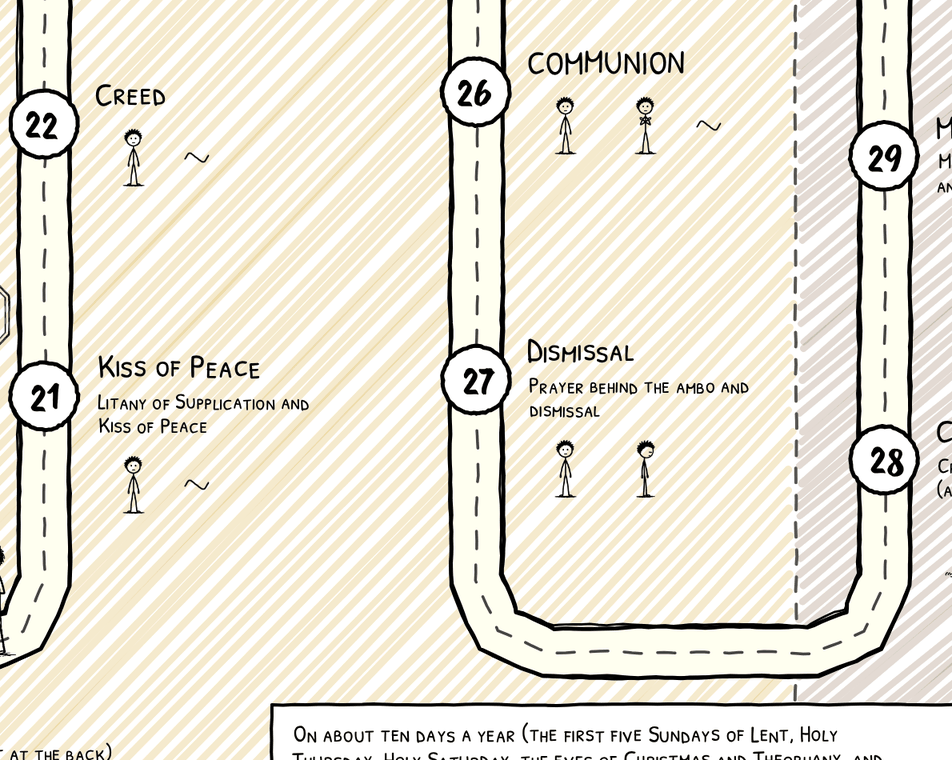
A short litany of thanks. Then: "Let us depart in peace." "In the Name of the Lord."3 And the priest comes out through the doors, down off the step, and stands among the people, in front of the icon screen, facing the altar, and prays out loud. It's the only prayer of the morning he says from your side of the wall.
Then "Blessed be the name of the Lord" three times.4 In a Slavic parish the choir follows it with Psalm 34 (33 in the Septuagint), "I will bless the Lord at all times";5 in a Greek parish it doesn't. Then a blessing, and a long sentence naming Christ and His Mother and a list of saints: the dismissal. On a Sunday it begins "May he who rose from the dead, Christ, our true God."6 And then nobody leaves. The parish forms another line. That's the next stop.
What it's called
The hymn is "We have beheld the true Light," borrowed from Pentecost Vespers. The litany is the Litany of Thanksgiving. The prayer the priest says among the people is the Prayer Behind the Ambo (Greek opisthambonos), because he stands behind, that is, below and in front of, the ambo (the raised step from which the Gospel is read). The ending is the Dismissal, Greek apolysis ("release"); Slavonic otpust.
What's actually happening
Three things: thanks, a last look, and a sending.
The litany thanks God for what just happened and asks that "this whole day may be perfect, holy, peaceful and sinless,"7 the same petition from before the Creed, because the day isn't over. The lifted chalice is the Ascension in miniature; the Church sees Christ going up, and then the priest carries Him away.
The Prayer Behind the Ambo is the whole Liturgy in one paragraph, prayed from the nave: bless the people (Psalm 28:9 (27:9 in the Septuagint)), keep the Church, sanctify "those who love the beauty of thy house" (Psalm 26:8 (25:8 in the Septuagint)), give peace to the world, the churches, the clergy, the rulers, and all Your people, because every good gift comes down from the Father of lights (James 1:17). Hapgood calls it the "Prayer before the Tribune."8 The ambo was once a raised platform in the middle of the nave, joined to the altar by a walkway, and Saint John Chrysostom preached from it; the prayer kept its name and its place after the furniture moved.
The dismissal names the saints of the day so you know, on your way out, whose company you've been in.
Why it matters
The service ends by sending you out. That's the point of the word. The Latin Mass got its name from its last line, Ite, missa est, "go, it is the dismissal"; the Orthodox apolysis means the same thing. Archimandrite Vasileios of Iveron says that a person who comes down from the mountain of the Liturgy comes down as a witness to the Kingdom.9
That's why "We have beheld the true Light" is sung on an ordinary Sunday. It's a Pentecost hymn, and the Church sings it every week because every Liturgy is Pentecost: the Spirit came down, you were there. Father Schmemann says thanksgiving, eucharistia, is the state of the perfect man, the life of paradise.10 You've just been in it. Now go.
The two disciples at Emmaus recognized Him in the breaking of the bread, and the next thing they did was get up and walk seven miles back to tell someone (Luke 24:30–35). The dismissal is the walk.
Where it came from
The Prayer Behind the Ambo is a Constantinople prayer, already in the oldest surviving Byzantine service book, the Barberini manuscript.11 The closing rites, Psalm 34 (33 in the Septuagint), the blessed bread, and the dismissal, first appear in the eleventh century.12 The post-Communion prayers the priest reads at the side, or a reader reads aloud while people venerate the cross, are later still, and in some parishes a few people stay for them.
What you do
If you're Orthodox: say "Blessed be the name of the Lord" with the choir, and cross yourself three times. Don't leave before the dismissal; the service isn't a buffet. When the priest comes out with the cross, get in line; that's the next stop. If your parish reads the post-Communion prayers aloud, stay and say them; Saint Gregory the Theologian says to eat the Body without shame, and the prayers are how you say thank you for it.13
If you're visiting: stay. This is the part where the parish becomes a parish instead of a congregation, and in about four minutes someone is going to hand you bread and invite you to coffee.
Field Note: the one prayer from your side. All morning the priest has prayed from behind the screen. For this one prayer he comes down and stands where you stand, facing the way you face. He used to go further: the rubric once had him climb the ambo in the middle of the nave and pray facing west, toward the people.14 It isn't a stage exit. It's the Church reminding him, and you, which side of the wall he belongs to the rest of the week.
Field Note: Mass vs. Liturgy. Catholics named their service after its last word, the sending. The Orthodox named theirs after the whole thing, a public work done on behalf of the people. Both names are right. One looks at the door; the other looks at the table.
Go deeper
- Luke 24:13–35.
- Hapgood, Service Book, pp. 120–122.
- Alexander Schmemann, For the Life of the World.
- Kallistos Ware, The Orthodox Church, the chapter "Orthodox Worship I: The Earthly Heaven."
Notes
-
Hapgood, Service Book, p. 119. ↩
-
Hapgood, Service Book, p. 120. ↩
-
Hapgood, Service Book, p. 121. ↩
-
Hapgood, Service Book, p. 121. ↩
-
Hapgood, Service Book, pp. 121–122; Getcha, The Euchologion Unveiled, p. 79. ↩
-
Hapgood, Service Book, p. 122. ↩
-
Hapgood, Service Book, p. 120. ↩
-
Hapgood, Service Book, p. 121. ↩
-
Vasileios, Hymn of Entry, p. 79. ↩
-
Schmemann, For the Life of the World. ↩
-
Getcha, The Euchologion Unveiled, p. 53. ↩
-
Getcha, The Euchologion Unveiled, p. 54. ↩
-
Gregory the Theologian, Oration 45.19 (NPNF2 7). ↩
-
Getcha, The Euchologion Unveiled, p. 78. ↩