



What you'll notice
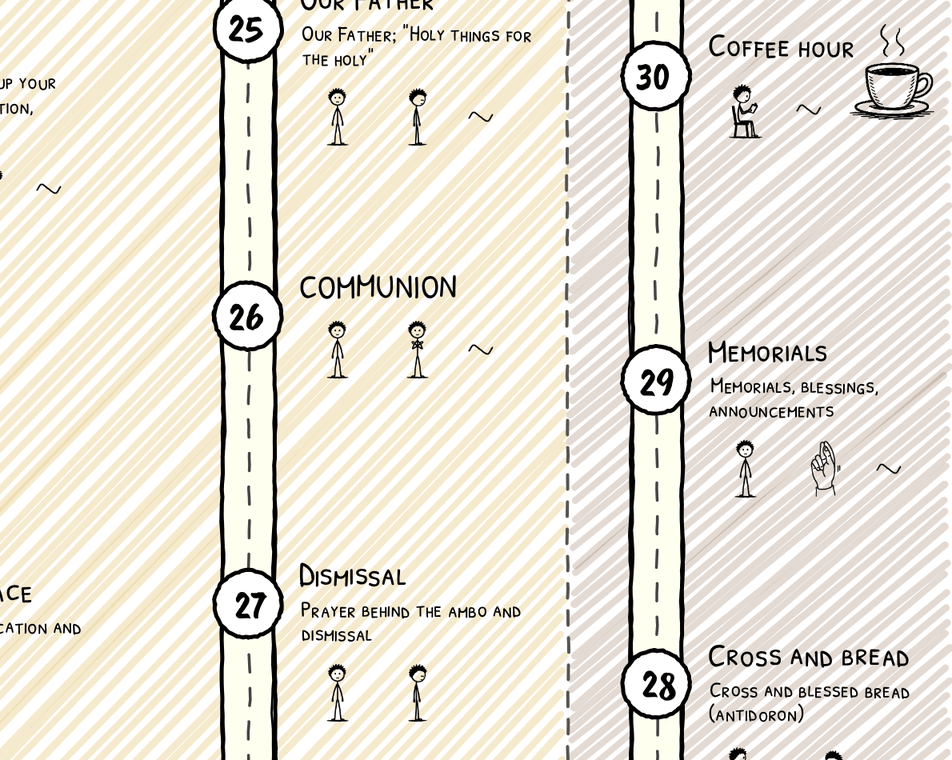
Some Sundays, after the dismissal and before the cross, the priest comes back out with the censer. A small table has appeared in front of the icon screen with a tray on it: boiled wheat, mounded and sweetened, dusted with powdered sugar, maybe a candle stuck in the middle. A family you hadn't noticed moves to the front. The choir sings something slow and minor. Names are read. The priest sings one line three times, "Memory eternal," and people cross themselves. It takes seven minutes, and then everyone goes to coffee hour and eats the wheat.
Other Sundays it's a cake blessed for a name day, a prayer for someone traveling, a baby's fortieth-day blessing, or just the announcements, delivered from the solea (the raised step in front of the icon screen) in the voice the priest used for the Gospel.
What it's called
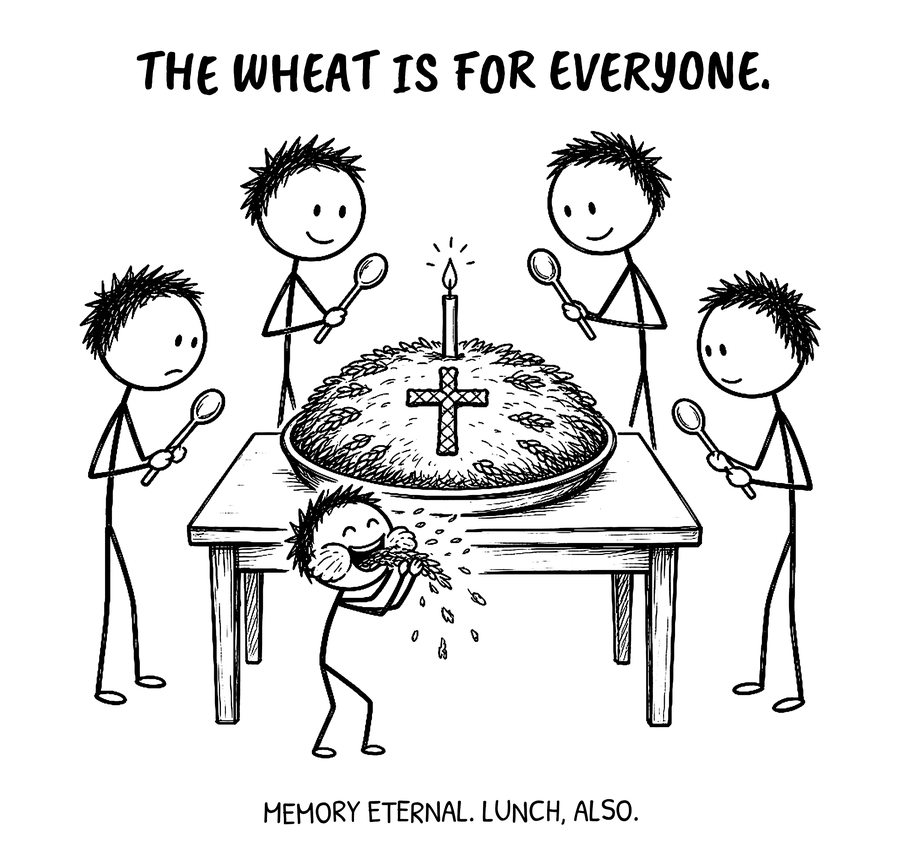
The service for the dead is a memorial: Greek mnemosyno (memorial service), Slavonic panikhida (memorial service; Hapgood prints the full Russian form),1 Arabic the Trisagion for the departed, after the Trisagion (the "Holy God, Holy Mighty, Holy Immortal" hymn) it begins with. The wheat is koliva (boiled wheat for the dead; Greek kollyva; Slavonic kutya; Serbian žito; Romanian colivă). Short prayers for the living are blessings or, in the books, a moleben (Slavonic, a short service of prayer) or a paraklesis (Greek, a service of supplication). The announcements are the announcements.
What's actually happening
The Orthodox pray for the dead the way they pray for the living, by name, because they don't think death took anyone out of the family. The memorial asks God to give rest "in a place of brightness, a place of verdure, a place of repose, whence all sickness, sorrow and sighing have fled away"2 to people whose names the family handed the priest, and it ends by asking that their memory be eternal, which is a prayer that God remember them, not that we do.
The wheat is Saint Paul's seed, "what you sow is not made alive unless it dies" (1 Corinthians 15:36), and the Lord's: "unless a grain of wheat falls into the ground and dies, it remains alone" (John 12:24). Afterward everyone eats it, which is the point: the dead are at the table.
The blessings for the living work the same way, a short prayer with a name in it. Blessings of water, homes, and things have their own entry.
Why it matters
God's people prayed for the dead before Christ came. Judas Maccabeus made an offering for his fallen soldiers (2 Maccabees 12:43–45),3 and the Liturgy itself names the departed at the altar every Sunday, right after the consecration. By the fourth century the Jerusalem Liturgy prayed for the departed too.4 This isn't a theory of what happens between death and the Last Day, and it isn't purgatory; the Orthodox don't calculate. They have Jesus to Martha, "He who believes in Me, though he may die, he shall live" (John 11:25–26), and the habit of saying so, with wheat. What Happens After Death? takes up what the Orthodox believe about death and the life after it; this stop is only what you'll see.
Where it came from
Memorials are customarily held on the third, ninth, and fortieth days after death and on the yearly anniversary; those days are already in the Apostolic Constitutions, around 3805 (Memory Eternal has more). Many families also keep a memorial at six months. The Church's own day for the dead is Saturday, and parishes that follow the Russian books closely keep memorials there; most American parishes, Greek ones above all, serve them on Sunday after the Liturgy, because Sunday is when the family can come. The rule yields to the people.
Don't mix up two stories about wheat. On the first Saturday of Lent the Church remembers Saint Theodore the Recruit, who, the story goes, came in a dream to Archbishop Eudoxios when Julian the Apostate (361–363) had the market food sprinkled with blood from idol sacrifices, and told the Christians to eat boiled wheat with honey instead; Nectarius, Archbishop of Constantinople (381–397), established the commemoration.6 That story explains the koliva on that one Saturday. It isn't the origin of memorial koliva, which needs no miracle to explain it: it's wheat, and the Lord already said what wheat means (John 12:24).
Greek parishes: koliva mounded on a platter, decorated, sometimes with the deceased's initials, the family standing by. Slavic parishes: a small table with a crucifix and rows of candles, often along the north wall, where memorials are served on Saturdays and after Liturgy; kutya is simpler. Antiochian parishes: the Trisagion, usually short, with or without koliva. The bulletin usually names whose memorial it is.
What you do
If you're Orthodox: stay for the memorial even if you didn't know the person; you're praying for family you haven't met. Cross yourself at "Memory eternal" and sing it if you can. Eat the koliva and tell the family it was good. For your own dead, arrange the memorial with the priest: give him the baptismal names a week ahead, and arrange the wheat; the office knows who makes it.
If you're visiting: stay or go, as you like; it's short and nobody minds either way. If you stay, stand and keep quiet, and cross yourself if you're comfortable. You may eat the koliva; it's offered to everyone and taking some is a kindness to the family. When the priest starts the announcements, that's your cue that it's over and coffee hour is next.
Field Note: the sweet wheat. The plate of boiled wheat with the powdered sugar and the candle is for a dead person, and you're supposed to eat it. Both halves of that sentence surprise visitors. The dead are at the table, and the living eat the wheat. It's one of the few things in Orthodox practice that tastes as good as it means.
Field Note: "Memory eternal." You'll hear it three times at the end of a memorial, and you'll see it in Orthodox obituaries where others write "rest in peace." It asks God to remember the person, with the Psalmist's sense that to be remembered by God is to be alive (Psalm 112:6 (111:6 in the Septuagint); Luke 23:42). The Church doesn't say "rest in peace" much. It says "keep going."
Go deeper
- John 11:17–44; John 12:20–26; 1 Corinthians 15:35–58.
- Hapgood, Service Book, General Panikhida, pp. 564–569.
- Saint Cyril of Jerusalem, Mystagogical Catecheses 5.9–10 (NPNF2 7).
- Memory Eternal: Funerals, Memorials, and Koliva.
Notes
-
Hapgood, Service Book, pp. 564–569. ↩
-
Hapgood, Service Book, p. 565; the same prayer at the Liturgy, p. 91. ↩
-
The Orthodox canonical tradition counts three books of Maccabees: Apostolic Canon 85, ratified by Trullo, canon 2 (NPNF2 14); Athanasius, Festal Letter 39 (NPNF2 4), omits them. ↩
-
Cyril of Jerusalem, Mystagogical Catecheses 5.9–10 (NPNF2 7). ↩
-
Apostolic Constitutions VIII.42 (ANF 7). ↩
-
OCA, Lives of the Saints, first Saturday of Lent. ↩