



What you'll notice
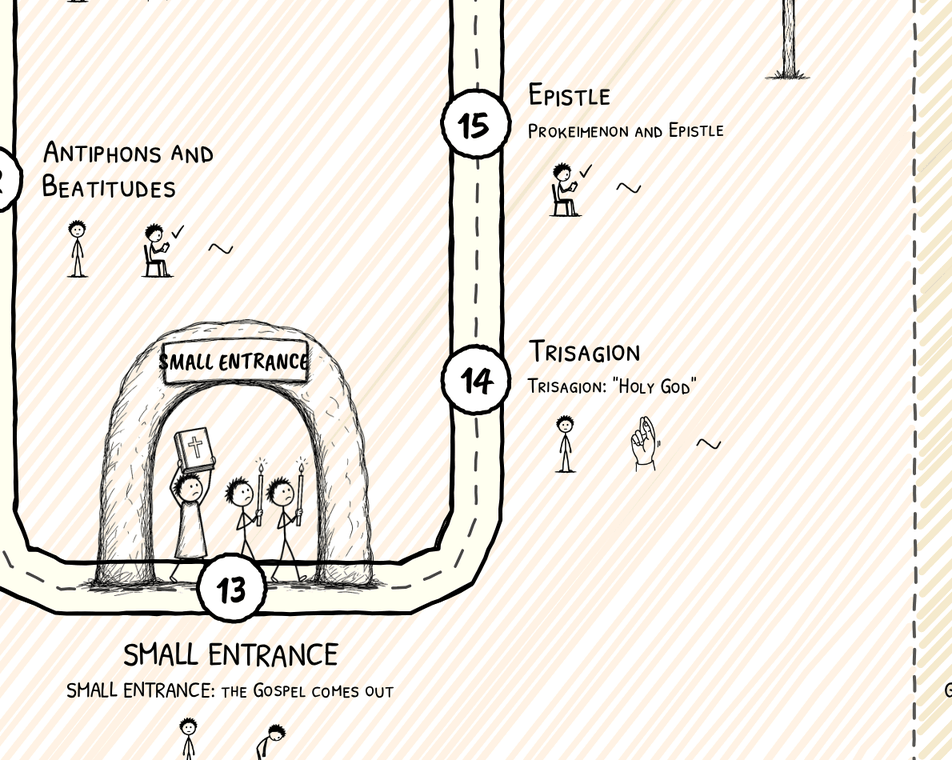
The troparia end and the choir settles into something slower and older-sounding. "O Holy God, Holy Mighty, Holy Immortal One, have mercy upon us." They sing it again. And again. Then "Glory to the Father, and to the Son, and to the Holy Spirit, now, and ever, and unto ages of ages. Amen." Then just the last half, "Holy Immortal One, have mercy upon us."
Then the deacon turns around, faces the people, and shouts one word, "Dynamis!" (Greek for "power"), and the choir sings the whole thing once more, louder. People around you are crossing themselves three times.
Meanwhile the priest has been standing with his head bowed, praying something you can't hear, and when the hymn ends he walks to the back of the altar, to a seat you can't quite see, and stands beside it rather than in it.
What it's called
The Trisagion, which is Greek for "thrice-holy" (Trisagion; Slavonic Trisvyatoe; Arabic quddusun Allah). The hymn is sometimes called the Trisagion Hymn to distinguish it from the Trisagion Prayers, a set of short prayers that open nearly every Orthodox service and begin with these same words. The wording above follows Hapgood's 1906 translation, and her notes explain the hymn.1
"Dynamis" means "power" or "strength." Think dynamite. The deacon is saying: this time, with strength. The seat at the back is the High Place, and the priest's walk to it is the Blessing of the High Place.
What's actually happening
The people are singing the song the angels sing. In Isaiah's vision the seraphim cry "Holy, holy, holy is the Lord of hosts" (Isaiah 6:3), and in John's they never stop: "Holy, holy, holy, Lord God Almighty, who was and is and is to come" (Revelation 4:8). The Church took the triple "holy," addressed it to the Trinity, and added the only thing a human can add: "have mercy on us." It's also where the procession you just watched ends: Father Thomas Hopko notes that the Small Entrance is "completed only with the singing of the Thrice-Holy Hymn."2
Under the singing, the priest prays the Trisagion prayer, which says what the hymn means. God made man in his own image, set repentance as the way back, and is now asked to accept this thrice-holy hymn "from the mouths of us sinners."3 The prayer leans on Isaiah 57:15, the God who lives on high and also with the humble.4 In other words: the angels sing this for free, and we sing it on credit.
Then the Blessing of the High Place. The priest goes to the seat behind the altar, the bishop's chair, says "Blessed art thou on the throne of glory of thy kingdom, who sittest on the Cherubim,"5 and stands to its right. The center is reserved for the bishop, whether or not he's in the building. Saint Germanus reads the bishop's walk to the throne as the Ascension, Christ going up to sit at the Father's right hand.6 Saint Ignatius of Antioch, writing early in the second century, told his churches to do nothing without the bishop,7 and the empty chair is the Liturgy agreeing.
Why it matters
This is the moment the room admits what it's been doing. The Great Litany prayed for the world; the antiphons sang the Psalms; the Small Entrance brought the Word in. Now the congregation joins the choir of heaven out loud, in the words heaven uses. Saint John Chrysostom says the angels surround the priest at the altar and "the whole sanctuary, and the space round about the altar, is filled with the powers of heaven."8 The Trisagion is when you can hear them.
The triple structure is a creed in miniature. Holy God, Holy Mighty, Holy Immortal: one tradition hears Father, Son, and Spirit; another hears three names for one God. Either way, three holies and one mercy. The Church has been singing this before the Liturgy's readings since at least the fifth century, which means the words have been on Christian lips every Sunday for fifteen hundred years. You're borrowing a very old song.
Where it came from
The Trisagion is one of the oldest hymns in the service. Tradition tells of an earthquake in Constantinople in the days of the Emperor Theodosius II and Patriarch Proclus (434–446), during which a boy was lifted into the air and heard the angels singing these words; when the city sang them back, the shaking stopped.9 Historians are cautious about the boy. Nobody disputes the earthquake or the hymn.
A generation later a patriarch of Antioch, Peter the Fuller, added "who was crucified for us," addressing the hymn to Christ alone. The Byzantine Church rejected the addition, because addressed to the Trinity it seemed to say the Trinity suffered; the non-Chalcedonian churches, the Armenians among them, still sing the hymn to Christ with Peter's line. One clause, one schism. The Church has long memories about adding words to hymns, which will come up again at the Creed.
On a few feasts the Trisagion is replaced. At Christmas, Theophany (the feast of Christ's baptism), Lazarus Saturday, Holy Saturday, Pascha (Easter), and Pentecost the choir sings "As many as have been baptized into Christ have put on Christ" (the hymn, from Galatians 3:27), because those were the ancient baptismal days. On the feasts of the Cross it's "Thy Cross do we worship, O Master, and we glorify thy Resurrection."10 Saint Basil's Liturgy, which the Church serves about ten times a year, five of them the Sundays of Great Lent,11 is identical to Saint John's at this point; the differences come later.
What you do
If you're Orthodox: cross yourself and bow a little at each "Holy God," three times, and once more at "Dynamis." Some people bow from the waist, some simply cross themselves, some do nothing visible. All three are fine.
If you're visiting: this is the easiest hymn in the service to join, because it's four phrases and they repeat. Sing it, hum it, or just stand there and let it go by. When the deacon shouts, don't be startled; he's talking to the choir.
Field Note: when the bishop comes. If a bishop is serving, the Trisagion stretches. He comes out through the Royal Doors with a two-branched and a three-branched candlestick, blesses the people on all sides, and prays Psalm 80 (79 in the Septuagint), "Look down from heaven, O God, and behold,"12 while the choir and the clergy trade the hymn back and forth. It takes a while. It's also the most beautiful five minutes in the Orthodox year, and worth finding out when your bishop visits.
Go deeper
- Isaiah 6:1–8 and Revelation 4:1–11.
- Saint John Chrysostom, On the Priesthood, Book VI (NPNF1 9).
- Hans-Joachim Schulz, The Byzantine Liturgy, pp. 22–25, on the hymn's history.
- A hierarchical Liturgy: go when your bishop visits.
Notes
-
Hapgood, Service Book, p. 86; notes 9–10, p. 598. ↩
-
Hopko, The Orthodox Faith, vol. 2, "Small Entrance" (OCA). ↩
-
Hapgood, Service Book, p. 85. ↩
-
Constantelos, The Divine Liturgy, pp. 30–31. ↩
-
Hapgood, Service Book, p. 87. ↩
-
Germanus, On the Divine Liturgy §§26–27. ↩
-
Ignatius, To the Smyrnaeans 8 (ANF 1). ↩
-
John Chrysostom, On the Priesthood VI.4 (NPNF1 9). ↩
-
Getcha, The Euchologion Unveiled, p. 46; Schulz, The Byzantine Liturgy, pp. 22–25. ↩
-
Getcha, The Euchologion Unveiled, p. 64; Hapgood, Service Book, p. 86. ↩
-
Hapgood, Service Book, p. 64. ↩
-
Hapgood, Service Book, pp. 86–87. ↩