
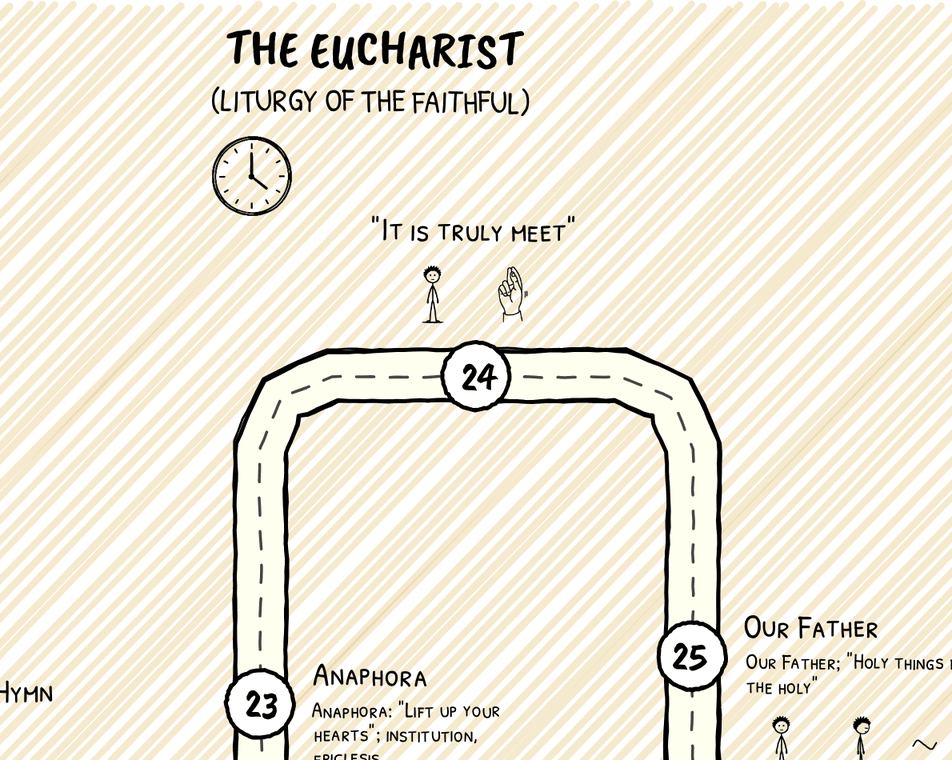



What you'll notice
The angels' hymn ends, and after a quiet stretch you hear the priest's voice rise for a sentence you'll recognize if you've been in any church: "Take, eat, this is my Body which is broken for you, for the remission of sins." Amen. "Drink ye all of this: for this is my Blood of the New Testament, which is shed for you, and for many, for the remission of sins." Amen.1 If there's a deacon, watch his hand. In Hapgood's rubrics he points to the paten at the first sentence and to the chalice at the second, holding his stole in three fingers of his right hand.2
Then: "Thine own, of thine own, we offer unto thee, in behalf of all, and for all,"3 and the choir begins "We praise thee, we bless thee…,"4 very slowly, while behind the screen the priest and deacon bow. Everyone in the nave bows with them. In many Russian parishes a bell rings outside during this part of the service, to tell the town the gifts are being consecrated.
When the hymn ends, the Church turns to the Mother of God. That's the next stop.
What it's called
This is the heart of the Anaphora, the Eucharistic Prayer that began at "Lift up your hearts." Its parts have names. The words of institution are Christ's words at the Supper ("Take, eat"). The anamnesis (ἀνάμνησις), "remembering," is the part that recalls everything He did. "Thine own of thine own" is the offering. The epiclesis (ἐπίκλησις), "calling down," is the prayer for the Holy Spirit to come upon the gifts.
What's actually happening
The prayer remembers the Supper in Christ's words. Then it remembers everything at once: "the Cross, the Grave, the Resurrection on the third day, the Ascension into Heaven, the Sitting on the right hand, the Second and glorious Coming-again."5 Notice the tense. The second coming is "remembered." This kind of remembering, anamnesis, doesn't look back at the past; it makes the thing present. The whole Incarnation is our salvation, not only the death: the life, the words, the miracles, the burial, the rising, the ascending, the praying for us now.
Then the offering: "Thine own, of thine own, we offer unto thee."6 King David said it first, when the people brought gifts for the Temple: "all things come from You, and of Your own we have given You" (1 Chronicles 29:14). We bring bread and wine, and we bring them back.
Then the epiclesis. The priest asks the Father to "send thy Holy Spirit upon us, and upon these Gifts here spread forth," and make the bread the Body of Christ and the cup the Blood of Christ, "Transmuting them by thy Holy Spirit." The deacon: "Amen, amen, amen."7 The words, the actions, the sign of the cross, the faith of our Amen: these are what the Holy Spirit honors when He comes upon the gifts.
Why it matters
Because it's real. Saint Ignatius of Antioch, on his way to be executed around the year 107, wrote that the Eucharist is the flesh of our Savior.8 Saint Justin Martyr, fifty years later: we don't receive these as common bread and common drink.9 Saint Irenaeus, a generation after that: the bread, receiving the invocation of God, is no longer common bread but Eucharist.10 Three witnesses within a century of the apostles, and the Church hasn't changed her mind.
Christ offered Himself once, for all (Hebrews 10:10); the Liturgy doesn't repeat that, it enters it.
Catholics will notice the Orthodox don't point to the words "This is My Body" alone. The words of institution, the remembering, and the calling of the Spirit are one prayer, and Orthodox writers have long given the epiclesis the decisive place in it. The West has tended to locate the moment at those words. It's a real difference, and an old one, and it's not a reason to raise your voice.
Where it came from
The words themselves come from the Supper, and the prayer says so. It tells how Christ, on the night He was given up, or rather gave Himself up for the life of the world, took bread, gave thanks, and gave it to His disciples.11 The offering line is older still; it's David's, as above.
The calling down of the Spirit is ancient. Saint Cyril of Jerusalem, in the fourth century, tells his newly baptized that after the hymn of the seraphim the Church asks God to send forth His Holy Spirit upon the gifts, "that He may make the Bread the Body of Christ, and the Wine the Blood of Christ; for whatsoever the Holy Ghost has touched, is surely sanctified and changed."12
What you do
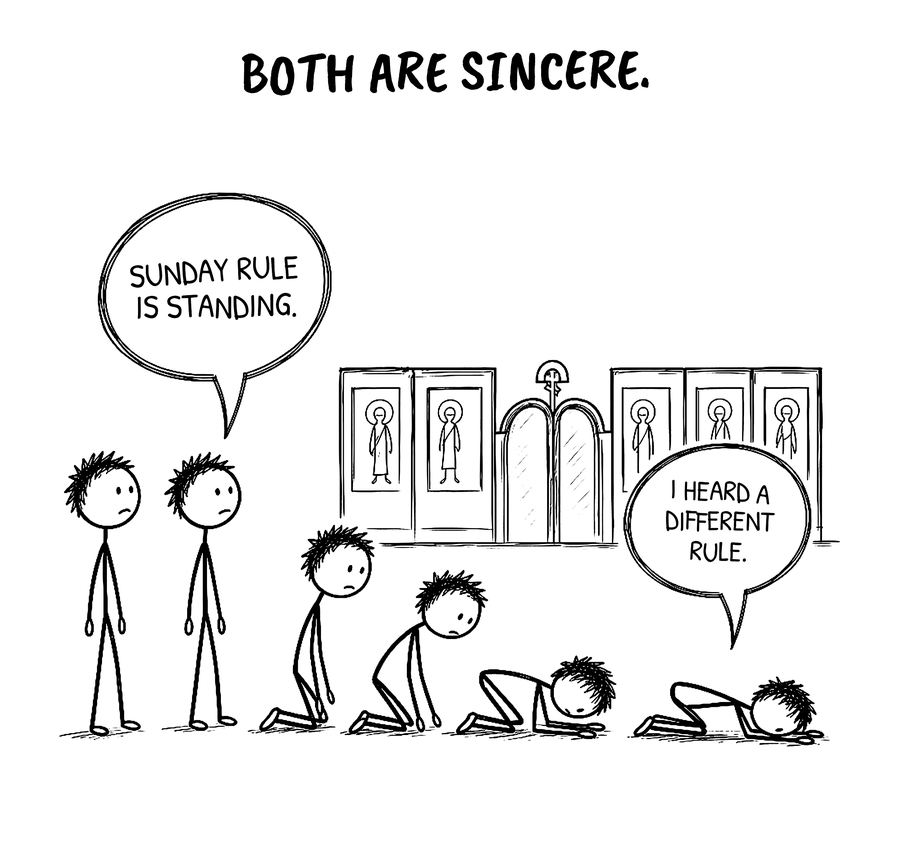
If you're Orthodox: say the Amens out loud; they're yours. Bow your head at "Take, eat." At the epiclesis, bow deeply from the waist; on a weekday many go to the floor, on Sunday the Church asks you to stay on your feet. Until the end of "We praise thee," stay put.
If you're visiting: this is the part Catholics call the Consecration and Protestants call the Lord's Supper. Stand, and if the people around you bow to the floor, bow your head.
Field Note: the Third Hour prayer. In Russian usage, partway into the epiclesis, before the gifts are blessed, the priest and deacon bow three times while the priest says a short prayer borrowed from the Third Hour: "O Lord, who at the Third Hour didst send down upon thine Apostles thy Holy Spirit: Take not the same from us, O Good One, but renew it in us who make our supplications unto thee."13 Today's Greek service books leave it out.14 If you hear it, you're probably in a Slavic parish.
Go deeper
- 1 Chronicles 29:10 to 19; Hebrews 9 to 10.
- Hapgood, Service Book, pp. 102 to 106.
- Saint Irenaeus, Against Heresies 4.18 (ANF 1).
- Saint Cyril of Jerusalem, Mystagogical Catecheses 5.7 (NPNF2 7).
- Saint Nicholas Cabasilas, A Commentary on the Divine Liturgy, the chapters on the anaphora.
Notes
-
Hapgood, Service Book, p. 104. ↩
-
Hapgood, Service Book, p. 104 (rubric). ↩
-
Hapgood, Service Book, p. 105. ↩
-
Hapgood, Service Book, p. 105; the hymn's opening words, and the prostration that goes with them, at p. xxxiii. ↩
-
Hapgood, Service Book, p. 104. ↩
-
Hapgood, Service Book, p. 105. ↩
-
Hapgood, Service Book, pp. 105 to 106. ↩
-
Ignatius of Antioch, Letter to the Smyrnaeans 7 (ANF 1). ↩
-
Justin Martyr, First Apology 66 (ANF 1). ↩
-
Irenaeus, Against Heresies 4.18.5 (ANF 1). ↩
-
Hapgood, Service Book, p. 102. ↩
-
Cyril of Jerusalem, Mystagogical Catecheses 5.7 (NPNF2 7). ↩
-
Hapgood, Service Book, p. 105. ↩
-
Getcha, The Euchologion Unveiled, p. 70. ↩