

What you'll notice
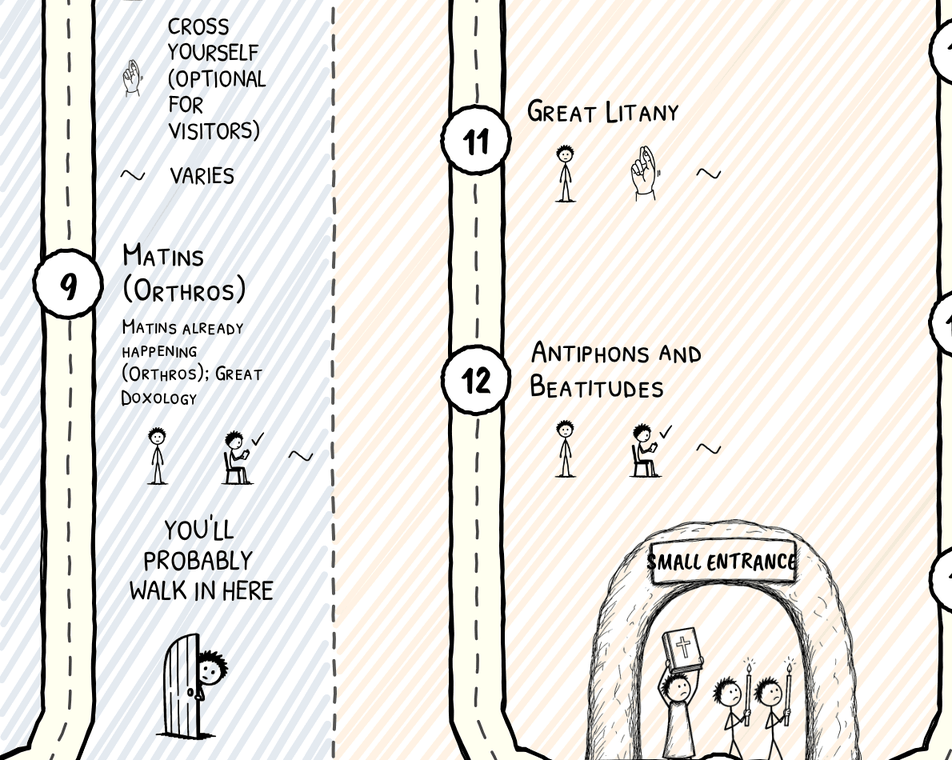
The Great Litany ends and the choir takes over. They sing a psalm, or pieces of one, and after each verse a refrain: "Through the prayers of the Birth-giver of God, O Saviour, save us." A short litany follows, almost a miniature of the one you just heard, three petitions and a "Lord, have mercy." Then another psalm with a different refrain: "Save, O Son of God, who didst rise again from the dead, us who sing unto thee: Alleluia." Then a hymn that sounds like a creed, about God's only-begotten Son who became man without ceasing to be God. Another small litany. Then a third song.
What the third song is depends on where you're standing. In a Slavic parish, it's the Beatitudes, "Blessed are the poor in spirit," sung slowly, with the thief's prayer as a refrain: "In thy Kingdom remember us, O Lord, when thou comest into thy Kingdom." In most Greek and Antiochian parishes you'll hear the Resurrection apolytikion (the dismissal hymn of the day) instead, and the Beatitudes are gone, or down to a verse or two.1 Either way, while this is happening, the clergy inside the altar are getting ready to come out.
What it's called
The antiphons (Greek antiphonon, Slavonic antifon). The word means "opposing voices": one choir answers another, or a cantor answers the people, back and forth across the room. Saint Basil described this kind of singing at the night vigils of his day: the people, "divided into two parts," "sing antiphonally with one another" (he's describing vigils, not the Liturgy).2
The three on a normal Sunday are Psalm 103 (102 in the Septuagint), "Bless the Lord, O my soul"; Psalm 146 (145 in the Septuagint), "Praise the Lord, O my soul," followed by the hymn "Only-begotten Son" (O Monogenis); and the Beatitudes (Matthew 5:3–12; Greek Makarismoi, Slavonic Blazhenny). Between them come the small litanies. Quotations follow Hapgood's 1906 translation: since her Sunday text uses the Typika psalms (the psalms of the short service of that name), the first refrain above comes from her festal antiphons.3 Father Thomas Hopko describes the third antiphon simply as "the Beatitudes or the Troparion of the day."4
What's actually happening
The congregation is singing the Psalms, which is what congregations did for a thousand years before anyone wrote a hymn. The two psalms are about the same thing: the soul telling itself to praise God, and listing reasons. Psalm 103 is the one with "Who forgives all your iniquities, Who heals all your diseases" (Psalm 103:3 (102:3 in the Septuagint)). Psalm 146 (145 in the Septuagint) is the one that says not to trust princes. It's a good warm-up for a service that will shortly pray for the president.
"Only-begotten Son" is a hymn about who Christ is: God the Word, born of the Virgin, crucified, "one of the Holy Trinity." It's credited to the Emperor Justinian, or to Severus of Antioch, in the early sixth century.5 It's a short creed set to music.
The Beatitudes, where they're sung, carry the refrain of the thief on the cross, "Remember me, O Lord, when You come into Your kingdom" (the hymn's wording, from Luke 23:42); in the Russian book the Church borrows it in the plural, "In thy Kingdom remember us, O Lord, when thou comest into thy Kingdom," and it heads the Third Antiphon.6 You'll hear that line again at the Great Entrance. The Church likes to borrow the prayers of people who had nothing left but the asking.
Meanwhile, under the singing, the priest is praying quietly for the people, asking God to "sanctify those who love the beauty of thy house."7
Why it matters
You are now doing the thing. The litany was the deacon's voice and your short reply; the antiphons are the people's voice at length. "Let the word of Christ dwell in you richly," Paul says, "singing with grace in your hearts to the Lord" (Colossians 3:16). The Orthodox take "richly" to mean a lot of psalms.
And the order matters. Praise first (Psalm 103 (102 in the Septuagint)), then the warning against trusting in man (Psalm 146 (145 in the Septuagint)), then a confession of who Christ is ("Only-begotten Son"), then the blessings he promised to the poor and the mourning and the meek. The service is walking you from the general to the specific, from God in his heaven to a crucified man promising paradise to a thief. By the time the doors open for the Small Entrance, you've been told whom to expect.
Where it came from
The antiphons are a fossil of a walk. In old Constantinople, the Sunday Liturgy often began outdoors: clergy and people gathered at one church and processed through the city to another, singing psalms with refrains as they went, and the Liturgy proper started when they arrived. When processions stopped, the psalms stayed, and the beginning of the Liturgy grew inward to hold them.8 That's why the service opens with three songs and two litanies before anyone reads anything. Robert Taft puts a date on the arrival: Saint Maximus, describing the Liturgy around 630, has the people enter with the bishop and go straight to the readings, while Saint Germanus (d. 733) knows the antiphons, so they came in "some time between 630 and 730."9
The Typika psalms and the Beatitudes came in as a third antiphon by way of the monasteries, through the twelfth-century typikon (the rulebook for services) of the Evergetis monastery; Greek parish use kept the older daily antiphons, Psalms 92, 93, and 95 (91, 92, and 94 in the Septuagint), with their short refrains, and never took up the monastic set on Sundays.10 The Greek book says otherwise: the 1888 Violakis Typikon of the Great Church, which in theory governs Greek and Antiochian parishes, prescribes the Typika and Beatitudes "indispensably" every Sunday and reserves the antiphons for weekdays and feasts.11 So "never took up" is true of practice, not of the rubric. The Church has survived worse. Either way, it's why Greek and Slavic Sundays sound different precisely here.
What you do
If you're Orthodox: sing. The refrains are short and repeat, and nobody minds a wrong note. Cross yourself at "Save, O Son of God" if that's your habit. In Greek parishes some people sit for the antiphons; in Slavic parishes most stand.
If you're visiting: this is a good place to pick up the service book and find your spot; the antiphons are near the front of any Liturgy book and the refrains are easy to follow. If your parish sings the Beatitudes, listen for the thief's prayer. It's the shortest prayer in the Gospels and it worked.
Field Note: the Beatitudes that went missing. If you learned the Liturgy in a Russian parish and visit a Greek one, you'll wait for "Blessed are the poor in spirit" and it won't come. It isn't that the Greeks have dropped the Sermon on the Mount; the history above explains the gap. On great feasts, both traditions sing special festal antiphons instead, and the whole room sounds different.
Go deeper
- Saint Germanus of Constantinople, On the Divine Liturgy §23, on the antiphons.
- Richard Barrett, "The Typika Psalms and Beatitudes: A Liturgical Opportunity," Orthodox Arts Journal (2017), on Greek and Slavic Sunday practice.
- Robert Taft, "How Liturgies Grow," on when the antiphons arrived.
Notes
-
Barrett, "The Typika Psalms and Beatitudes," Orthodox Arts Journal (2017). ↩
-
Basil, Letter 207 (NPNF2 8). ↩
-
Hapgood, Service Book, pp. 81–84; festal antiphons, Nativity, p. 180. ↩
-
Hopko, The Orthodox Faith, vol. 2, "Small Entrance" (OCA). ↩
-
Getcha, The Euchologion Unveiled, pp. 45–46. ↩
-
Hapgood, Service Book, p. 83. ↩
-
Hapgood, Service Book, p. 82 (the Prayer of the Second Antiphon). ↩
-
Getcha, The Euchologion Unveiled, pp. 45–46. ↩
-
Taft, "How Liturgies Grow." ↩
-
Getcha, The Euchologion Unveiled, pp. 61–62. ↩
-
Barrett, "The Typika Psalms and Beatitudes," quoting the 1888 Violakis Typikon of the Great Church. ↩