



What you'll notice
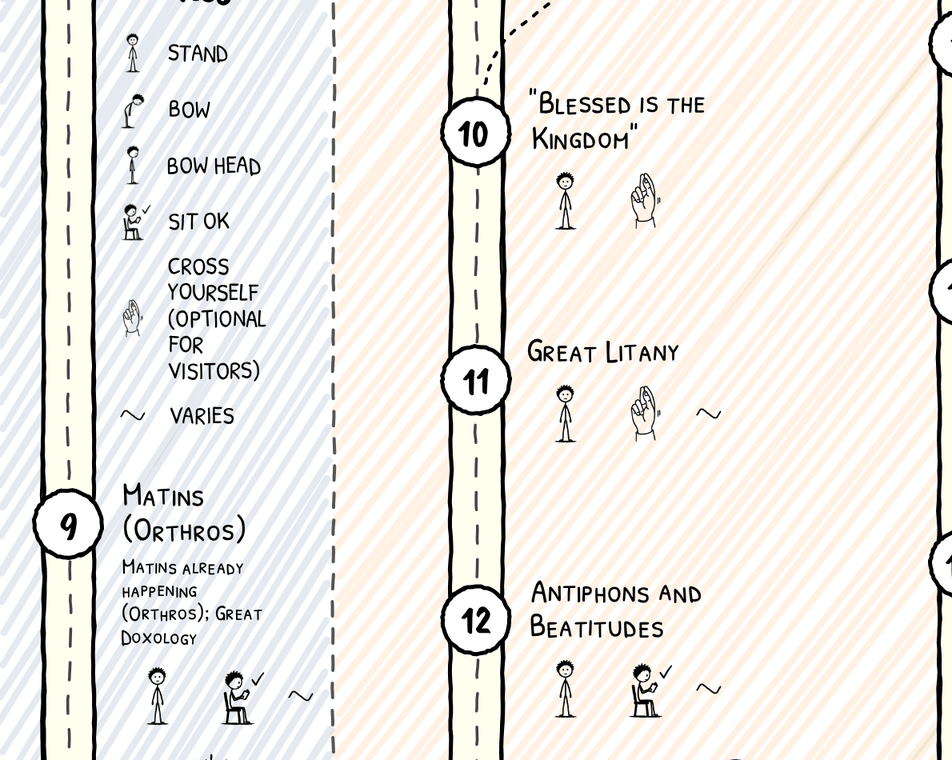
A man in a long robe, with a wide ribbon over his left shoulder—the orarion (the deacon's stole; see Vestments at a Glance)—comes out through one of the side doors, stands in front of the center doors with his back to you, raises the end of the ribbon in his right hand the way a conductor lifts a baton, and starts singing requests. "In peace let us pray to the Lord." The choir answers, "Lord, have mercy." He sings another. "Lord, have mercy." Another. "Lord, have mercy."
This goes on for a dozen rounds. The requests get specific: the bishop by name, the president by office, "this city," "healthful seasons," "those who travel by sea or by land," "the sick and the suffering," "those who are in captivity." People around you are crossing themselves, some at every single "Lord, have mercy," some only at the end. Then the deacon names the Virgin Mary "with all the Saints," the choir sings "To thee, O Lord," the priest sings a line about glory from inside the altar, and everyone says "Amen."
If there's no deacon, the priest does all of this himself from inside the altar, and you'll see the doors but not the man. The rhythm is the same.
What it's called
The Great Litany, or the Litany of Peace (Greek Eirinika, from its first word; Slavonic Velikaya ekteniya; Arabic al-talaba al-salamiyya al-kubra). A litany is a prayer in rounds: a leader sings petitions, the people answer with one short line. It's "great" because of its reach and "of peace" because that's how it starts.
Two phrases to learn now, because you'll hear them all morning. "Let us pray to the Lord" means: ask, beg, plead. "Lord, have mercy" (Kyrie eleison; Gospodi pomiluy; ya Rabb irham) means more than "forgive me." The old word covers mercy, comfort, help, and strength all at once. It's what you say to a doctor as much as to a judge. Quotations follow Hapgood's 1906 translation, whose rubric already leaves the civil petition to local circumstance ("Emperor, or King, and Reigning House, or President");1 American parishes pray for the country and its president by office.
What's actually happening
The Church is praying for everything, out loud, in order.2
These are the common prayers, the ones that belong to everybody. Saint Justin Martyr, describing a Sunday service around the year 150, says the Christians prayed "for ourselves... and for all others in every place."3 That's this. The list starts with peace from above and the salvation of our souls, widens to the whole world and all the churches, narrows to this parish and its clergy, takes in the government and the armed forces, the city, the harvest and the weather, the travelers and the sick and the prisoners, and ends by asking to be delivered from "all tribulation, wrath, peril and necessity."
Then it hands the whole list to Mary and the saints and commends "ourselves, and each other, and all our life unto Christ our God." We don't pray alone. Not even alone as a congregation.
The deacon doesn't pray these prayers for you. He announces what to pray for, and "Lord, have mercy" is your prayer. If you're wondering what your part in the Liturgy is, this is where it starts.
Why it matters
Saint Paul asked "that supplications, prayers, intercessions, and giving of thanks be made for all men, for kings and all who are in authority" (1 Timothy 2:1–2). Jeremiah told the exiles to "seek the peace of the city" where God had sent them (Jeremiah 29:7 (36:7 in the Septuagint)). James says to call the elders when you're sick (James 5:14), and Hebrews says to remember the prisoners "as if chained with them" (Hebrews 13:3). The Great Litany is those verses set to music and said every week until they sink in.
The weather petition catches visitors off guard. It shouldn't. With twenty-four-hour forecasts in our pockets, we sometimes forget to pray about the weather at all, and the farmers who wrote this prayer never did. "Ask the Lord for rain in the time of the latter rain" (Zechariah 10:1) is older than the forecast.
Remember the people's Amen from the opening blessing. That's why the Litany ends with glory and an Amen: a list of requests, and then the people sign it.
Where it came from
Litanies are among the oldest things in Christian worship; the deacon's job of announcing petitions is already described in the fourth-century church orders.4 The Greek word ektenia means "stretched out," a prayer extended across many needs. This particular litany didn't always open the Liturgy. In the early service the people's prayers came after the readings and the sermon,5 and a litany still stands there today (the Litany of the Catechumens). The petitions themselves have barely changed in a thousand years, except that the emperor became the president.
What you do
If you're Orthodox: answer. Sing "Lord, have mercy" with the choir or say it under your breath, but say it. Cross yourself and bow a little at the end, when the Theotokos (the Birth-giver of God, Mary) and the saints are named. In the Slavic tradition people cross themselves at nearly every petition until it becomes second nature; in Greek parishes most people cross once or twice. Neither is wrong.
If you're visiting: listen to the list. It's the fastest way to learn what the Orthodox Church thinks prayer is for. You're welcome to say "Lord, have mercy" along with everyone, and nobody will mind if you don't. Note that the deacon is praying for you in there, under "those who with faith, devoutness, and in the fear of God have entered therein."
Field Note: how many times? The Great Litany has a dozen or so petitions; the number of "Lord, have mercy" replies in a full Sunday Liturgy runs well past fifty, and in some services it's sung forty times in a row. Protestant visitors sometimes hear repetition. Orthodox hear persistence. Jesus told a story about a widow who wore down a judge by asking again (Luke 18:1–8), and the Church took the hint.
Field Note: not groveling. "Lord, have mercy" isn't the cringe of a servant. It's the shout of the two blind men by the road out of Jericho, "Have mercy on us, O Lord, Son of David!" (Matthew 20:30–31), who kept shouting when the crowd told them to be quiet. The Church took their side, and kept the volume.
Go deeper
- Saint Justin Martyr, First Apology 65–67 (ANF 1), the oldest description of a Christian Sunday.
- Saint Nicholas Cabasilas, A Commentary on the Divine Liturgy, on the litanies.
- 1 Timothy 2:1–4 and Luke 18:1–8.