
What you'll notice
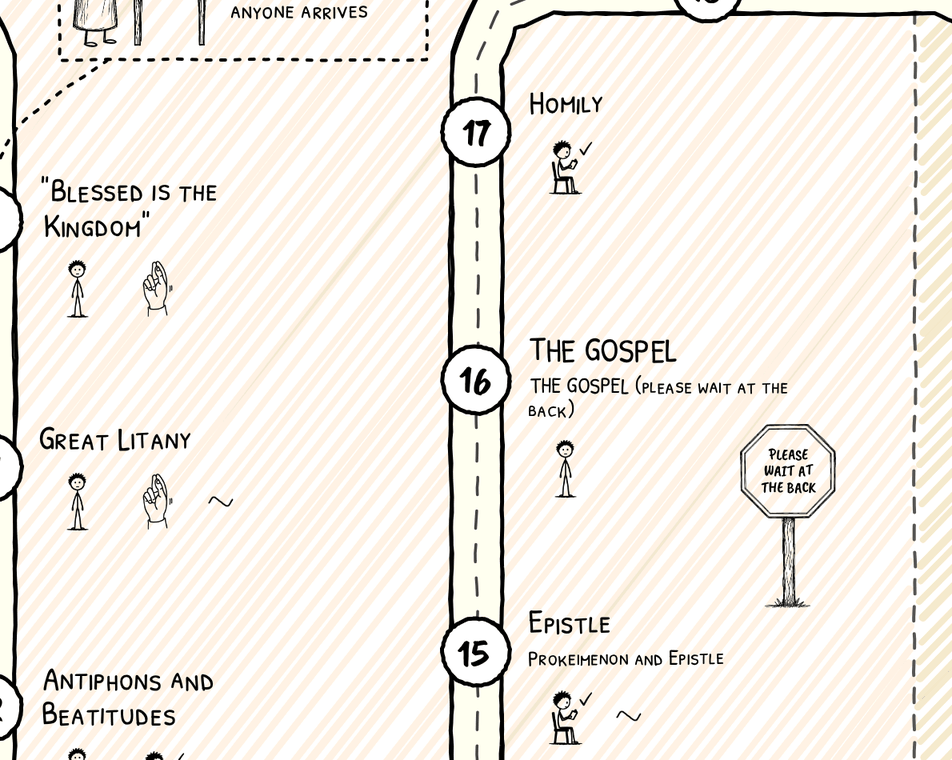
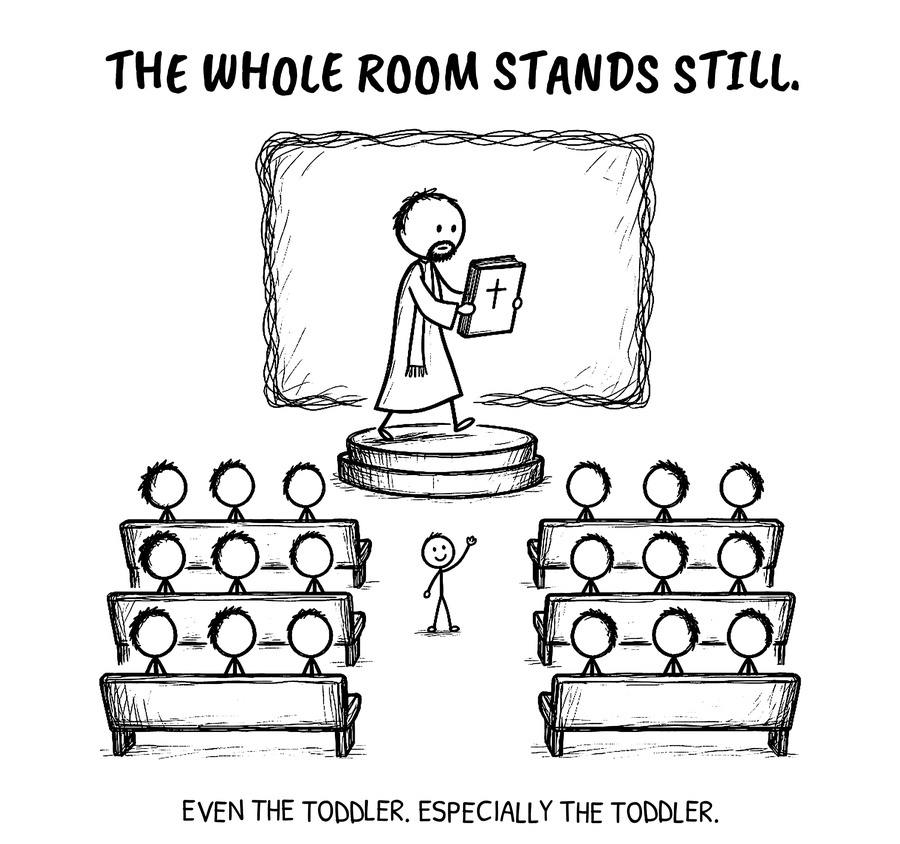
The Alleluia ends and the whole room gets to its feet, including the people who've been sitting since the Epistle. The deacon takes the gold book from the altar, the candle-bearers come out ahead of him, and he carries it to the center of the solea (the raised walkway in front of the icon screen), or up into the pulpit, and sets it on a stand. The call goes up: "Wisdom, O believers! Let us listen to the Holy Gospel." The priest: "Peace be with you all." The choir answers, "And with thy spirit." The deacon: "The Lesson from the Holy Gospel according to Luke." The choir: "Glory to thee, O Lord; glory to thee." The priest: "Let us attend."
And then the deacon chants the Gospel, slowly, in a voice pitched to the back wall. When he finishes, the choir sings "Glory to thee, O Lord" again, and the priest blesses the people with the book, or the deacon brings it to him to kiss, and it goes back on the altar.
Nobody has moved. Nobody has crossed the aisle. For four minutes the busiest room in the building has been perfectly still.
What it's called
The Gospel (Greek Euangelion, "good news"; Slavonic Evangelie; Arabic al-Injil). The word means three things at once: the message itself, the four books that carry it, and this moment in the service. "Wisdom, O believers!" is the same cue you heard at the Small Entrance. Quotations follow Hapgood's 1906 translation.1
What's actually happening
We bind the Gospel in a golden book and carry it around, because its words contain the mysteries of eternal life. That's the whole explanation, and the Church has never found a better one.
The passage is set by the calendar, and the calendar follows the evangelists in turn: John from Pascha (Easter) to Pentecost, Matthew through the summer, Luke from after the Elevation of the Cross in mid-September until Lent, Mark in Lent, with the great feasts cutting in wherever they fall.2 On an ordinary Sunday you'll hear a parable or a healing or an argument with the Pharisees, and the same one is being read in every Orthodox church that day.
"Wisdom! Let us attend!" And so we go silent, we stand, and listen. The deacon says it again and again across the Liturgy, and Cabasilas explains why: the mind is forgetful and easily carried off, so it needs to be called back from outside. The Wisdom being announced is Christ himself, "the power of God and the wisdom of God" (1 Corinthians 1:24; see also Proverbs 8:22). Hapgood's Russian book splits the call before the Gospel: the deacon says "Wisdom, O believers! Let us listen to the Holy Gospel," and the priest, after the Gospel is announced, says "Let us attend."3 During the Alleluia after the Epistle, the priest quietly says the Prayer before the Gospel, asking God to make the light of his knowledge shine in our hearts, which is 2 Corinthians 4:6 turned into a request.4
Why it matters
The Church doesn't read the Gospel the way a classroom reads a textbook. She reads it the way you'd listen to someone in the room. Saint Germanus says that in the Gospel God now speaks to us face to face, and not through riddles,5 which is why the book is carried in procession, kissed, censed, and stood for: it's treated as a presence, not a record. Gogol, watching the clergy kiss the book, said it was as if they were kissing the Lord himself.6
The candles are part of that. Saint Jerome, answering a critic who thought lamps in daylight were silly, said Christians light them at the Gospel "by way of evidencing our joy."7 Saint Symeon heard in this reading the Gospel going out to the whole world through the disciples.8 Whatever the passage is, the moment is the same one Luke describes in Nazareth: he opened the book, and the eyes of all were fixed on him (Luke 4:17–20).
Where it came from
From the synagogue, by way of Nazareth, as the last stop said. What's distinctly Orthodox is who reads it and how. The Gospel belongs to the deacon, the one who "serves," and when there's no deacon the priest reads it himself; a layman never does. It's chanted, not spoken, for the same reasons the Epistle is: carrying power and humility. And the book itself became an object of honor early. It lives on the Holy Table, and Hapgood's book gives the reason: it is laid there "to denote that God himself is mystically present thereon."9 For the Orthodox it's the other way the Word is present on the altar.
The Gospel book as the Church reads it, the four evangelists cut into the year's readings, was compiled and in use by the fourth century, and the first printed edition came off the press in 1586.10 Saint Germanus was already explaining why there are four.11 If you want to know what next Sunday's Gospel is, you can look it up; it was decided a thousand years ago.
What you do
If you're Orthodox: stand, and stay standing. Bow your head at "Peace be with you all." Cross yourself at "Glory to thee, O Lord" before and after. In Slavic parishes people bow when the book is lifted; in Greek parishes most simply stand. Don't move around the church during the reading, and don't let your kids, within reason.
If you're visiting: stand. If you've been following in the bulletin, this is the moment to put it down and listen; the Gospel is meant to be heard. If the priest blesses the people with the book afterward, bow your head a little. That's it.
Field Note: why the deacon faces you. For the Epistle the reader faces the altar, or the people, depending on the parish. For the Gospel the deacon always faces the people, from the center or the pulpit, because this isn't a report to God, it's an announcement to you. The variation you'll actually see is who reads and from where: a deacon from the ambo (the half-round step jutting out from the solea) or the solea facing the people, or, where there's no deacon, the priest from the holy doors; the blessing with the book afterward is old enough that Germanus describes the bishop doing it.12 Either way, the Gospel is the one reading the Church refuses to let you overhear.
Go deeper
- Luke 4:16–30 and 1 Corinthians 1:18–25.
- Saint Germanus of Constantinople, On the Divine Liturgy §§31–33.
- Nikolai Gogol, Meditations on the Divine Liturgy, p. 25.
Notes
-
Hapgood, Service Book, pp. 88–89. ↩
-
Mavropoulos, Passing Through the Church, pp. 274–275. ↩
-
Hapgood, Service Book, p. 89. ↩
-
Constantelos, The Divine Liturgy, pp. 30–31; Hapgood, Service Book, pp. 88–89. ↩
-
Germanus, On the Divine Liturgy §31. ↩
-
Gogol, Meditations on the Divine Liturgy, p. 7 (paraphrased). ↩
-
Jerome, Against Vigilantius 7 (NPNF2 6). ↩
-
Symeon of Thessalonica, Explanation §56. ↩
-
Hapgood, Service Book, p. xxviii. ↩
-
Mavropoulos, Passing Through the Church, pp. 274–275. ↩
-
Germanus, On the Divine Liturgy §32. ↩
-
Germanus, On the Divine Liturgy §33. ↩