

What you'll notice
The singing stops, and for the first time all morning a single voice reads. The priest says "Let us attend. Peace be with you all," and a layperson, often young, sometimes in a plain white robe, steps to the center and chants a line from a psalm. The choir sings it back. The reader chants another line, the choir repeats the first. Then: "The Lesson from the Epistle of the holy Apostle Paul to the Romans." "Let us attend!" And the reader chants the whole passage on a single pitch, rising slightly at the end of each sentence and climbing at the last line so you know it's over.
The priest answers, "Peace be with thee," the choir sings "Alleluia" three times with a couple of psalm verses in between, and somewhere in there the deacon walks through the church with the censer, swinging it toward the icons and then toward you.
Most parishes cense during the Epistle, which is what Hapgood's Russian book prescribes;1 the older rule, which Getcha still holds to, puts the censing at the Alleluia, so the incense goes ahead of the Gospel instead of over the reader's voice.2 Greek service books also drop the priest's "Peace be with you all" before the readings,3 so you may not hear it. Some parishes sit for the Epistle. Some don't sit for anything.
What it's called
The psalm verses are the prokeimenon (Greek Prokeimenon, "that which is set before"; Slavonic prokimen). The reading is the Epistle, though in Greek and Slavonic the book it comes from is simply called the Apostle (Apostolos; Apostol), because the readings come from the apostles' letters and the Acts. The person reading is a reader (anagnostis; chtets), a layman set apart for the job by the bishop with a short rite called tonsure. Quotations follow Hapgood's 1906 translation.4
What's actually happening
The Church is reading her mail.
The Epistle is a passage from the letters of Paul, Peter, James, John, or Jude, or from Acts, chosen by the calendar, not the priest. The prokeimenon before it is a psalm fragment that sets the mood, also by calendar; on Sundays it changes with the tone of the week. The readings follow a yearly cycle that works through Acts and the Epistles in order, starting with Acts at Pascha (Easter).
Why chant it instead of reading it? Partly because a chanted voice carries in a stone room with no microphone, which is where this started. Partly because chanting flattens the reader's personality: you hear the text, not the performance. And partly for the reason Chrysostom gave about singing (see the opening blessing): the Church would rather you sang the Bible than merely heard it.
Saint John Chrysostom describes "the Reader standing up" to say "Thus saith the Lord," while "the Deacon stands and imposes silence on all"; the silence, he says, honors not the reader but God, who speaks through him.5 The book is still announced before it's read: the reader tells you who wrote it before he tells you what it says.6
Why it matters
"Peace be with you" is what the risen Christ said when he walked through a locked door (John 20:19). The priest says it before the Scripture is read because the Scripture is the same visit. Saint Paul tells the Colossians to "let the peace of God rule in your hearts" (Colossians 3:15), and the reader is handed that peace back when he finishes: "Peace be with thee."
Two of the commentators heard something here. Saint Germanus heard the prokeimenon before the reading as the prophets announcing Christ;7 Saint Symeon heard the Epistle itself as the apostles sent out to the nations.8 The Epistle is the Church remembering that she was sent.
The Alleluia afterward is Hebrew for "praise the Lord," one of the few words that passed into every Christian language untranslated. It's sung three times with verses because, like everything here, it's a psalm with a refrain.
Where it came from
The synagogue. Jesus stood up in Nazareth, was handed the scroll of Isaiah, read it, and sat down to preach (Luke 4:16–21), and the first Christians, who were mostly Jews, kept the shape: readings, then a sermon. Saint Justin Martyr, around 150, says that on Sunday "the memoirs of the apostles or the writings of the prophets are read, as long as time permits."9 For centuries the Byzantine Liturgy had three readings, prophets, apostle, Gospel. The Old Testament reading had dropped out of the Liturgy by the eighth century,10 and the prokeimenon, the psalm that used to sit between two readings, is what's left of its place;11 it is "all that is left of this psalm reading," in the Metropolitan Cantor Institute's phrase.12
The reader is one of the oldest offices in the Church, older than most of the vestments. Readers are mentioned by the middle of the second century.13 Today the reader is usually a layman, sometimes a teenager, sometimes a retired professor, and in a small mission sometimes whoever can hold a tune.
What you do
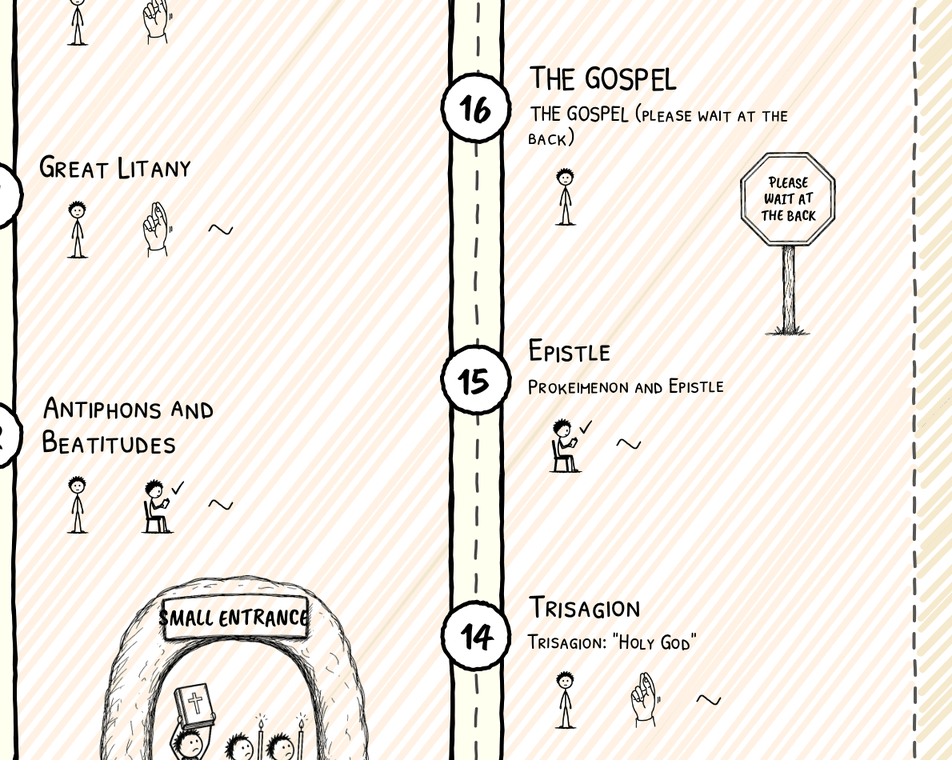
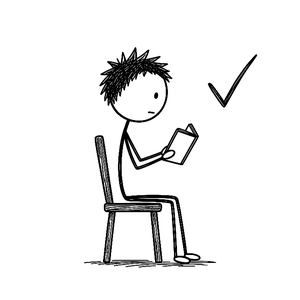
If you're Orthodox: listen. If you've got a service book, follow along; the readings are printed in the bulletin in most parishes. When the deacon censes your way, bow slightly. Sit if your parish sits for the Epistle; stand if it doesn't; and if you can't tell, stand.
If you're visiting: this is the part of the service where nothing is required of you and the words are in English. Pick up the bulletin, find the reading, and read along. If you've never heard the Bible chanted, you'll either find it strange or find you can't get it out of your head. Usually both.
Field Note: the same reading everywhere. Orthodox lectionaries are fixed. The Epistle you hear in Chicago this Sunday is the one being read in Thessaloniki, Moscow, Damascus, and a mission in Kansas, allowing for the calendar difference. If you're traveling and walk into a church where you don't speak the language, you can still know what's being read. Check the bulletin at home before you leave.
Field Note: "the Orthodox never read the Old Testament." You'll hear this, sometimes from the Orthodox. It's wrong twice over. The Liturgy once had an Old Testament reading before the Epistle, and the prokeimenon is its footprint.14 And the Old Testament never left the other services: Vespers on the eve of every great feast reads three passages of it, and the Psalms are the skeleton of everything. What's true is that on an ordinary Sunday morning you'll hear a psalm fragment, a letter, and a Gospel, and not Leviticus. Come Saturday night.
Go deeper
- Saint Justin Martyr, First Apology 67 (ANF 1), and Luke 4:16–21.
- Saint John Chrysostom, Homilies on 2 Thessalonians 3 (NPNF1 13), on the reader and the deacon's call to silence.
- Vespers on the eve of a great feast, for the Old Testament readings: see Vespers, Vigil, and the Daily Round.
Notes
-
Hapgood, Service Book, p. 88. ↩
-
Getcha, The Euchologion Unveiled, pp. 64–65. ↩
-
Getcha, The Euchologion Unveiled, p. 65. ↩
-
Hapgood, Service Book, p. 87 (the prokeimenon) and p. 88 (the Epistle, the reader's "Peace be with thee," and the censing). ↩
-
John Chrysostom, Homilies on 2 Thessalonians 3 (NPNF1 13). ↩
-
Metropolitan Cantor Institute, "The Divine Liturgy: The Readings." ↩
-
Germanus, On the Divine Liturgy §28. ↩
-
Symeon of Thessalonica, Explanation §55. ↩
-
Justin Martyr, First Apology 67 (ANF 1). ↩
-
Taft, "How Liturgies Grow," citing Mateos, La célébration de la parole dans la liturgie byzantine. ↩
-
Getcha, The Euchologion Unveiled, p. 44. ↩
-
Metropolitan Cantor Institute, "The Divine Liturgy: The Readings." ↩
-
Justin Martyr, First Apology 67 (ANF 1). ↩
-
Getcha, The Euchologion Unveiled, p. 44. ↩