

What you'll notice
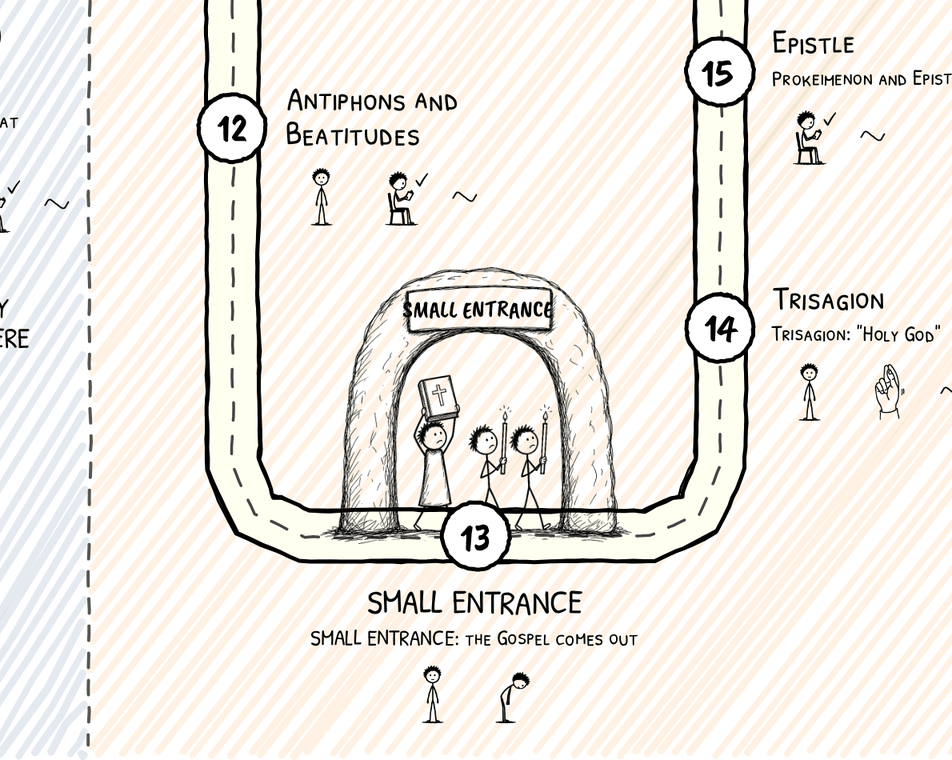
During the third song the center doors open. A boy with a candle comes out the side door, then the deacon carrying the big gilded book high in both hands, then the priest, and they walk in a short loop across the front of the church and stop in front of the open doors. The deacon lifts the book and sings, "Wisdom, O believers!" and the choir answers with a hymn: "O come, let us worship and fall down before Christ. Save, O Son of God, who didst rise again from the dead, us who sing unto thee: Alleluia."1
Then they go in through the center doors, the book is set back on the altar, and the choir launches into a run of short, brisk hymns, one after another, each in a slightly different tune. You can't tell how many there'll be. Neither can most of the congregation.
On a big feast the loop may go all the way around the nave. If the bishop is there, it's longer and there's a lot more going on.
What it's called
The Small Entrance, or Little Entrance (Greek Mikra Eisodos, Slavonic Malyi vkhod, Arabic al-dukhul al-saghir). It's "small" to distinguish it from the Great Entrance later, when the bread and wine take the same walk.
The hymns that follow are troparia (singular troparion), short hymns of one stanza. The one for the day or feast, sung at the end of Vespers and again here, is the apolytikion, the "dismissal hymn." The last in the set is usually a kontakion, a hymn that sums up the feast. Greek parishes sing only the troparia of the day and the closing kontakion, so the run is shorter there.2 The deacon's call is Sophia, orthi in Greek and Premudrost', prosti in Slavonic; orthi means "upright," a call to stand. Hapgood renders the call "Wisdom, O believers!", and the entrance hymn above follows her text there; its "O come, let us worship" is Psalm 95:6 (94:6 in the Septuagint) doing its job.
What's actually happening
We like processions in the Orthodox Church. This is the first of two, and both of them were once literal: the clergy actually entering the building. More on that below.
What it is now is simpler. The Word of God walks out among the people and then goes in to the altar, and the people sing to him as he passes. The book is treated the way you'd treat a person, because that's who it stands for. Meanwhile the priest prays quietly that the procession won't be only human: "Cause that with our entrance may enter also the holy Angels with us serving thee, and with us glorifying thy goodness."3
After the entrance, the troparia tell you what day it is. On a Sunday the first one is the Resurrection hymn in the tone of the week; then the parish's patron saint; then the saint of the day; then the kontakion of the season.
Why it matters
Saint Germanus saw in this entrance the appearance of the Son of God in the world.4 The other commentators each picked a scene: Saint Maximus, Christ's first coming; Saint Nicholas Cabasilas, his baptism, when he first appeared in public; Saint Symeon of Thessalonica, the Resurrection, Ascension, and Pentecost together.5 They aren't contradicting each other. The history below is plainer: this was once simply everyone walking in the door. Both can be true; only one of them is history. The point they share is that the Gospel coming out is Christ coming out, and "the Word became flesh and dwelt among us, and we beheld His glory" (John 1:14). Father Thomas Hopko reads the procession as "the movement of the entire Church through its Head Jesus Christ" to the altar, which stands for the Kingdom, a movement "made possible by the Gospel of Christ, the Way to the Kingdom."6 The historian Robert Taft is more guarded: the Gospel procession is "said to symbolize Christ's coming to us in the Word."7
Orthi, "upright," is the deacon's instruction in Greek, and it's addressed to you. Stand up straight. Someone is here.
The word "today" in so many of the hymns ("Today the Virgin gives birth," "Today salvation has come to the world") isn't poetic license. The Church sings the feast as present tense on purpose, because in the Liturgy the thing remembered is made present. You'll hear "today" a lot. It means today.
Where it came from
In the great church of Constantinople, the Liturgy began outside. The people gathered in the courtyard, the patriarch arrived in procession, and at this moment everyone went in together, clergy to the altar and people to the nave, with the Gospel book carried ahead of them. That was the entrance; the Liturgy started when they got inside.8 The antiphons were what they sang on the way.
Over the centuries the clergy began the service inside, and the entrance shrank to a loop around the altar and back in. It took a while. Taft notes that until at least the eleventh century the bishop wasn't in church for the antiphons at all; he came in at this entrance, which makes it the old beginning of the Liturgy, with everything before it added later.9 The gesture survived the reason. That happens a lot in liturgy, and it's not a flaw: the Church keeps the body's memory even after the mind has moved on.
The word kontakion is usually traced to kontos, the rod a long scroll was wound on. Saint Romanos the Melodist wrote them in the sixth century; today only the first stanza of each is sung, except for the Akathist (the long hymn to the Virgin Mary, sung standing) in Lent.
What you do
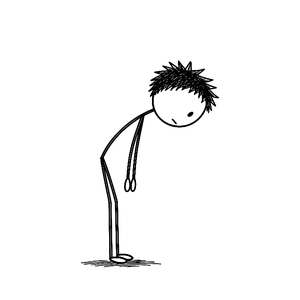
If you're Orthodox: bow your head as the Gospel book passes, and cross yourself. Sing "O come, let us worship." If you know the troparion of the day, sing that too; if you don't, listen for the Resurrection tone and you'll learn it in eight weeks, because there are only eight.
If you're visiting: stand if you were sitting, because "upright" is good advice. Watch the book. Everything that happens in the next twenty minutes is about it.
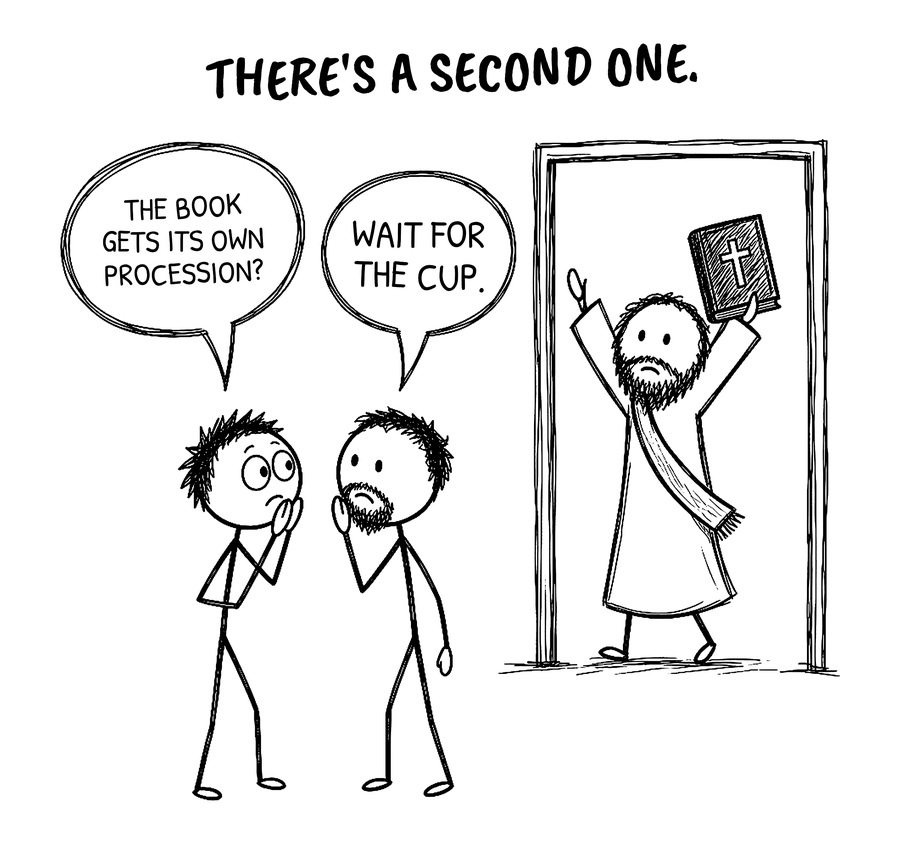
Field Note: the cuckoo clock. Visitors sometimes say the clergy pop in and out of the icon screen like figures on a cuckoo clock. It's not far off. There are only two processions in the Liturgy, and this is the first; the second, with the bread and wine, is the Great Entrance. Everything else that comes through the doors is Communion or a blessing. If you count the trips, you'll have the service's shape by the second Sunday.
Go deeper
- John 1:1–14.
- Saint Germanus of Constantinople, On the Divine Liturgy §24.
- Father Lawrence Farley, Let Us Attend, on the Small Entrance.
- Robert Taft, "How Liturgies Grow," on the entrance as the Liturgy's old beginning.
Notes
-
Hapgood, Service Book, p. 84. ↩
-
Getcha, The Euchologion Unveiled, p. 63. ↩
-
Hapgood, Service Book, p. 83. ↩
-
Germanus, On the Divine Liturgy §24. ↩
-
Germanus, On the Divine Liturgy §24; Maximus, Mystagogy 8; Symeon of Thessalonica, Explanation §§46–48. ↩
-
Hopko, The Orthodox Faith, vol. 2, "Small Entrance" (OCA). ↩
-
Taft, "How Liturgies Grow." ↩
-
Getcha, The Euchologion Unveiled, pp. 45–46, 61–63; Schmemann, Introduction to Liturgical Theology; Schulz, The Byzantine Liturgy, p. 160, on the bishop's entrance. ↩
-
Taft, "How Liturgies Grow." ↩