
What you'll notice
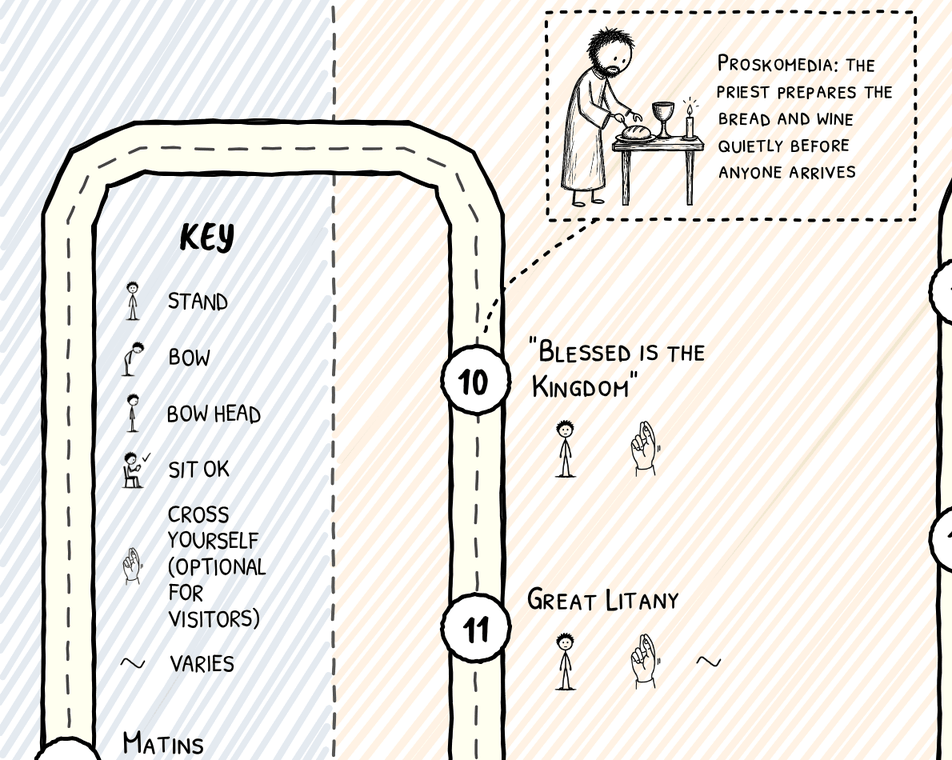
You've been standing there a while now. Matins has been going on around you, chanted, unhurried, with a lot of psalms. Then something shifts. The chanting stops. The priest, who has been mostly out of sight, steps up behind the Holy Table, lifts the big gilded Gospel book, and makes the sign of the cross with it over the cloth on the altar. And then he sings, in a voice meant to carry: "Blessed is the kingdom of the Father, and of the Son, and of the Holy Spirit, now, and ever, and unto ages of ages."1
The choir answers: "Amen."
That's it. That's the start. No announcements, no "good morning," no hymn number. A sentence about a kingdom and a one-word reply, and the Divine Liturgy is under way.
Some things you'll notice right away, now that you're paying attention: almost everything is sung, even, sometimes, the Scripture readings. The air smells of incense. There may be no pews, and nobody is kneeling. Hold those thoughts. The singing and the standing each get a Field Note below.
What it's called
The opening blessing. In Greek the line is Evlogimeni i Vasilia; in Slavonic, Blagosloveno Tsarstvo. The wording above follows Hapgood's 1906 translation; your parish's English will be more modern. Just before it, the priest has quietly said three short prayers you probably didn't hear: "O Heavenly King" (replaced by "Christ is risen" from Pascha, the Orthodox Easter, until its leave-taking), "Glory to God in the highest" twice (Luke 2:14), and "O Lord, open thou my lips" (Psalm 51:15 (50:17 in the Septuagint)).2
What's actually happening
The priest is announcing where we are. Not "welcome to church" but "blessed is the Kingdom," as if to say: you have just crossed a border, and this is the country on the other side.
The first word of the Liturgy is a blessing, and the first thing blessed is not us, or the day, or the weather. It's the Kingdom of God, named by its three Persons. Everything that follows for the next ninety minutes happens inside that sentence. The Liturgy is where you get ready.
The Gospel book makes the cross over the antimension (the cloth signed by the bishop; the Litany of the Catechumens says more about it). The Word of God signs the altar before a word is said.
Why it matters
Jesus's first sermon was one sentence long: "The kingdom of God is at hand. Repent, and believe in the gospel" (Mark 1:15). The Liturgy opens by taking him at his word. The phrase itself echoes the Palm Sunday crowd, "Blessed is the kingdom of our father David" (Mark 11:10),3 and Gogol heard in it the Trinity and the Kingdom proclaimed in one breath.4
The old commentators heard the whole story of salvation compressed into this moment. Saint Germanus heard the antiphons as the prophets foretelling the Incarnation; Saint Nicholas Cabasilas as the time before John the Baptist, when Christ was not yet known; Saint Symeon of Thessalonica heard the prophets too, and read the bishop's coming down from his throne before them as the Incarnation itself.5 They disagree about the exact scene and agree about the plot: the opening prepares us for the coming of Christ.
And then the people say "Amen." Cabasilas says that by the Amen the people take the priest's prayers and make them their own. Which means the Liturgy has two celebrants from the first line: the priest who says it, and the congregation who agrees. If you only ever say one word in an Orthodox church, make it that one. It means "May it be so."
Where it came from
The habit of opening worship by blessing God rather than asking him for something is Jewish before it's Christian; Jewish blessings open with "Blessed are You, Lord."6 The Byzantine Liturgy made the blessing Trinitarian and gave it to the Kingdom. The whole opening of the service, from this blessing through the antiphons, is a later layer laid over an older Liturgy that began with the entrance and went straight to the readings.7 "To the ages of ages" is the Church's way of saying "forever" without implying that forever is merely a long time.
The blessing with the Gospel book over the antimension is later and practical: the antimension is the priest's permission slip from his bishop, and the Liturgy cannot be served without one.
What you do
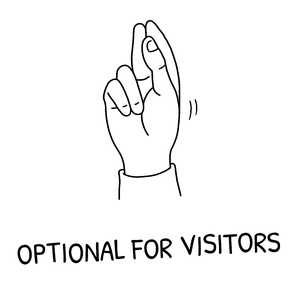
If you're Orthodox: cross yourself when the Trinity is named. Say the Amen out loud, or at least on purpose. If you came in during Matins and have been drifting, this is the moment to stop drifting.
If you're visiting: nothing is required. But if you want to do one thing, you can cross yourself with everyone else, or simply say "Amen" under your breath. Nobody will check.
Field Note: pews and kneeling. For most of Christian history nobody sat in church. Pews are a Western invention, and in Orthodox America they're a twentieth-century one. Sitting is always allowed. Standing is the native posture, and Nicaea's twentieth canon is why the whole room stays on its feet from here to the dismissal.8 Standing, Sitting, Pews, and Kneeling has the canon, the reasons, and the parishes that kneel anyway. Whatever the people around you do, don't correct them.
Field Note: the singing. Nearly everything in an Orthodox service is sung, unaccompanied. Saint John Chrysostom says the Holy Spirit enters at once into the soul that sings.9 That's the reason, and also the reason you'll find the melodies in your head on Tuesday.
Go deeper
- Mark 1:14–15, the sermon the opening blessing takes at its word, and Psalm 51 (50 in the Septuagint), behind the priest's last quiet prayer.
- Father Emmanuel Hatzidakis, The Heavenly Banquet, on the opening blessing.
- Matins Is Already Happening, for what you walked in on, and The Great Litany, for what comes next.
Notes
-
Hapgood, Service Book, p. 80. ↩
-
Hapgood, Service Book, p. 77. ↩
-
Constantelos, The Divine Liturgy, pp. 28–29. ↩
-
Gogol, Meditations on the Divine Liturgy, p. 18. ↩
-
Symeon of Thessalonica, Explanation §§43–44. ↩
-
Encyclopaedia Judaica, "Benedictions" (Jewish Virtual Library). ↩
-
Getcha, The Euchologion Unveiled, pp. 61–62; Taft, "How Liturgies Grow." See The Small Entrance. ↩
-
Nicaea I, canon 20 (NPNF2 14); Hapgood, Service Book, p. xxxiii; Germanus, On the Divine Liturgy §§12–13; Mavropoulos, Passing Through the Church, pp. 96–97. ↩
-
John Chrysostom, Exposition on Psalm 41. ↩