



What you'll notice
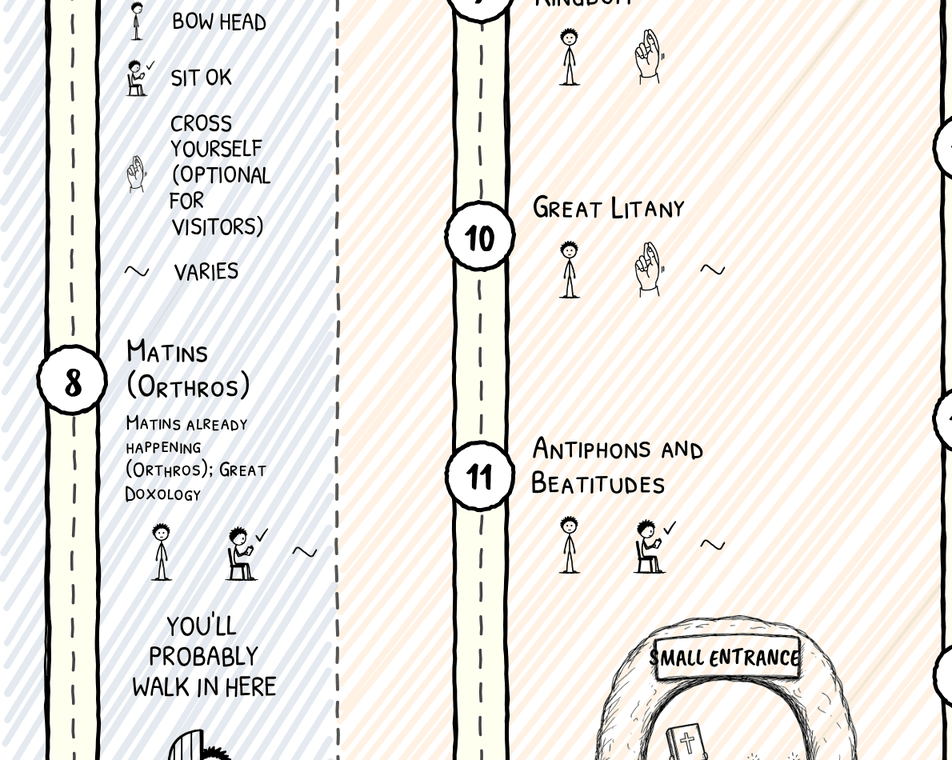
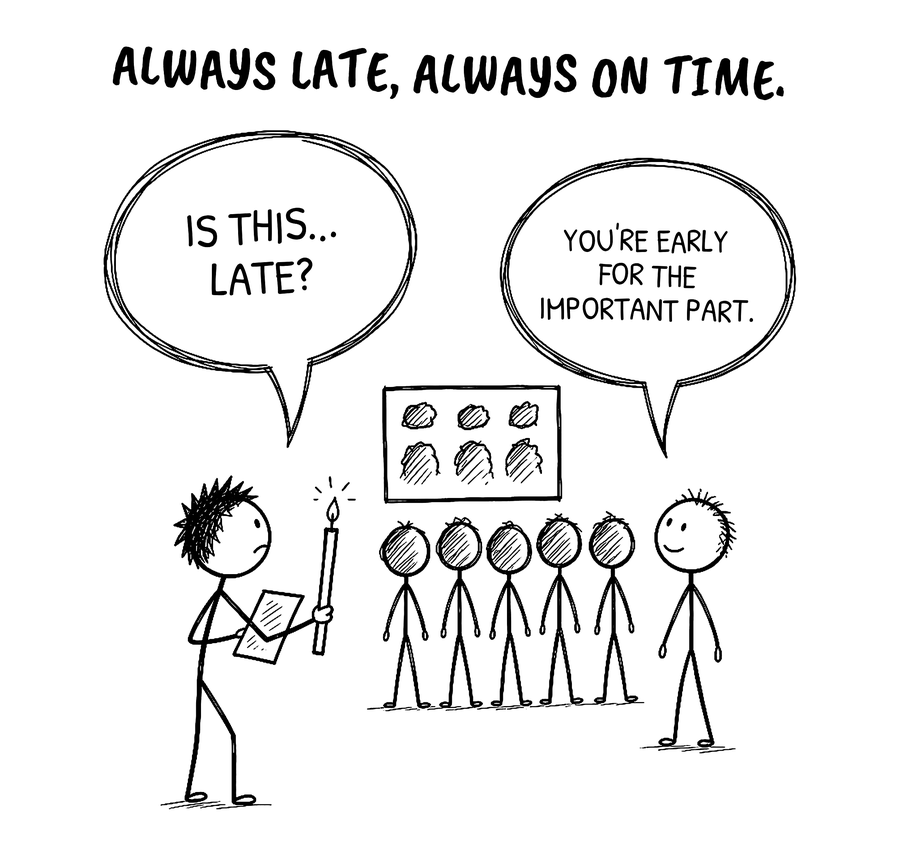
The website said ten. You pulled in at 9:52, pleased with yourself, and somewhere between the candle box and the back wall it dawns on you that the service is already going. There are chanters up front and off to one side, trading lines in a style you don't recognize. The priest is swinging the censer and saying something you can barely hear. And people are still wandering in, kissing icons, lighting candles, crossing themselves, finding their spots, as if none of this has started yet. Two older women in head scarves glance your way; you smile awkwardly, they smile back, and you drift toward the rear wall and stay there. Nobody looks at you like you're late. Ten minutes later the chanting swells, the lights come up, the priest comes out in his cape, and the thing you came for starts.
You didn't get the time wrong. You walked in on the service before the service.
What it's called
It's Matins (the morning service), from the Latin for "of the morning"; Greeks say Orthros, "dawn"; Slavs say Utrenya. The Church's day begins at sunset, so on Sunday, Matins sits between Saturday evening's Vespers and the Liturgy; Vespers, Vigil, and the Daily Round has the whole cycle. The swell you heard at the end is the Great Doxology, the hymn that opens with the angels' line at Bethlehem: "Glory be to God on high, and on earth peace, good will towards men."1
What's actually happening
The Church is doing what it does every morning of the year, which is to get up and pray before anything else. Sunday Matins tells the Resurrection out loud before the Liturgy makes it present: psalms, a long sung poem called the canon, and a reading of one of the Gospel accounts of the empty tomb, which rotate week by week so that over eleven Sundays you hear them all (the eleven Resurrection Gospels, the Eothina).2 In the Sunday morning we're following, the room has already been praying through Matins by the time the priest says "Blessed is the Kingdom." The Liturgy doesn't start from a standing start; it starts mid-sentence, on purpose.
Meanwhile, behind the screen, the priest has already prepared the bread and wine at the side table, a rite called the proskomedia; The Cross and the Bread tells you what he did. The Great Doxology is the hinge. It's an ancient hymn of praise,3 and it comes with the lights on, when the service tips from night into day. In the full Russian order of Matins, the Doxology is near the end.4 When Sunday Matins leads into the Liturgy, this hymn tells you Matins is nearing its end. If a bishop is serving, he's greeted during Matins, after the sixth ode of the canon, which is why a whole parish will sometimes turn toward the door in the middle of the chanting.5
Why it matters
There's a practical grace in this. The beginning is soft, and plenty of people walk in during Matins; it's a mercy to people with small children and bad traffic. And there's a theological point under the practical one. The Liturgy is the center of the Church's day, but it isn't the whole day. The Church prays at sunset and at dawn and at the hours in between, and the Liturgy is what all that praying opens into. If you only ever see the Liturgy, you've had the main course without the first; most people do, and it's fine. But if you ever wonder why the Liturgy feels like it's already going when it starts, that's why. It is.
Where it came from
Christians have kept fixed hours of prayer since the apostles went up to the Temple "at the hour of prayer" (Acts 3:1); Vespers, Vigil, and the Daily Round tells how those prayers grew into the services you hear now.
In many Greek-practice parishes, Matins—also called Orthros—is served on Sunday morning before the Liturgy. In many Slavic-practice parishes, Matins is joined to Vespers in the Saturday-night Vigil, and the Third and Sixth Hours—short services of psalms and prayers—are read before Sunday Liturgy. Local schedules vary. Check which service the posted time names; the Liturgy itself has a definite beginning.
Planning your morning? Allow roughly an hour and a half to two hours for the ordinary Sunday Liturgy itself, with local variation. Matins or the Hours add time before it; a memorial and optional coffee hour add time afterward. The First-Liturgy Cheat Sheet has the short planning note, including when to check a special schedule.
What you do
If you're Orthodox: come for Matins, or some of it. The Resurrection Gospel and the Doxology are worth the alarm clock, and the people who arrive at the Doxology miss nothing from the Liturgy and gain the whole morning. If you walk in during the canon, do your candles and icons quietly and save the greetings for coffee hour.
If you're visiting: chanting before the posted Liturgy time may be Matins or the Hours. If that time has passed, the Liturgy may already have begun; you can still come in quietly. Wait at the door if the Gospel is being read or a procession is passing, then find a place toward the back, along a side aisle, or wherever there's room, and get your bearings. Observe for a while, use a service book if one is available, and sit when you need to. Follow any quiet direction from a greeter. The Narthex covers candles and coming in.
Field Note: it isn't a late Liturgy. If chanting is already underway, it may be Matins, the Hours, or the Liturgy itself. Check the posted service times; if you arrive late, come in quietly. The Liturgy has a real beginning, a blessing of the Kingdom with the Gospel book lifted and the sign of the cross, and you'll know it when it happens.
Field Note: the reader is probably a layperson. The person chanting the psalms on one note is usually a tonsured reader, a lay member of the parish with a blessing to read; sometimes a teenager, sometimes a retired engineer. The Church has had readers since the second century.6
Notes
-
Hapgood, Service Book, p. 34, from Luke 2:14. ↩
-
Hapgood, Service Book, p. 595, note 7: "All the eleven Lessons from the Gospels, appointed to be read in rotation, refer to the Resurrection." ↩
-
Schmemann, Introduction to Liturgical Theology. ↩
-
Hapgood, Service Book, pp. 15–37. ↩
-
Getcha, The Euchologion Unveiled, p. 79. ↩
-
Justin Martyr, First Apology 67 (ANF 1). ↩