
What you'll notice
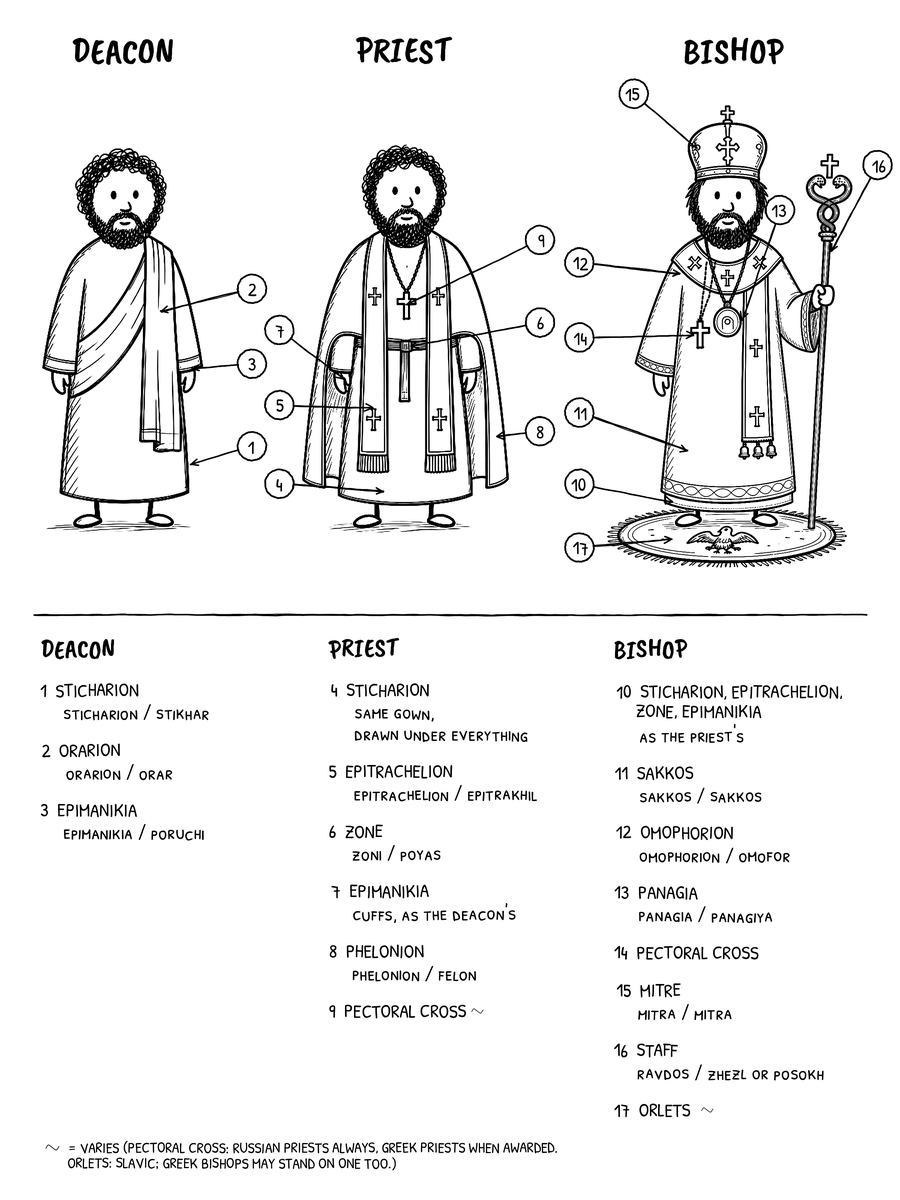
The priest is wearing a floor-length gown with wide sleeves, and over it a heavy cape, cut short in front and long behind, embroidered with crosses, in a color that will be different next time. A wide band hangs from his neck to his shins. His wrists are laced into stiff cuffs. If you came early you saw him in the gown alone; if you'd run into him at the grocery store on Tuesday, a black shirt and a collar, or just a shirt. The deacon's outfit is simpler: a straight tunic, cuffs, and a long ribbon off one shoulder. The altar boys wear the tunic alone. If a bishop is here, he's wearing more than everyone else combined, and a crown.
What it's called
Rank by rank, following Hapgood's "Symbolism of the Church," plain words first:1
- Reader: the gown, the sticharion (Slavonic stikhar'). In Russian use he's also given a short cape at his tonsure, "a short Tunic (Felon), which barely covers the shoulders," that "is rarely worn except upon that day."2
- Subdeacon: sticharion plus the ribbon, the orarion (orar'), crossed over both shoulders.
- Deacon: sticharion, orarion over the left shoulder, and cuffs, the epimanikia (poruchi).
- Priest: sticharion; the long band, the epitrachelion ("on the neck"; epitrakhil'); the belt, the zone (poyas); cuffs; and the cape, the phelonion (felon'). Awards add a stiff diamond or rectangle hung at the hip (epigonation / palitsa; nabedrennik), a pectoral cross, a hat (kamilavka), a second stole. Awards mark years of service or a position, not holiness, and the ladders differ: Slavic churches give them on a rough schedule, while Greek use has no fixed timeline and even the titles carry different hardware (an oikonomos, "steward," wears a pectoral cross in the Ecumenical Patriarchate, a protopresbyter, "first presbyter," in the Church of Greece).
- Bishop: everything the priest wears except that the phelonion gives way to the sakkos, a wide-sleeved tunic; over it the omophorion (omofor), a broad band around the shoulders; the mitre (mitra), the crown; a medallion of the Theotokos (the Mother of God), the panagia; a staff; and under his feet a round rug with an eagle on it, the orlets ("to him alone is its use accorded").3
What's actually happening
Before the Liturgy, in the altar, the priest puts the vestments on one at a time, and for each piece he says a verse of Scripture. Gogol, who wrote a tender commentary on the Liturgy in the 1840s, says this is where the priest stops being a private person; he even notes the rule that clergy may not wear vestments in the street.4 The man about to stand at the altar is not standing there as himself. He's been dressed in the household's livery so that when he speaks, it's clear whose house he speaks for. The gold is a uniform, not a costume.
Field Note: a Psalm for every piece. Each vestment goes on with its own verse. For the stole, Psalm 133:2 (132:2 in the Septuagint), the oil running down Aaron's beard.5 For the belt, Psalm 18:32 (17:33 in the Septuagint), God girding him with strength. For the cuffs, Exodus 15:6 on the right hand and Psalm 119:73 (118:73 in the Septuagint) on the left.6 For the phelonion, Psalm 132:9 (131:9 in the Septuagint), priests clothed with righteousness. Constantelos tabulates the set.7 There's no verse for the trousers, which seems an oversight until you remember the men who wrote the rite weren't wearing any.
Why it matters
Saint Germanus reads the vestments as a picture of the Passion: the stole is the cloth around Christ's neck as he was bound and led away, the unbelted phelonion is Christ walking to the cross, the cuffs are the bonds on his hands; the deacon's orarion is an angel's wing, and the bishop's omophorion is the lost sheep carried home on the Shepherd's shoulders.8 You don't need to memorize any of it. Keep this: the priest is dressed as Christ on the day he was led out to die, because the Liturgy is where that one sacrifice is made present.
There's a plainer reason too. A Protestant pastor wears what the congregation wears, plus or minus a tie, and that says something true: he's one of us. The vestments say something else that's also true: at the altar, he's not himself. The Orthodox would rather you looked at the robe and forgot the man, which is a kindness to the man. (The Catholic chasuble is the same garment as the phelonion, the Roman and Byzantine cuts of one ancient cloak; if you grew up Catholic you've seen half of this already.) Mavropoulos calls the vestments "figurative," "a way to indicate that Christ is there."9
Where it came from
The sticharion and phelonion are late-Roman street clothes, the tunic and traveling cloak of the fourth century, that the clergy kept wearing after fashion moved on. The stole and orarion may descend from the badges of Roman officials. The cuffs came later, from the imperial court. The sakkos and mitre are frankly imperial: both come from the Byzantine emperor's wardrobe. Saint Symeon of Thessalonica, around 1400, still explains every piece by rank.10
Colors. There is no single Orthodox color calendar; the old rubrics only say "bright" or "dark." Greek parishes usually wear gold or white for feasts of Christ, blue for the Theotokos, red or gold for martyrs, green for Palm Sunday and Pentecost, and purple in Lent, but never on Lenten Sundays. Russian parishes follow a fuller scheme, with black on the weekdays of Great Lent, and many of them serve Pascha (Easter) in red. Look at what the clergy are wearing and you'll learn the local scheme faster than any chart.
What you do
If you're Orthodox: when you greet the priest after Liturgy, kiss the hand, not the phelonion. In Greek and Middle Eastern parishes people touch the hem of the phelonion as the priest passes at the Great Entrance; Slavic parishes don't. If you serve, learn to take a blessing before putting on your sticharion; that's the whole rite for a layman.
If you're visiting: nothing. Enjoy the embroidery. If you want to know what something is, the drawing above names every piece, and the glossary has the rest. No pictures during the service, even of the vestments, unless you've asked.
Go deeper
- Psalm 133 (132 in the Septuagint) and Psalm 132 (131 in the Septuagint).
- Hapgood, Service Book, pp. xxxiv–xxxviii.
- Saint Germanus of Constantinople, On the Divine Liturgy §§14–19.
- Demetrios Constantelos, The Divine Liturgy, pp. 26–27.
Notes
-
Hapgood, Service Book, pp. xxxiv–xxxviii. ↩
-
Hapgood, Service Book, p. xxxiv. ↩
-
Hapgood, Service Book, p. xxxviii. ↩
-
Gogol, Meditations on the Divine Liturgy, pp. 7–10; the street rule at p. 8. ↩
-
Gogol, Meditations on the Divine Liturgy, p. 9. ↩
-
Hapgood, Service Book, p. 69 (the deacon's vesting); the priest's stole, belt and phelonion verses run on to p. 70. ↩
-
Constantelos, The Divine Liturgy, pp. 26–27. ↩
-
Germanus, On the Divine Liturgy §§14–19. ↩
-
Mavropoulos, Passing Through the Church, pp. 178–179. ↩
-
Symeon of Thessalonica, Explanation of the Divine Temple §§24–42. ↩